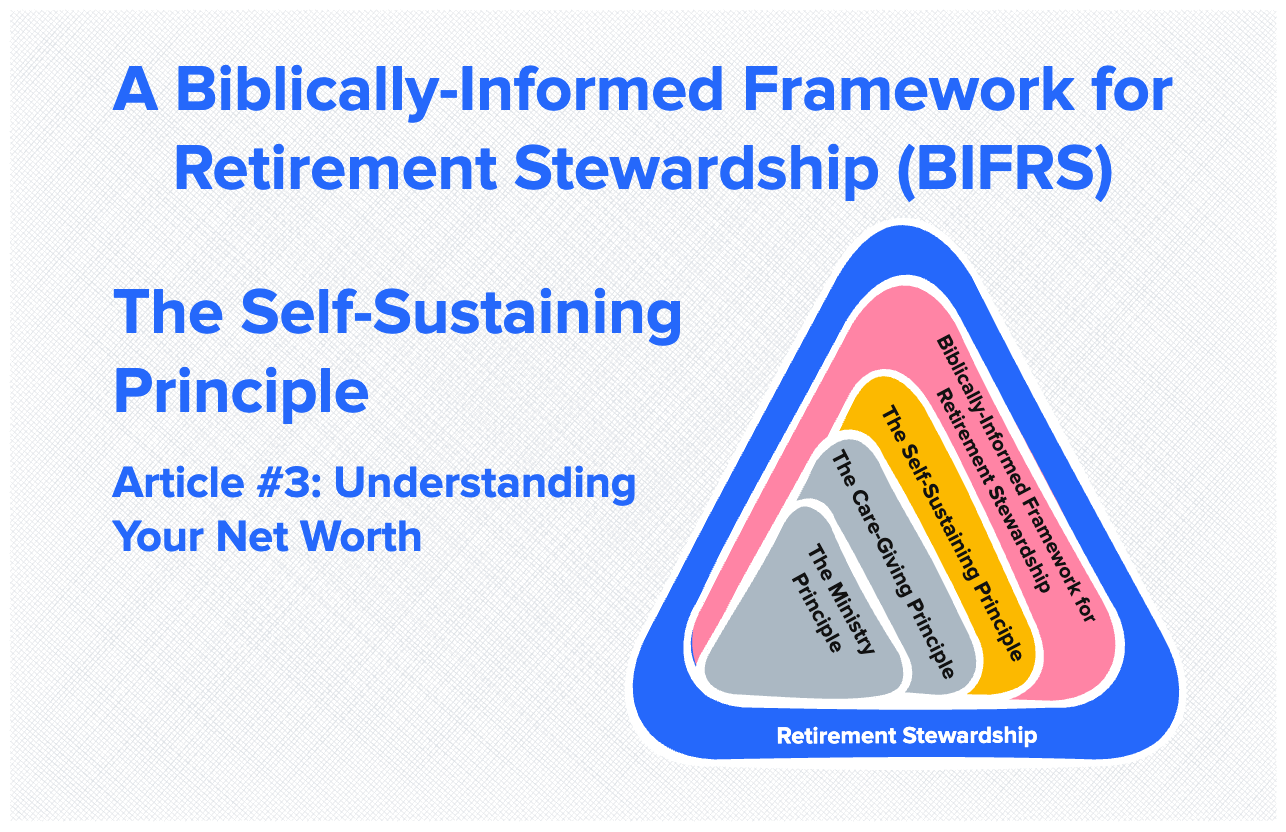
This article is part of the Biblically-Informed Framework for Retirement Stewardship (BIFRS) series.
In the first two articles in this series, I introduced the Sustainability Principle—the fundamental concept that your retirement will be financially sustainable when your reliable income sources consistently cover your ongoing expenses and obligations throughout your lifetime. We also discussed this from a biblical perspective and recommended guardrails to help ensure self-sustainability doesn’t become self-sufficiency.
At its core, the Sustainability Principle can be expressed as a simple relationship:
Sustainable Retirement = Reliable Income ≥ Ongoing Expenses (over time, adjusted for inflation and risk)
But before you can create sustainable retirement income, you need something to work with—your “guaranteed” income sources (such as Social Security and pensions), typically supplemented with your retirement savings (accumulated wealth) that will become the foundation of your retirement sustainability.
This article examines what net worth means, why it matters for achieving sustainable retirement, and how to calculate and track it effectively.
Your net worth at retirement represents the culmination of decades of decisions about earning, saving, spending, giving, and investing. It’s part of the foundation upon which everything else in the Sustainability Principle rests. Whether you achieve a sustainable retirement could depend almost entirely on how much wealth you accumulate during your working years and how you position that wealth across different account types and asset classes.
This article addresses the first critical question: “What is it? And where do you stand today?
Our uneasiness with “wealth”
You won’t find the words “net worth” in the Bible; you’re more likely to see “wealth” or “riches.” That said, I may use the terms “wealth” and “net worth” interchangeably, but they are not identical.
Wealth refers to the total value of valuable assets, while net worth is specifically the value of all assets minus liabilities. Essentially, net worth measures an individual’s financial health, while wealth encompasses a broader range of financial and material resources. So, our net worth is basically our “wealth” minus any claims by others against us (mainly debts for loans, taxes, settlements, etc.).
Many Christians feel uncomfortable with the word “wealth.” Perhaps because it sounds too worldly, too “wealthy,” too “scroogy,” perhaps conjuring images of selfishness, greed, or materialism. We worry that talking about building wealth, much less doing it, contradicts the Bible’s numerous warnings about the dangers of riches:
“No one can serve two masters, for either he will hate the one and love the other, or he will be devoted to the one and despise the other. You cannot serve God and money.” (Matthew 6:24, ESV)
“Again I tell you, it is easier for a camel to go through the eye of a needle than for a rich person to enter the kingdom of God.” (Matthew 19:24, ESV)
“But those who desire to be rich fall into temptation, into a snare, into many senseless and harmful desires that plunge people into ruin and destruction. For the love of money is a root of all kinds of evils.” (1 Timothy 6:9-10, ESV)
We are right to be concerned given these warnings and others. But we also need to be careful here. Wealth is actually a biblical concept, often used interchangeably with “riches” throughout Scripture—and not always negatively. Consider Psalm 112:1-3:
“Blessed is the man who fears the Lord, who greatly delights in his commandments! His offspring will be mighty in the land; the generation of the upright will be blessed. Wealth and riches are in his house, and his righteousness endures forever.” (ESV)
In these verses, the phrase “wealth and riches” is what scholars call a hendiadys—two words used together to express a single concept. Here, it emphasizes “an abundance of valuable possessions.” These material blessings are present, according to one commentator, “as a reward, not as the aim of life.”1
This distinction is everything. The psalm describes a person who “fears the Lord” and “greatly delights in his commandments” (vs. 1). The wealth and riches that follow are presented as consequences of righteous living (not guaranteed), not the goal that motivated it. The godly person doesn’t pursue wealth as their ultimate aim; they pursue God, obedience, love, mercy, compassion, generosity, and righteousness. The material blessings come as byproducts of faithful stewardship, not as the object of their striving. Though they may come, they must not be presumed upon.
The second half of the verse reinforces this: “His righteousness endures forever.” Some translations render “righteousness” as “prosperity,” but the deeper meaning is that the righteous character and faithful stewardship that produced the wealth continue. It’s not just about accumulating—it’s about a lifestyle of faithfulness that endures through all seasons, including when material blessings arrive and when they don’t.
Yes, the greatest wealth is knowing God Himself, experiencing His goodness, and the assurance of eternal life in Christ. But material blessings are also expressions of His grace, which come to each person in different proportions according to His sovereign will and are intended to be stewarded faithfully.
A blessing or a curse
Scripture presents wealth in tension—it can be either a blessing or a curse2, and wisdom requires understanding both dimensions.
Wealth as a blessing
God intends for us to enjoy His material blessings and use them according to His purposes. This is the heart of stewardship: managing resources for our benefit, God’s glory, and others’ good, as God intended.
The practical blessings of building wealth include:
Meeting needs and wants: Wealth provides for yourself and your family, purchases necessary items, and occasionally allows “extras” that enrich life and create memories.
Creating margin: Adequate wealth enables you to withstand financial shocks—job loss, medical crises, unexpected expenses. This margin reduces financial stress and anxiety, creating breathing room.
Enabling flexibility: More resources mean more options in how you spend your time and what you do with your life. Want to change careers at 40? Support a mission effort? Help a child through a crisis? Wealth makes these possibilities real.
Facilitating generosity: One of the greatest blessings of wealth—the ability to give generously to God’s work, help others in need, and make an eternal impact with temporary resources. As Paul told Timothy, the wealthy should be “generous and ready to share” (1 Timothy 6:18).
Providing for a sustainable retirement: Adequate wealth allows you to retire with dignity, maintain your independence, and continue serving without financial anxiety—which is precisely what the Sustainability Principle calls us to prepare for.
Wealth as a “curse”
Wealth is never directly called a “curse” in the Bible, but it is full of warnings about the dangers of the love of money and material things. For example,
Do not love the world or the things in the world. If anyone loves the world, the love of the Father is not in him. For all that is in the world—the desires of the flesh and the desires of the eyes and pride of life—is not from the Father but is from the world. And the world is passing away along with its desires, but whoever does the will of God abides forever. (1 John 2:15-17, ESV).
Wealth becomes a curse when it commands too much of our time, energy, and affection. Jesus told the parable of the rich fool who built bigger barns to store his wealth, focused entirely on personal ease and comfort, with no thought for God or others. His wealth became a curse because it captured his heart (Luke 12:13-21).
The Bible repeatedly warns:
“Whoever trusts in his riches will fall, but the righteous will flourish like a green leaf.” (Proverbs 11:28, ESV)
“And Jesus looked around and said to his disciples, ‘How difficult it will be for those who have wealth to enter the kingdom of God!'” (Mark 10:23, ESV)
The solution is stewardship
The solution to this apparent contradiction—extolling the virtues of wealth while warning of its dangers—lies in proper stewardship.
When we manage our finances according to biblical values and keep our hearts free from the love of money, we can enjoy God’s material blessings without becoming enslaved to them, using wealth wisely for kingdom purposes, and giving generously from grateful hearts. We can plan responsibly for future needs—including a sustainable retirement—while maintaining proper priorities, with God, not money, holding our ultimate allegiance.
It’s not either-or but both-and. We can build wealth faithfully while keeping our hearts fixed on God.
Is Building Wealth for Retirement “Striving After the Wind”? (Updated 2026) discusses the crucial distinction between “wealth” (funded contentment—having enough to live and flourish) and “riches” (an insatiable desire for more that’s never satisfied). The former is biblical stewardship; the latter is idolatry.
Can Retirement Stewardship Make You a Rich Fool? (Updated 2026) examines the tension between Luke’s warning against hoarding and Proverbs’ commendation of saving. The rich fool’s problem wasn’t that he saved for the future—it was that he was “not rich toward God,” storing up wealth only for himself with no thought for others or kingdom purposes.
The Sustainability Principle navigates this tension well: We build wealth not for selfish accumulation but for responsible self-sufficiency that allows us to avoid burdening others while maintaining the freedom to serve and give generously. That’s faithful stewardship.
“But if anyone does not provide for his relatives, and especially for members of his household, he has denied the faith and is worse than an unbeliever.” (1 Timothy 5:8, ESV)
Building adequate net worth for sustainable retirement is part of providing for your household—ensuring you don’t become a burden to others in old age.
Understanding your current net worth
For our purposes, I’ll use “wealth,” “current wealth,” and “net worth” interchangeably. Net worth is simply calculated as:
Net Worth = Assets – Liabilities
Where:
- Assets are resources with economic value that you own or control: cash, investments, home equity, real estate, retirement accounts, vehicles, etc.
- Liabilities are debts owed to others, such as mortgages, car loans, credit card balances, and student loans.
This relatively simple calculation forms the foundation for understanding your financial position and your capacity to achieve a sustainable retirement.
Why net worth matters for sustainability
Here’s the fundamental reality: Your ability to achieve a sustainable retirement may depend significantly on the wealth you’ve accumulated by retirement age.
Unless you have substantial guaranteed income from pensions or annuities, your personal savings and investments must bridge the gap between Social Security and your living expenses, perhaps for 25-30 years or more.
Consider the three primary income sources most of us will have in retirement:
1. Social Security: Provides base income (typically covering 30-40% of expenses), inflation-adjusted and guaranteed for life. Importantly, Social Security isn’t dependent on your net worth; it’s based on your earnings history. You can’t buy more Social Security by having more wealth, nor will you receive less because you have more wealth.
2. Pension (if you have one): Provides additional guaranteed income, though these are increasingly rare. Like Social Security, pension amounts are based on years of service and salary, not on your accumulated wealth.
3. Personal Savings and Investments: These must cover the remaining 50-70% of expenses for most retirees, and they’re directly determined by your accumulated wealth at retirement.
Here’s how the math works using a standard 4% sustainable withdrawal rate:[^2]
- Retire with $500,000 in savings: you can safely withdraw approximately $20,000/year
- Retire with $1,000,000 in savings: you can safely withdraw approximately $40,000/year
- Retire with $2,000,000 in savings: you can safely withdraw approximately $80,000/year
If Social Security provides $30,000 annually, your total retirement income would be:
- $500,000 saved: $50,000/year total ($30K SS + $20K portfolio)
- $1,000,000 saved: $70,000/year total ($30K SS + $40K portfolio)
- $2,000,000 saved: $110,000/year total ($30K SS + $80K portfolio)
The Sustainability Principle requires adequate current wealth. If you retire with insufficient savings, you’ll either need to work longer, reduce your living expenses dramatically, or risk running out of money and losing your financial sustainability.
This isn’t about greed or materialism—it’s about responsibility. Building adequate wealth during your working years is the foundation for a sustainable retirement.
It’s also important how your wealth is positioned
Current wealth isn’t just about the total dollar amount. How that wealth is structured matters enormously for your ability to achieve a sustainable retirement.
Tax diversification
Where your money sits has huge implications for retirement sustainability:
Traditional IRA/401(k): Tax-deferred growth, but taxed as ordinary income when withdrawn. RMDs begin at 73-75. Every dollar withdrawn increases taxable income.
Roth IRA/401(k): Tax-free growth and withdrawals. No RMDs during your lifetime. Provides flexibility to manage taxable income in retirement.
Taxable brokerage accounts: Taxed annually on dividends/interest, but withdrawals of principal are tax-free. Capital gains are taxed at preferential rates.
Having money across all three buckets provides flexibility to optimize taxes each year, which can significantly extend how long your money lasts and, in turn, your retirement sustainability. As I’ll explore in future articles on tax planning, this flexibility is crucial for maximizing sustainability.
Asset allocation
How you divide between stocks, bonds, and cash determines both your risk exposure and growth potential:
Too aggressive (too much stock): Risk of catastrophic losses early in retirement (sequence risk) that you can’t recover from while withdrawing, threatening sustainability.
Too conservative (too much in bonds/cash): Risk of not keeping pace with inflation over 30 years, slowly eroding purchasing power and undermining long-term sustainability.
The right balance depends on your age, risk tolerance, other income sources, and total wealth. But the principle remains: Your allocation directly affects your ability to maintain a sustainable retirement.
Liquidity and accessibility
Some wealth is readily accessible (savings accounts, brokerage accounts), while other wealth is tied up (home equity, retirement accounts with penalties, illiquid investments).
Sustainable retirement requires adequate liquid wealth for:
- Emergency reserves (unexpected expenses without derailing plans)
- Planned withdrawals (regular income generation)
- Flexibility (opportunity to help others, handle surprises)
Having wealth that’s entirely illiquid (such as being “house rich, cash poor”) can undermine sustainability, even with substantial net worth.
Calculating and tracking your net worth
Understanding your current wealth requires an accurate and honest assessment. Here’s how:
Step 1: List all assets
Liquid assets:
- Checking and savings accounts
- Money market accounts, CDs
- Taxable brokerage accounts
- Bonds and bond funds
Retirement accounts:
- Traditional IRA/401(k)/403(b)
- Roth IRA/401(k)
- Other retirement accounts (SEP, SIMPLE, etc.)
Real estate:
- Primary residence (current market value)
- Investment/rental properties
- Vacation homes
Other assets:
- Vehicles
- Business ownership interests
- Valuable collections
- Life insurance cash value
Step 2: List all liabilities
Home Debt: Mortgage, home equity loans/lines
Vehicle Debt: Auto loans, RV/boat loans
Consumer Debt: Credit cards, personal loans, student loans
Other Debt: Business loans, any other money owed
Step 3: Calculate net worth
Total Assets – Total Liabilities = Net Worth
But for retirement planning purposes, break it down further:
Retirement-Specific Net Worth:
- Liquid financial assets (cash, investments, retirement accounts)
- Minus: Outstanding debts
- Equals: Investable wealth available for retirement income
This is the number that determines your withdrawal capacity and, in turn, your ability to achieve a sustainable retirement.
Practical tools for tracking net worth
You can’t manage what you don’t measure. Here are excellent tools:
Comprehensive automated tracking
Personal Capital (now Empower) – Free, links all accounts automatically, excellent dashboard showing net worth trends over time.
Monarch Money – Subscription-based (~$100/year), great for couples, clean interface.
YNAB (You Need A Budget) – Subscription-based (~$99/year), best for integrating detailed budgeting with net worth tracking.
Simple calculations
Bankrate Net Worth Calculator – Free online calculator, no account required.
Spreadsheet – Build your own in Excel or Google Sheets for complete customization.
My Recommendation: Start with Personal Capital/Empower for comprehensive free features. For complete control, maintain your own spreadsheet alongside automated tools.
The key is tracking regularly—at least quarterly, ideally monthly. This allows you to:
- See trends over time (Is wealth growing as expected?)
- Catch problems early (Overspending? Investment underperformance?)
- Stay motivated (Watching progress is encouraging)
- Make adjustments (E.g., Change savings rate, allocation, etc.).
Assessing your sustainability trajectory
Once you know your current wealth, the critical question becomes: Am I on track to accumulate enough for a sustainable retirement?
We will get into this in much more detail in future articles about portfolio withdrawals and your sustainable withdrawal rate (SWR), but for now, here’s a simple framework for a quick assessment:
Step 1: Estimate required retirement income
Start with your current expenses and adjust for retirement:
- Eliminate work-related costs (commuting, professional wardrobe)
- Eliminate savings (you’re now drawing, not saving)
- Add healthcare costs (premiums, out-of-pocket)
- Adjust lifestyle assumptions (travel, hobbies)
Example: If you spend $70,000 now, you might need $60,000 in retirement. Or, depending on your plans, you might need more, at least early on.
Step 2: Estimate guaranteed income
- Social Security: Use ssa.gov to get your projected benefit
- Pension: Check with employer for projected amount
- Annuities: Any guaranteed income you’ve purchased
Example: $30,000 from Social Security + $10,000 pension = $40,000 guaranteed
Step 3: Calculate portfolio income needed
Required Income – Guaranteed Income = Portfolio Income Needed
Example: $60,000 needed – $40,000 guaranteed = $20,000 from portfolio
Step 4: Calculate savings required
Using 4% rule as a rough sustainable withdrawal rate guideline:
Portfolio Income Needed ÷ 0.04 = Wealth Required
Example: $20,000 ÷ 0.04 = $500,000 needed
Step 5: Compare to your current trajectory
If you’re 45 with $200,000 saved, and 20 years until retirement:
- Current: $200,000
- Target: $500,000
- Gap: $300,000
- Years remaining: 20
With consistent saving and reasonable returns, you can likely close this gap.
If you’re 55, have $100,000 saved, and have 10 years to go, you’ll need to dramatically increase your savings or adjust your retirement expectations.
This assessment reveals whether you’re on track for a sustainable retirement. If you’re falling short, you have options:
- Increase your savings rate now
- Work longer (even 2-3 extra years makes a huge difference)
- Reduce expected retirement expenses
- Plan for part-time work in retirement
- A combination of the above
The earlier you assess and adjust, the more options you have.
What Condition is Your (Retirement Financial) Condition In? (Updated 2026) provides real-world context about the range of retirement financial conditions, showing five distinct financial profiles that humanize these concepts and help you understand where you stand relative to other retirees.
Help—I Think Too Much About My Retirement Savings! (Updated 2026) discusses how Christians can obsess over retirement savings just like everyone else, constantly checking accounts and worrying about their “number.” Not due to poor planning, but due to heart issues. We struggle with fear (not having enough), guilt (having too much), loss aversion, and discontentment. The solution isn’t willpower but biblical thinking: trust God rather than riches, practice contentment with what He’s provided, surrender control over what you can’t control, and establish a solid plan that allows you to check accounts only 1-2 times per year.
A biblical perspective on net worth
How should Christians think about tracking and understanding their net worth?
First, recognize that understanding your financial position isn’t pride or materialism—it’s wise stewardship:
“Know well the condition of your flocks, and give attention to your herds.” (Proverbs 27:23, ESV)
In ancient times, wealth was measured in livestock. Today, we measure it differently, but the principle remains: faithful stewards know their financial condition.
Second, understand that your net worth isn’t your identity or a measure of security. It’s simply a measurement tool that helps you steward well:
“Command those who are rich in this present world not to be arrogant nor to put their hope in wealth, which is so uncertain, but to put their hope in God, who richly provides us with everything for our enjoyment.” (1 Timothy 6:17, NIV)
Third, remember that everything belongs to God. You’re not calculating “your” wealth—you’re assessing resources God has entrusted to you:
“The earth is the LORD’s and the fullness thereof, the world and those who dwell therein.” (Psalm 24:1, ESV)
Finally, use this knowledge for faithful stewardship, not anxious striving:
“But if anyone does not provide for his relatives, and especially for members of his household, he has denied the faith and is worse than an unbeliever.” (1 Timothy 5:8, ESV)
Understanding your net worth helps you provide faithfully—neither presuming on God’s provision nor neglecting your responsibility to plan wisely.
Wrapping up
This article addresses understanding your current net worth, where you stand today, and how to measure it. The next article will explore how to build that net worth through consistent saving and wise investing during your working years.
Together, these form the foundation of the Sustainability Principle: understanding what you have, building what you need, and eventually converting it into sustainable retirement income.
- https://www.thegospelcoalition.org/commentary/psalm-107-psalm-150/ ↩︎
- Just to be clear, the Bible doesn’t explicitly state that wealth itself is a curse, but it warns about the spiritual dangers associated with it, such as pride, greed, and false security. It emphasizes that the love of money can lead to various evils and that one should be cautious about placing their trust in riches rather than in God. ↩︎