

This article is part of the Retirement Financial Life Equation (RFLE). It was initially published on October 28, 2020, and updated in March 2026.
The coronavirus pandemic and corresponding market crash in March 2020 validated what retirement researchers had been saying for years: the “Cash Bucket Strategy” isn’t just theoretical—it’s essential (or at least really, really, important).
As Dave Ramsey often says, “cash is king.” After living through not just the 2020 COVID crash but also the 2022 inflation crisis and bond market meltdown, I can confirm from personal experience that this strategy works exactly as designed.
In early 2020, as the COVID-19 pandemic unfolded, I watched like millions of other retirees as my retirement investments took a massive hit. My stock allocation dropped 30% in just three weeks during March. Early estimates suggested millions in the U.S. could die from the virus. Due to concerns about a catastrophic economic meltdown potentially rivaling the 1929 meltdown, I, like many others, briefly considered bailing out of everything and going all cash.
But I didn’t, mainly because I had built in a buffer as part of my portfolio asset allocation, so I wasn’t tempted to sell during times of economic stress. That buffer is what I’ll explain in this article as the “cash bucket strategy.” Five years later, having weathered both the 2020 crash and the 2022 downturn without selling a single share of depreciated stocks, I can tell you this strategy is worth far more than the modest returns you sacrifice by holding cash.
During times of extreme economic turbulence, cash really is “king.”
Cash is “king,” really?
So as not to be misunderstood, neither Dave nor am I suggesting that “cash” should be the king of our lives, something of the utmost importance to us, or anything close. We never want to make cash our king. It should never be what we give our highest allegiance to—that should be for the Lord Jesus Christ and Him alone.
The Bible is clear on this—placing our ultimate trust and allegiance in anything but Christ is idolatrous. So when we talk about building up a cash cushion for one purpose or another, we’re on thin ice. We risk making that “cushion” a “fortress,” our source of ultimate security. The Bible warns us repeatedly that money can’t give us that.
Proverbs 18:11: A rich man’s wealth is a strong city and like a high wall in his imagination.
We are warned not to become like the rich fool in Luke 12 who built bigger barns so he could store up more and more—much more than he needed—with the fantasy that it would make his soul happy and bring him ultimate security.
Proverbs 11:28: Whoever trusts in his riches will fall, but the righteous will flourish like a green leaf.
When we say “cash is king” in the context of wise retirement stewardship, we’re saying that having a cash cushion is better than not having one during challenging economic times. That can be cash in an emergency fund, a vacation fund, or, as we shall see, a retirement account.
Proverbs 27:12: The prudent sees danger and hides himself, but the simple go on and suffer for it.
Why I Needed a Strategy
When I decided to retire back in late 2016, I needed a plan for how to withdraw from savings to supplement our Social Security benefits and cover retirement expenses—not just “take money out when needed.” After reviewing several strategies for generating income, including fixed withdrawals, flexible withdrawals, and annuities, I leaned toward a flexible variable withdrawal strategy. Deciding on a fixed withdrawal percentage and then only increasing it for inflation seemed too rigid to me.
The basic strategy I settled on was the “Bucket Strategy.” Now, nine years into retirement, I can report that this approach has worked exceptionally well through multiple market cycles. The 2020 crash validated the strategy’s design. The 2022 simultaneous stock and bond decline—something that wasn’t supposed to happen—further proved its value. And the 2023-2024 recovery showed how maintaining discipline during downturns allows full participation in the subsequent gains.
The bucket strategy explained
At its core, the Bucket Strategy helps retirees continue paying bills even when financial markets tank, without having to sell depreciated assets. This directly mitigates the dreaded “sequence of returns” risk early in retirement. It also contributes enormously to the SWAN factor—sleep-well-at-night.
The main idea is to think of your retirement savings and investments as in three different buckets. The bucket metaphor conveys that buckets can be filled, emptied, and refilled over time. After managing this system through five years of actual market volatility, I’ve learned that the psychological benefit of seeing your buckets properly filled may be worth as much as the mathematical protection they provide.
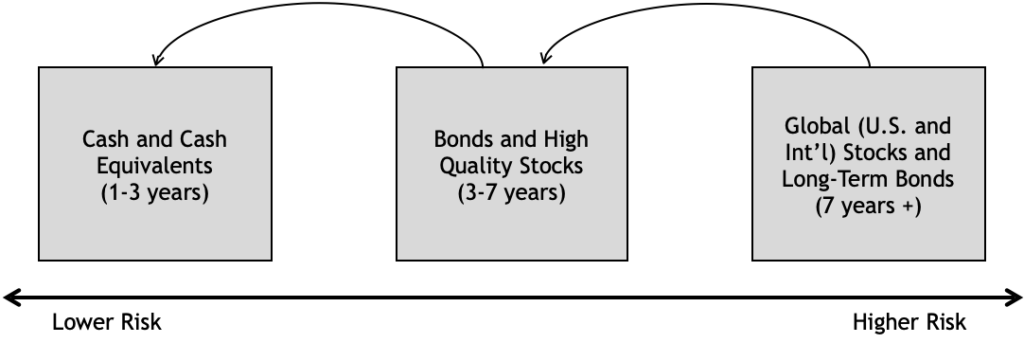
Bucket #1: The “cash bucket”
The “Cash Bucket” holds 18-24 months of your spending needs in cash in safe accounts such as insured checking or savings accounts, money market funds, or Treasury bills. In today’s environment with money market funds yielding 4.5-4.8%, this bucket actually generates reasonable returns while providing complete safety and liquidity—a dramatic improvement over the near-zero yields available when I wrote the original version of this article in 2020.
To set up this bucket, you need to identify your essential expenses—everything you must pay regardless of market conditions. Everything else becomes discretionary spending that can flex during difficult years.
This is the bucket you regularly draw from to supplement other income sources, such as Social Security, a pension, or an annuity, to cover essential expenses in retirement. If your guaranteed income from Social Security doesn’t cover all essential expenses, you’ll need withdrawals from bucket one to fund the difference at a minimum. Ideally, you won’t need more than 3-4% annually of your total portfolio value, as it’s difficult to sustainably produce more income than that from Buckets #2 and #3 over long periods.
Although you’re taking cash out of this bucket regularly, you’re also replenishing it from the other buckets during favorable market conditions. During March 2020, when my stocks dropped 30%, I simply continued spending from Bucket #1 without touching my stock holdings. By the time the cash bucket needed refilling in late 2020, stocks had fully recovered and then some, allowing me to refill the bucket by selling shares at higher prices than before the crash. The same pattern repeated in 2022-2023, though the recovery took longer.
Bucket #2: The “income bucket”
Bucket #2 generates income through interest and dividends to refill bucket one with minimal risk of principal and a focus on stability. Bucket #1 is “no risk / no return” (though current money market yields make this less true than it was in 2020), but Bucket #2 is “modest risk / modest return.”
With its focus on capital preservation and income, investments in Bucket #2 should be oriented toward high-quality fixed-income assets—bonds, TIPS, investment-grade corporates—with a smaller complement of stable, dividend-paying stocks or funds. Some people use balanced mutual funds like Vanguard’s Wellesley (VWINX) or Fidelity’s Balanced Fund (FBALX), or dividend stock funds like Vanguard’s Dividend Growth Fund (VDIGX) or Fidelity’s Dividend Growth Fund (FDGFX). I use a combination of short-term bond funds, TIPS, and dividend-paying stock funds.
The 2022 experience taught a crucial lesson about Bucket #2: bonds don’t always provide the stability we expect. When the Fed raised rates aggressively, bonds dropped alongside stocks—my intermediate-term bond funds fell 10-13% that year. This reinforced my preference for short-term bonds and TIPS in Bucket #2, which experienced far smaller declines. My STIP (short-term TIPS fund) lost only about 2.4% in 2022 compared to 13% for the aggregate bond market, demonstrating that not all bonds provide equal stability.
Buckets #1 and #2 build a buffer against stock market volatility and sequence of returns risk. Depending on how risk-averse you are, you may want to cover 8-10 years of expenses between the cash in Bucket #1 and the bonds and stocks in Bucket #2. If Bucket #1 contains 18-24 months of expenses, Bucket #2 would hold 6-8 years of spending needs.
You may notice this resembles a balanced portfolio of stocks, bonds, and cash. If Bucket #2 is two-thirds bonds and one-third dividend-paying stocks, and Bucket #3 is growth stocks, your allocation would be roughly 55% stocks and 45% bonds and cash. It becomes more conservative if you add more cash to Bucket #1 or increase your bond allocation in Bucket #2. My current allocation after nine years of retirement sits at approximately 35% stocks, 55% bonds (with significant TIPS allocation), and 10% cash—more conservative than many recommend, but it allows me to sleep well regardless of market conditions.
Bucket #3: The “growth bucket”
This is your growth bucket with the longest time frame. You shouldn’t plan to tap this money for at least 8-10 years, allowing time to weather and recover from bear markets.
Because the focus is on long-term growth to offset inflation and provide funds needed in future years, this bucket invests mostly in stocks. Yes, there’s more risk in Bucket #3, but only stocks have demonstrated the ability to consistently beat inflation over long periods. Furthermore, your investments are diversified across the three buckets, so you’re not overly exposed to any single risk.
You can take moderate to higher risk in Bucket #3. Since you’re primarily seeking growth, growth-oriented stocks make sense. You can invest in individual stocks or growth-oriented mutual funds such as the Vanguard Total Stock Market Index Fund (VTSAX) or the Fidelity Total Market Index (FSKAX). I personally lean toward dividend growth ETFs like iShares Core Dividend Growth (DGRO) and Vanguard’s Dividend Appreciation Fund (VIG) because they pay dividends while also offering capital appreciation potential—providing some current income while maintaining growth orientation.
Because of the heavy allocation to stocks, this bucket will be more volatile than the others. You shouldn’t be overly concerned since you won’t need the money for 10 or more years. You can sleep well during a prolonged bear market, knowing it will most likely recover before you need to tap into it. This helps you avoid panic selling during major market downturns or prolonged bear markets, which turns “paper losses” into real ones. During both 2020 and 2022, I watched my Bucket #3 holdings drop significantly, but knowing I had Buckets #1 and #2 fully funded meant I could completely ignore those declines and let them recover naturally.
How to implement the bucket strategy
If you already have a balanced portfolio with a cash component, you have the basics in place for implementing this strategy. Let me walk through the mechanics of setting up and managing it, drawing on nine years of real-world experience.
Filling your “cash bucket” (1)
To get started, you may need to shift some assets to a “cash bucket” account within your IRA or 401(k) if you don’t already have one. Most brokerage accounts have a default cash account, and with current money market fund yields around 4.5-4.8%, this cash is actually working for you rather than sitting idle.
You’ll also need a transactional account—a checking or savings account with check-writing privileges. Most people use one outside their retirement account for ease of access. This account should be liquid and very low or no risk.
I use Fidelity for my self-directed IRA, and my cash bucket holds about 20 months of withdrawals in a money market fund (SPAXX in my case, yielding 4.78% as of early 2026). I do monthly transfers from it to my Fidelity Cash Management Account with checking and bill-pay features. This setup has worked flawlessly through nearly a decade of retirement.
For example, if you have a portfolio of $500,000 and have determined you need to withdraw $20,000 annually (4%) from your savings to supplement Social Security, a reasonable target for Bucket #1 would be $30,000-40,000 (18-24 months). You would set up an automatic monthly transfer of approximately $1,667 from the cash bucket to your checking or savings account.
Filling your “income bucket” (2)
The main goal of Bucket #2 is to generate income to refill Bucket #1 using relatively stable, income-producing assets. For most people, including me, this means dividend-paying stock funds and bond funds. There’s some market risk and interest-rate risk, but you’re looking for investments at the lower end of the risk spectrum. In addition to dividends and interest, you’re also aiming for some capital growth.
Because I’m conservative with a current allocation of approximately 35% stocks and 55% bonds (with 10% cash), my Bucket #2 is mostly bonds and TIPS. The 2022 bond market debacle reinforced my preference for short-term bonds over intermediate or long-term bonds in this bucket. My short-term allocation outperformed intermediate bonds when rates spiked.
Returning to our $500,000 example portfolio, if you fill Bucket #2 with about 7-8 years of spending, it would contain $140,000-160,000 ($20,000 x 7-8 years). Combined with $30,000-40,000 in Bucket #1, you’d have roughly 8.5-10 years of spending needs covered by your two most stable buckets.
In my situation, Buckets #1 and #2 contain about 12 years of spending, which is on the conservative side. This conservatism cost me some potential gains during the strong 2023-2024 market years, but it was exactly right for 2020 and 2022 when volatility spiked. The peace of mind has been worth any opportunity cost.
Filling Your “long term growth bucket” (3)
Bucket #3 targets long-term growth and should be filled with money you won’t need for at least 10-15 years. Since we’ve covered approximately 9 years of spending in Buckets #1 and #2, Bucket #3 would hold the remainder. In our $500,000 example with $35,000 in Bucket #1 and $150,000 in Bucket #2, Bucket #3 would contain about $315,000.
Given the growth orientation, most people, including me, populate this bucket with stocks or stock funds, both domestic and international. I lean toward dividend growth ETFs such as iShares Core Dividend Growth (DGRO), Schwab U.S. Dividend Equity (SCHD), Fidelity High Dividend (FDVV), and Vanguard Dividend Appreciation Fund (VIG). I like these because they pay dividends while offering capital appreciation opportunities. Others may want more aggressive allocations, including mid-caps, small-caps, and emerging market funds.
This bucket will be the most volatile since it’s tied to the stock market’s ups and downs. But the beauty of the bucket strategy is that you can “let it ride,” knowing you won’t need it until sometime in the future. This framework helped me completely avoid panic during the March 2020 crash when my Bucket #3 dropped 30%, and again during the 2022 decline. I never once considered selling because I knew I wouldn’t need that money for many years.
Refilling Buckets #1 and #2
Ideally, Bucket #1 can be refilled with dividends and interest from Buckets #2 and #3. In the current environment with money market funds yielding nearly 5%, short-term bonds yielding 4.5-5%, and dividend stocks yielding 3-4%, generating sufficient income is more feasible than it was during the 2020-2021 period of near-zero rates.
However, there’s still a potential challenge. If Buckets #2 and #3 contain $465,000 and generate 3.5% in combined interest and dividends, you’ll produce $16,275 annually—still short of the $20,000 needed. Where does the additional money come from?
This is where the “total return” approach becomes essential—combining interest, dividends, and capital gains. If total return for Buckets #2 and #3 averages 5-6% annually (reasonable over long periods), you could generate $23,250-27,900 annually ($465,000 x 5-6%), more than covering the $20,000 requirement and allowing you to refill the buckets during strong market years.
A simple way to implement the total return approach is reinvesting all interest and dividends instead of depositing them directly into a cash account. You then periodically sell stocks if they’re up, or sell bonds if they’re up but stocks are down. By doing this, you’re rebalancing your asset allocation to maximize total return over time. How often you do this is up to you, but doing it more than 2-3 times annually may be counterproductive and generates unnecessary transaction costs.
During times of strong market performance—and markets can be up 10%, 20%, or even 30% during some years as we saw in 2023 and 2024—you incrementally sell assets from Bucket #3 to refill Buckets #1 and #2, effectively locking in those gains for future use. This is exactly what I did in late 2023 and throughout 2024, refilling my cash and bond buckets from strong stock gains, positioning myself well for whatever comes next.
If both stocks and bonds are down simultaneously, as happened in 2022, you continue withdrawing from Bucket #1 and only refill it with dividends and interest. This is when having 18-24 months in cash becomes crucial—it buys you time for markets to recover without forcing sales at the worst possible moment. During 2022, my cash bucket provided all my spending while stocks and bonds recovered, and by late 2023 I was able to start refilling it from gains.
Real-world validation
When I originally wrote this article in October 2020, the bucket strategy was still somewhat theoretical for me—I had only been retired about four years. Now, with nine years of retirement experience including two major market disruptions, I can offer concrete validation.
March 2020: My stock allocation dropped 30% in three weeks. Because I had 20 months in cash, I didn’t sell a single share. I just kept spending from Bucket #1. By November 2020, stocks had fully recovered and I refilled my cash bucket by selling shares at higher prices than before the crash.
2022: Stocks fell 18%, bonds fell 13%, and inflation spiked to 8-9%. This was supposed to be impossible—stocks and bonds falling simultaneously—but it happened. Again, my cash bucket meant I never had to sell anything during the decline. I actually increased my TIPS allocation during this period, buying when real yields spiked above 2% for the first time in over a decade.
2023-2024: Strong recovery in both stocks and bonds allowed me to systematically refill both Buckets #1 and #2 from Bucket #3 gains, locking in appreciation and positioning the buckets for the next inevitable downturn.
The strategy worked exactly as designed. The peace of mind it provided was worth far more than any opportunity cost from holding “excess” cash. When friends and fellow retirees were panicking in March 2020 and again in 2022, I slept soundly knowing my buckets were properly positioned.
Who this strategy works best for
After nine years of experience, I’ve observed that the bucket strategy works best for:
Retirees who value psychological comfort over maximum theoretical returns. If market volatility keeps you awake at night, the bucket strategy’s structure provides enormous peace of mind.
Those in early to mid-retirement (ages 65-80) when sequence risk poses the greatest threat. Once you reach your 80s with a portfolio that’s survived 15-20 years of withdrawals, sequence risk matters less.
Retirees with portfolios large enough that holding 18-24 months in cash doesn’t cripple their growth potential. This strategy works well with portfolios of $400,000 or more. Smaller portfolios may need different approaches.
People who can implement disciplined rebalancing during both bull and bear markets. The strategy requires refilling buckets during good times, which means selling winners—psychologically harder than it sounds.
Those comfortable with moderate complexity. While not highly complex, the bucket strategy requires more management than a simple target-date fund or balanced fund approach.
Potential weaknesses and alternatives
The bucket strategy isn’t perfect. The main weakness is opportunity cost—money in cash and bonds earns less than a higher stock allocation over long periods. During extended bull markets like 2023-2024, conservative bucket allocations underperform more aggressive approaches.
There’s also the risk of being too conservative. Some retirees build excessively large cash and bond buckets out of fear, ending up with insufficient growth to sustain 25-30 year retirements. Finding the right balance requires honest assessment of your risk tolerance and spending flexibility.
For those who find the bucket strategy too complex or conservative, alternatives exist including variable withdrawal strategies with smaller cash reserves, immediate annuities for guaranteed income covering essential expenses with stocks for discretionary spending, or systematic rebalancing with moderate cash reserves of 6-12 months rather than 18-24 months.
Bottom line
After nine years of retirement and two major market crises, I can confidently say the cash bucket strategy delivers on its promises. It protects against sequence risk, provides psychological comfort during volatility, and allows you to maintain your spending without panic selling during downturns.
Is it optimal from a pure returns perspective? Probably not—a more aggressive allocation would have generated higher returns during the strong years. But retirement isn’t just about maximizing returns. It’s about creating sustainable income with acceptable risk and manageable stress levels. The bucket strategy excels at all three.
If you’re approaching retirement or in early retirement, I strongly encourage you to consider implementing some version of this strategy. The specific bucket sizes will vary based on your situation, but the core principle—having sufficient cash and stable assets to weather multi-year market downturns without selling depreciated stocks—is sound for virtually all retirees.
The peace of mind it provides is priceless. And when the next market crisis arrives—and it will—you’ll sleep soundly knowing your buckets are properly positioned to weather the storm.