
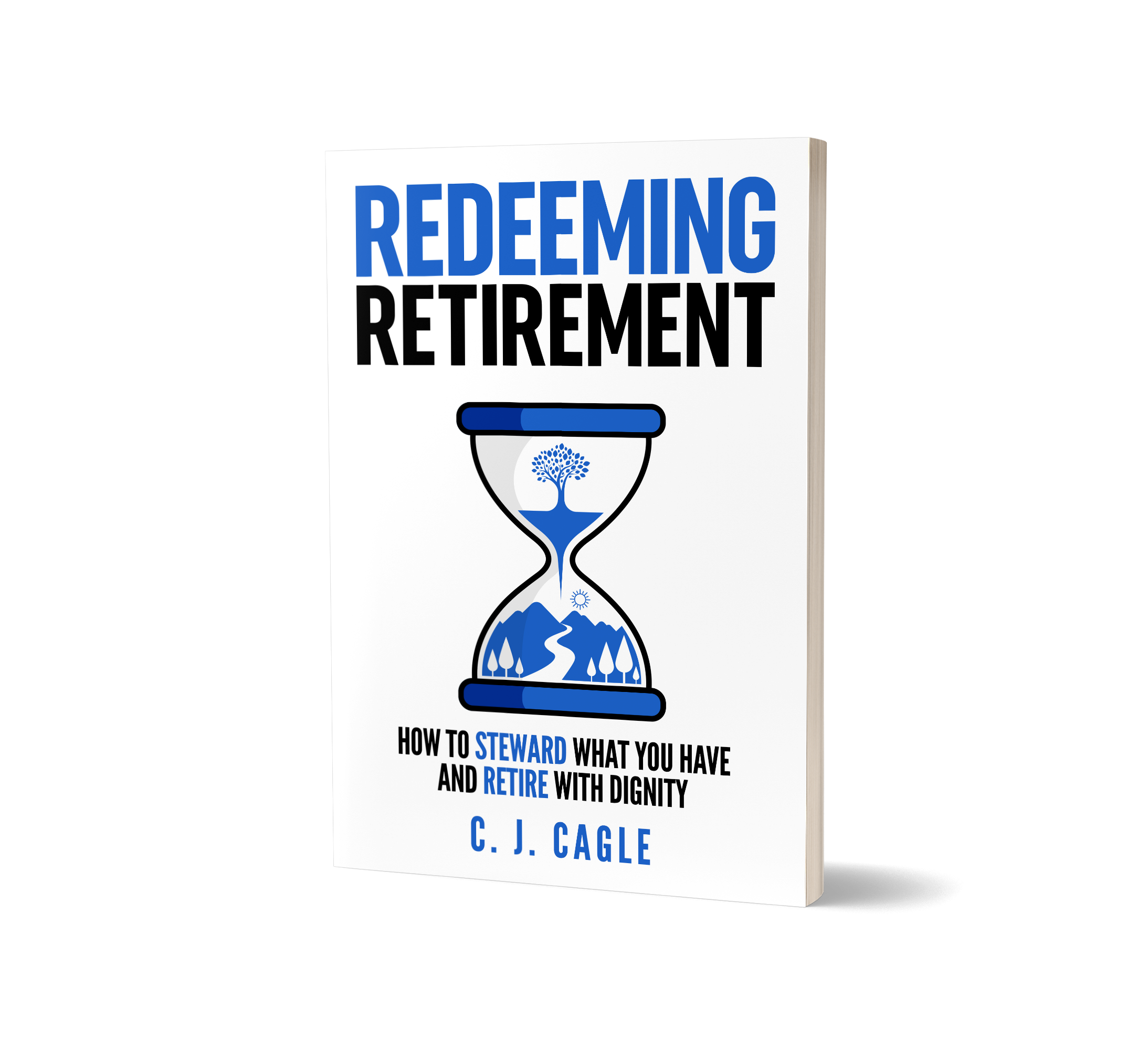
I’m excited to announce that I have completed a significant update and expansion of my Redeeming Retirement book, originally published in 2021. The new edition is titled: Redeeming Retirement: How to Steward What You Have and Retire with Dignity.
In may ways, this book is now an excellent “sequel” to NextGen Steward—it picks up where that book leaves off. NextGen Steward is targeted at 20 and 30-somethings, whereas Redeeming Retirement would be most relevant for those in their 40s and beyond—all the way through retirement.
The new book is now available from Amazon in both paperback and Kindle formats.
A short summary
Here’s the book’s summary from the back cover. As you will see, I’ve updated many of the original chapters and also added several new ones to make it a more comprehensive book on retirement stewardship. There’s over 100 pages of new content, so you might be interested in this one, even if you purchased the first edition.
REVISED AND EXPANDED EDITION—Previously published as Redeeming Retirement: A Practical Guide to Catch Up by C.J. (Chris) Cagle
It’s now the most current comprehensive retirement planning guide written from a biblical perspective—combining rock-solid financial wisdom with a theological framework that embraces faith, wisdom, humility, generosity, and simplicity while rejecting both prosperity gospel optimism and scarcity-driven fear.
If you’re in your 40s, 50s, or 60s who’s not sure whether you’re adequately planning for retirement, nearing retirement and short on savings, or in retirement and not sure whether your savings will last, then this book was written for you.
Nearly half of Americans approaching or living in retirement are financially unprepared, not because they’re irresponsible, but because life happened. Medical bills, job losses, family obligations, and the simple reality of starting late have left many facing retirement with less savings than financial planners say they need. Others, including those already in retirement, aren’t sure whether they will have enough income or if it will last a lifetime.
This book provides comprehensive practical guidance for those who find themselves in any of these situations, whether you’re in your fifties scrambling to catch up, in your sixties making critical Medicare and Social Security decisions, or already retired and trying to make your savings last. It addresses the questions that keep you up at night:
- Can I retire with dignity on what I’ve saved?
- If not, how can I catch up?
- How do I navigate healthcare costs before Medicare?
- How do I optimize Social Security and Medicare in retirement?
- Should I invest differently before and during retirement?
- What withdrawal strategy makes limited resources last?
- How can I be generous and also pay my bills?
- How do I avoid tax traps that devastate constrained budgets?
Written from a Christian stewardship perspective but accessible to any reader, Redeeming Retirement offers hope without false promises and practical strategies without mind-numbing complexity. From catching up in your final working years to optimizing Social Security, managing RMDs, protecting against long-term care costs, and planning your legacy, this book walks you through the complete journey from midlife planning and preparation through retirement, regardless of your starting condition.
You may not have saved as much as some experts recommend, but with the right strategies, you can still retire with dignity. This book shows you how.
Why the update?
Here’s more about why I did released the updated version (taken from the book’s Preface):
I first published this book in early 2021 during the COVID pandemic. The 2026 edition you’re holding is substantially revised and expanded, while also including much of the original content. This new edition includes several entirely new chapters and has been extensively revised throughout, with nearly every chapter updated to reflect current law, research, and economic conditions. It is by far the most comprehensive book on retirement stewardship I have written.
The book you’re holding is substantially different from the 2021 edition. for multiple reasons:
I deliberately widened the scope. The original edition focused almost entirely on people still working and trying to catch up. This edition also speaks directly to those already in retirement, people managing distributions, healthcare costs, RMDs, and the daily reality of making fixed resources last. That transition from saving to spending brings its own questions, and they deserve serious answers.
The retirement landscape has changed significantly since 2021. The SECURE 2.0 Act of 2022 raised the required minimum distribution age from 72 to 73 (rising to 75 in 2033). It introduced a new “super catch-up” provision allowing those aged 60–63 to contribute an additional $11,250 annually to their 401(k) plans, a provision that didn’t exist when I first wrote this book. Tax law, economic conditions, and healthcare costs have all shifted. This revision reflects those realities.
The “One Big Beautiful Bill Act” (OBBBA), enacted in 2025, made the 2017 tax brackets and increased standard deductions permanent. It also gave seniors age 65 and older a special (temporary) bonus deduction of $6,000 per person. This provided greater (but not total) certainty about tax rates for the near future.
Annual contribution limits across retirement accounts have increased substantially. Due to inflation adjustments, 401(k) limits have risen from $19,500 to $23,500, and the total contribution limit for older workers can reach $80,250 in some cases.
The economic landscape has shifted dramatically as well. After more than a decade of near-zero interest rates, the Federal Reserve’s fight against inflation drove interest rates above 5% by 2024, fundamentally changing the calculus for reverse mortgages, home equity lines of credit, and annuity products. This positively impacted interest income from fixed-income investments, such as money markets, CDs, and bonds.
Americans experienced an inflation surge peaking at over 8% in 2022 before moderating, while home equity values surged from $15.54 trillion to over $32 trillion, making home equity an even more significant component of net worth for many retirees.
Social Security earnings test thresholds have increased substantially (from $18,960 to $23,400 for those below full retirement age). Also, the 2024 Social Security Trustees Report updated trust fund projections, and the program delivered its largest cost-of-living adjustment since 1981 (8.7% in 2023) to address inflation.
Respected retirement researchers, including Wade Pfau and Morningstar, have refined safe withdrawal rate guidance to a range of 3.9-5.2% rather than rigidly adhering to the traditional 4% rule. They recognize that individual circumstances, spending flexibility, and portfolio allocation matter significantly.
The 2022 bear market—which saw both stocks and bonds decline simultaneously—validated the conservative, diversified investment approach advocated in this book. While the fundamental principles of biblical stewardship and retirement planning remain unchanged, these updates help ensure you have the most up-to-date information to make informed decisions about your retirement.
Artificial Intelligence (AI) is exploding on the scene and will be the most disruptive and transformational technology of our lifetimes. It’s already reshaping personal finance and retirement, from AI-powered scams targeting seniors to tools that can help you navigate Medicare, optimize withdrawals, and manage healthcare decisions.
Finally, retirement itself has become more complicated, and the stakes for getting it wrong have never been higher for people with modest resources as well as those who have more.
Consider what the numbers actually show. Recent research from the Center for Retirement Research found that healthcare costs alone consume 29% of the median retiree’s Social Security benefits. For someone who entered retirement with modest savings and depends heavily on Social Security, losing nearly a third of it to healthcare before anything else is paid isn’t a planning inconvenience; it’s a crisis. And that’s before accounting for the Medicare surcharges known as IRMAA, which can add $1,000 to $7,000 or more annually for retirees whose income crosses certain thresholds, sometimes triggered by a single large IRA withdrawal or an unexpected capital gain.
The good news is that these problems are solvable, and the solutions are more accessible than most retirees realize. Smart Medicare decisions — choosing the right coverage for your health situation and income — can save thousands per year. Qualified Charitable Distributions (QCDs) allow retirees age 70½ or older to make direct distributions from their IRAs to their church or ministry, reducing their taxable income dollar-for-dollar without having to itemize. For someone who gives $5,000 annually anyway, routing it through QCDs rather than writing checks can save $600–$1,500 in federal taxes while simultaneously lowering Medicare premiums and reducing the percentage of Social Security that gets taxed. Required Minimum Distributions, handled strategically, become a coordinated system rather than an annual scramble. Withdrawal sequencing — knowing which accounts to draw from and in what order — can reduce lifetime taxes by tens of thousands of dollars compared to the approach most retirees take by default.
From the introduction
This book is organized to help you retire with dignity, regardless of where you’re starting. Here’s a summary of the major topics covered in the various chapters:
Part 1: Foundation and Assessment (Chapters 1-6)
- Understanding what “redeeming retirement” actually means
- Identifying the challenges you’ll face
- Recognizing your knowledge gaps
- Honestly assessing where you stand financially—whether a decade out or in the final stretch.
- Determining if you can retire with financial dignity
Part 2: Core Protection Strategies (Chapters 7-10)
- Protecting what you’ve already accumulated
- Managing healthcare costs before Medicare eligibility
- Choosing Medicare coverage wisely (where most retirees lose money)
- Optimizing Social Security benefits (can add $100,000+ in lifetime value)
Part 3: Investment Management (Chapters 11-14)
- Understanding investment basics without the jargon
- Building a portfolio appropriate for limited savings
- Managing risk when you can’t afford mistakes
- Avoiding expensive investment errors that devastate constrained budgets
Part 4: Catching Up and Optimization (Chapters 15-20)
- Catching up even when it seems impossible
- Eliminating debt strategically in your final working years
- Making smart housing decisions that free up cash flow
- Optimizing taxes in retirement (can save thousands annually)
- Navigating RMDs, QCDs, and Roth conversions strategically
- Planning withdrawal strategies that make modest savings last
Part 5: Risk Protection and Planning (Chapters 21-24)
- Protecting against catastrophic long-term care costs
- Getting the right insurance at the right price
- Deciding whether to work with a financial advisor
- Planning your estate with the five essential documents
Part 6: Legacy and Perspective (Chapters 25-29)
- Helping family without jeopardizing your own security
- Navigating AI tools and scams in retirement planning
- Giving generously even on a limited budget
- Considering your legacy beyond money
- Living with biblical contentment in retirement
Much of the new material in the book was taken from articles I have written on my blog, retirementstewardship.com, over the last few years, especially in 2025, due to all the tax law changes. These chapters, along with updates to existing ones, provide comprehensive guidance on retiring with dignity. Some will be immediately relevant to your situation. Others will become relevant as you transition through different phases, including retirement.
Use what helps and adapt what needs modification. By all means, seek professional guidance when it’s warranted. But keep this central: Retiring with dignity is achievable even when you’re behind, not through magic tricks or false promises, and certainly not get-rich-quick schemes, but through wise stewardship, strategic decision-making, realistic planning, and trust in God’s provision.
Whether you’re in midlife and trying to catch up, approaching retirement with critical decisions to make, or already retired and trying to make your resources last, you’ll find practical, biblically-grounded guidance for retiring with dignity.
A request
Should you decide to get the book, I’d really appreciate it if you would submit a review and rate it on Amazon. Because I changed the book’s subtitle, I had to publish it as a new work and that meant losing all the reviews for the original version. (That’s just how Amazon does things.)