
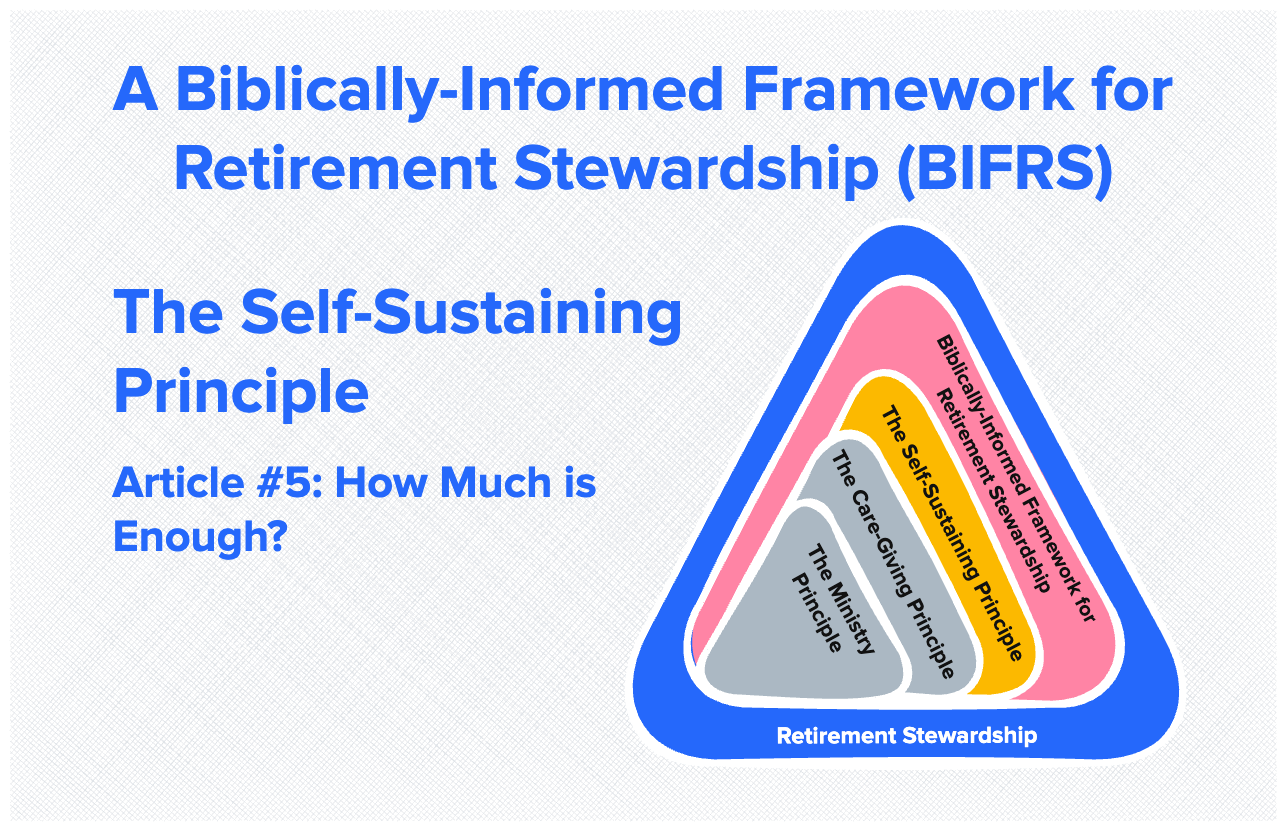
This article is part of the Biblically-Informed Framework for Retirement Stewardship (BIFRS) series
Before we delve into ways to generate sustainable retirement income, we need to discuss how to determine how much you need to save to retire with dignity and self-sustainability. How do you calculate this for your specific situation? What can you do now if it appears you’re behind?
This article will help you understand the challenges you face, calculate a realistic retirement income target, assess your current trajectory, and implement practical catch-up strategies, whether you have 10 to 15 years until retirement or you’re already there.
Understanding the headwinds
Before we calculate what you need, let’s acknowledge the real challenges retirees face. These aren’t meant to frighten you but to help you plan realistically.
The longevity challenge
We’re living longer than ever before. According to Social Security Administration data, a 65-year-old man today can expect to live until age 84, and a 65-year-old woman until age 87. But these are averages; many will live much longer. A 65-year-old couple has roughly a 50% chance that at least one spouse will reach age 90.
This means our retirement savings might need to last 25-30 years, possibly longer. That $500,000, which seems substantial, could generate only $16,000 to $20,000 per year over three decades.
The decline of pensions
According to recent Bureau of Labor Statistics data, fewer than 15% of private-sector workers have traditional defined-benefit pensions. This represents a dramatic shift from previous generations who could rely on guaranteed lifetime income from their employers.
Most of us must generate retirement income primarily from Social Security plus personal savings. The guaranteed income floor that pensions once provided no longer exists for most retirees today.
The reality of inflation
Even at historically “normal” inflation rates of 2–3% annually, prices double approximately every 24-28 years. What costs $50,000 today will cost $82,000–$ 97,000 in 25 years at these rates.
This means you can maintain your portfolio balance; it needs to grow at least enough to keep up with inflation to preserve purchasing power. A static $500,000 portfolio loses value in real terms every year.
The healthcare cost explosion
Healthcare costs typically grow 5 to 6% annually, substantially faster than general inflation in the generating retirement income series. Fidelity Investments estimates that the average 65-year-old couple retiring today will spend approximately $315,000 on healthcare costs throughout retirement (premiums, deductibles, co-pays, out-of-pocket expenses).
Healthcare isn’t just another expense category. It’s a growing, often unpredictable cost that can devastate even well-planned retirements.
The uncertainty of Social Security
While Social Security will likely continue in some form, the program faces funding challenges. Current projections suggest the trust fund reserves may be depleted by the 2030s, potentially requiring benefit reductions or tax increases unless Congress acts.
While you should plan on receiving Social Security, prudent planning means not assuming benefits at 100% of current projections, especially if you’re younger.
These realities point to one conclusion: most of us should save more than we currently do.
But how much more? Let’s calculate an estimate for your specific situation.
How much is “enough”?
This is one of the most perplexing questions in all of personal finance. Before we discuss ways to figure this out, I’m going to go out on a limb and say that, in an absolute sense, this is an unanswerable question. Why, you ask? Because the answer depends on unknowable variables, things that may or may not happen in the future.
For example, we don’t know how long we will live. We don’t know what our healthcare or long-term care costs will be. We don’t know how much we’ll spend. We don’t know what inflation will be. So, how can we determine how much savings we need and how much income we’ll need to generate for a largely unknown future?
We can’t know with absolute certainty, but we can make an estimate based on certain assumptions.
The financial services industry offers various rules of thumb that can be helpful. But they often conflict with each other and may not apply to your situation. There are some “back of the envelope” methods that take into account the specifics of your personal situation. They can be a little more helpful, so let’s examine the most common approaches and then review a helpful (though imprecise) personalized calculation method you can use.
Are Christians Saving Too Little for Retirement (2024) analyzes 2024 Institute for Christian Financial Health survey data showing a concerning disconnect between confidence and reality among 437 Christian respondents. While 65% believe the Bible teaches the wisdom of saving and 54% feel “on track” for retirement, actual savings reveal a crisis: 56% across all ages have under $100K saved, including 55% of ages 45-60 (peak earning years) and 63% over age 60 (nearing retirement). Using Fidelity’s Retirement Account Multiple guidelines (even reduced by 50%), most respondents fall drastically short—those 60+ should have $780K+ saved (6x median income of $130K), but the majority have under $100K. A survey shows Christians are conflicted about retirement savings—35% are unsure or do not believe biblical teachings on saving, fearing either hoarding (the rich fool in Luke 12) or presuming on God’s provision without action (ignoring Proverbs 6:6-8 and wisdom).
So You Want To Be An “Everyday Millionaire” (Updated 2026) examines former team member Chris Hogan’s book, which promotes Dave Ramsey’s philosophy that ordinary people can become millionaires through disciplined saving, debt avoidance, and consistent investing. Chris clarifies that “net-worth millionaire” (assets minus liabilities) differs from having $1 million in liquid assets—a couple with $610K in retirement savings, $350K in home equity, and $40K in cars would reach $1M in net worth but can’t write a $1M check.
5 Reasons You Shouldn’t Save For Retirement (2018) presents counterintuitive biblical cases when retirement saving should be delayed or reduced despite saving’s general importance. It also discusses the Biblical balance: pursue generosity always, establish an emergency fund, and eliminate non-secured debt, then save prudently without becoming a rich fool or miser, maintaining proper trust in God’s provision.
7 Hard Truths About Retirement (Updated 2026) presents biblical perspective on retirement’s challenges: (1) Loss of purpose—work provides meaning; find identity in Christ (1 Peter 2:9), not career; (2) Healthcare costs—$315K lifetime average for couples, rising faster than inflation; plan with HSAs, Medicare supplements, LTC insurance; (3) Limited support—Social Security averages only $1,900-$2,000/month ($3,500-$4,500 couples), provides 40-50% of retirement income; don’t presume on family; (4) God provides but requires action—Philippians 4:19 promises provision but Proverbs 6:6-8 demands wise preparation; (5) Behavioral/emotional risks—COVID-19 crash proved panicked sellers locked in losses while disciplined investors recovered; (6) Longevity uncertainty—50% chance one spouse lives to 92, requiring 25-30 year income; 4% withdrawal rate, consider annuities (now 6-7%); (7) Unreliable inheritances—average $230K-$250K often depleted by healthcare; one-third squander within two years. Balance prudent planning with trust in God’s faithfulness (Psalm 37:25).
Pascal’s Wager and Retirement Stewardship (2016) applies Blaise Pascal’s famous theological argument to retirement planning, specifically addressing “longevity risk” (outliving your money). Pascal’s Wager argues that belief in God is rational: if you’re wrong, you lose nothing; if you’re right, you gain everything. Similarly applied to retirement: If you plan/save for a long life but die early, you lose little (some current enjoyment); if you fail to plan for longevity and live to 90+, consequences are severe (dependency on children/welfare, loss of dignity). The core problem: only God knows our lifespan (Job 13:4), yet we must plan amid uncertainty. Scripture views long life as a blessing (Proverbs 9:10-11), so wise stewardship means “betting on longevity” through planning, saving, investing, and considering longevity insurance (annuities). The framework distinguishes risk (quantifiable probability) from uncertainty (unquantifiable future unknowns).
Contentment with Retirement Stewardship is Great Gain (2017) explains why Christians struggle with contentment (trusting in possessions, cultural influences, love of money, and not seeking God’s Kingdom first) and balances two biblical truths: God’s promise to care for His children and our responsibility to plan wisely for retirement. Without contentment, we can’t live below our means, give generously, or save prudently—discontentment leads to overspending, debt, and poor financial decisions driven by restlessness rather than wisdom. True contentment doesn’t come from accumulating wealth (even though 89% of Americans have a standard of living above the global middle class), but from pursuing God Himself through worship, prayer, gratitude, and recognizing that we already have the greatest treasure—Christ, forgiveness, and eternal life. As John Piper wrote, “The greatest commandment implies: ‘Thou shalt be happy in God.'”
Common guidelines (and their limitations)
We will delve into this further in future articles about sustainable portfolio withdrawals, but I wanted to introduce them as reasonable ways to gauge your progress without having to use extremely complex calculations.
Fidelity’s Age-Based Milestones:
- Age 30: 1x annual salary saved
- Age 40: 3x annual salary saved
- Age 50: 6x annual salary saved
- Age 60: 8x annual salary saved
- Age 67: 10x annual salary saved
These assume you start saving 6% of your salary at age 25, increase it by 1% annually to 12%, receive a 3% employer match, work continuously to age 67, and earn 5.5% annually on investments.
Using the milestones framework, a couple aged 57, with a $70,000 income, should have about $560,000 by the time they turn 60.
The “4% Withdrawal Rule”:
This widely cited rule suggests you can safely withdraw 4% of your portfolio annually (inflation-adjusted) with high confidence that it will last for 30 years. Therefore, you need savings equal to 25 times your annual expenses beyond guaranteed income.
Example: If you need $50,000 annually from savings, you need $1,250,000 saved ($50,000 × 25).
The “Replace 80% of Income” Rule:
Many planners suggest you’ll need 80% of pre-retirement income in retirement, assuming reduced work expenses, no more retirement contributions, and generally lower spending.
Example: If you have $100,000 pre-retirement income, you need $80,000 of retirement income. Keep in mind that more than 50% of the $80,000 may come from Social Security and perhaps a pension, so you may need only $30,000 to $$40,000 from your savings. If you settled on $35,000, you’d need $875,000 in savings under the “4% Withdrawal Rule.”
The problem with generic rules
These guidelines suffer from several limitations:
They don’t account for individual circumstances. Your health, housing costs, family obligations, and lifestyle preferences may differ dramatically from “average.”
They’re based on assumptions that may not hold. Historical investment returns, inflation rates, and life expectancies that shaped these rules may not reflect future reality.
They often overestimate needs. Many retirees find they spend less than 80% of their pre-retirement income, especially if they’ve paid off mortgages and eliminated debt.
They can create unnecessary anxiety. Seeing you “should” have $1 million when you have $200,000 can be paralyzing; your actual needs may be much more modest.
A more realistic approach
Instead of relying on generic formulas, you can estimate what you specifically need, your “personal number.” This four-step manual process provides a realistic, personalized target (you can use online planning tools to accomplish the same thing):
Step 1: Estimate retirement living expenses
Instead of using a percentage of pre-retirement income, start with your current annual expenses, then adjust for retirement realities:
Expenses that decrease or disappear:
- Retirement contributions (currently saving)
- Work-related costs (commuting, professional wardrobe, lunches out)
- Mortgage payment (if paid off before retirement)
- Payroll taxes (Social Security, Medicare)
- Children’s expenses (if they’re independent)
Expenses that may increase:
- Healthcare (Medicare premiums, supplemental insurance, out-of-pocket costs)
- Travel and hobbies (if you plan more leisure activities)
- Home maintenance (spending more time at home)
Expenses that stay roughly the same:
- Property taxes, insurance, utilities
- Food (though eating-out costs may decrease)
- Auto expenses
- Entertainment and discretionary spending
To accomplish this, review your last 12 months of actual expenses. Eliminate items that will disappear (work costs, retirement savings). Add healthcare premiums and out-of-pocket estimates. Adjust for paid-off mortgage if applicable.
If calculating expenses feels overwhelming, you could revert to the percentage approach and use 70-80% of your current gross income as a starting estimate, adjusting up if you have expensive hobbies or down if you’ll have minimal housing costs.
But don’t forget inflation if retirement is years away. At 2.5% annual inflation, expenses grow roughly 28% over 10 years, 63% over 20 years.
Step 2: Estimate guaranteed income sources
Calculate the annual income you’ll receive without touching savings:
Social Security: Visit ssa.gov to get your personalized estimate. Consider when you’ll claim benefits; they increase by roughly 8% per year from 62 to 70. Your estimate should reflect your planned claiming age.
Pension (if applicable): Check with your employer for projected monthly benefit. Verify whether it includes cost-of-living adjustments (most don’t).
Annuities: If you’ve purchased annuities, include projected annual income.
Part-time work: If you plan to work in retirement, estimate a realistic annual income. Be conservative—many retirees work less than planned due to health or opportunity constraints.
Rental income: If you have rental properties, include net annual income after expenses, taxes, and maintenance.
Other guaranteed sources: Military pensions, disability payments, or other reliable income streams.
Example (our couple at age 67):
- Social Security (Mike): $32,000 annually
- Social Security (Debbie, spousal benefit): $16,000 annually
- Part-time work: $8,000 annually
- Total guaranteed income: $56,000 annually
Notice that their guaranteed income is 80% of their pre-retirement income of $70,000.
Step 3: Calculate your income gap
This is simple math, but reveals your crucial “personal number”:
Income Gap = Estimated Annual Expenses – Guaranteed Annual Income
This gap must be filled by portfolio withdrawals.
Example (our couple again):
- Estimated retirement expenses: $65,000 annually
- Guaranteed income: $56,000 annually
- Income gap: $9,000 annually
Step 4: Calculate required savings
Use the 4% withdrawal rule as a starting guideline, recognizing you may need to adjust:
Required Savings = Income Gap × 25
Or more conservatively:
Required Savings = Income Gap × 30 (represents a 3.33% withdrawal rate)
Example (couple using 4% rule):
- Income gap: $9,000
- Required savings: $9,000 × 25 = $225,000
Example (couple using conservative 3.33% rule):
- Income gap: $9,000
- Required savings: $9,000 × 30 = $270,000
Important caveats about the 4% rule
The 4% rule faces increasing scrutiny. It was developed using historical market data that may not reflect current low-interest-rate environments and longer life expectancies. Many experts now suggest:
Variable withdrawal strategies: Adjust spending based on portfolio performance rather than a fixed percentage.
Lower initial rates: Start at 3-3.5% if retiring before 65 or concerned about longevity.
Higher rates may be acceptable if: You’re retiring after 70, have flexibility to reduce spending, or maintain significant home equity as backup.
The rule remains useful as a starting point for estimation while recognizing you’ll need flexibility when actually in retirement.
Rules can be helpful, but…
Throughout this article, I’ve referenced various rules of thumb: the 4% withdrawal rate, Fidelity’s retirement multiples, and the 80% replacement ratio. These are genuinely helpful as starting points. They give you a ballpark figure to work toward and can quickly reveal whether you’re in the right neighborhood or wildly off course.
But here’s the truth: Your specific situation is shaped by dozens of variables that no general rule can fully capture: your health and family longevity, your mortgage status, whether you’ll relocate to a lower-cost area, your hobbies and passions, whether you’ll work part-time, how you’ll spend your time in retirement, your healthcare needs, whether you’ll help adult children or aging parents, your giving commitments, and most importantly, what God is calling you to do in this season of life.
Two couples could both have $800,000 saved and receive identical Social Security benefits, yet one might thrive while the other struggles—not because one planned better, but because their circumstances, values, and callings differ. The couple with paid-off housing, modest hobbies, and good health needs far less than the couple with a mortgage, expensive travel plans, and chronic health conditions. The couple called to support grandchildren’s education or increase their ministry giving will need different resources than those focused primarily on personal comfort.
This is why the rules can only take you so far. They provide the framework, but you must do the detailed work of calculating your specific number based on your expected expenses, your life expectancy estimates, your risk tolerance, and your sense of calling.
What if it’s not enough?
The goal isn’t to match some generic benchmark; it’s to have enough to accomplish what God has called you to do in retirement without burdening others, while maintaining the freedom to serve and give generously. That number is deeply personal, and discovering it requires honest self-assessment, realistic projections, and prayerful discernment about how God wants you to steward this final season.
But what if you do some preliminary estimates and it looks like you haven’t saved enough? What can you do? Here’s some additional help:
Behind in Retirement Saving? There’s Hope and a Path Forward (Updated 2026) introduces Mike and Debbie (both 60) with $240,000 saved but needing $400,000 for early retirement at 62, facing a $160,000 gap while still trying to be faithful stewards. This connects to the Self-Sustaining Principle (1 Thessalonians 4:11-12), planning wisely to “be dependent on no one” while maintaining freedom to serve. The article balances two biblical truths: God’s promise to provide for His children (Matthew 6:25-26, Philippians 4:19) with our responsibility to take wise action (Proverbs 10:4-5, 21:5): “sovereignty does not mean passivity.” Christians must avoid both extremes of anxious hoarding and presumptuous passivity, instead walking the path of faithful stewardship by planning diligently while trusting God completely, rejecting fear-based decisions (2 Timothy 1:7) that lead to emotional rather than rational choices, and remembering that adequate self-sustainability matters more than maximum wealth. The situation isn’t hopeless with realistic assessment, strategic action, and faith in God’s provision.
From accumulation to income generation
This article (and the ones before it) covered the accumulation phase—saving and investing to build wealth during your working years. But the fundamental shift in retirement is from accumulation to distribution—converting your accumulated wealth into reliable, sustainable retirement income.
In the upcoming articles in this Sustainability Principle series, we’ll shift our focus to income and explore:
- Article #6: Generating Retirement Income – Understanding the three tiers of sustainable income
- Article #7: Tier 1 Income (The Sustainability Foundation) – Building your guaranteed income foundation with Social Security, pensions, and annuities
- Article #8: Tier 2 Income (The Stability Layer) – Creating stable, reliable cash flow through bonds, dividends, and other reliable sources
- Article #9: Tier 3 Income (The Flexibility Layer) – Managing portfolio withdrawals sustainably
I may change some of these or the order, but together, these components create the complete picture of sustainable retirement—built on the foundation of wealth you’re accumulating today.