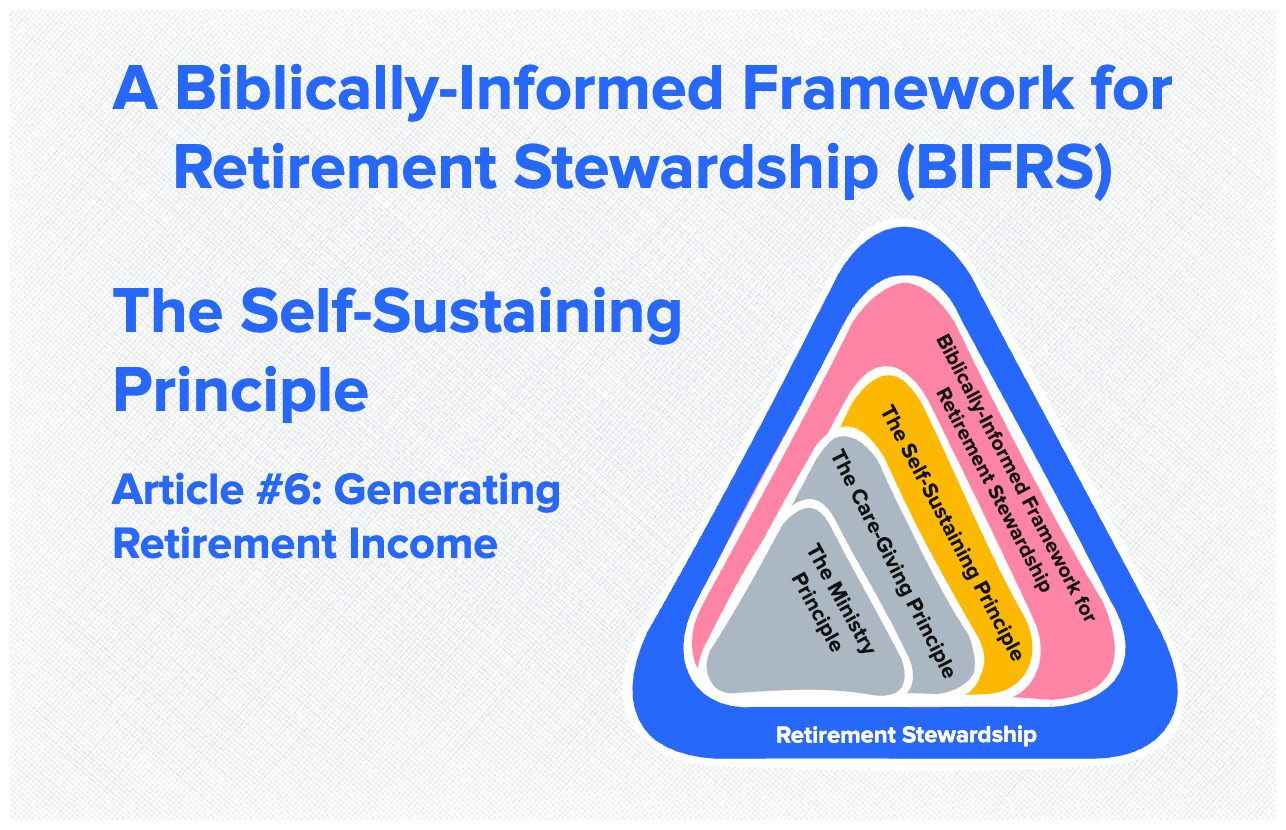
This article is part of the Biblically-Informed Framework for Retirement Stewardship (BIFRS) series.
I remember when I received my last paycheck from my employer in 2018, I felt an odd mix of emotions. I was excited about what was to come (I was going to finish my first book and do lots of other things I didn’t have time for when I was working), but I also sensed the subtle concern that I now have to create my own paycheck and make sure I don’t “blow it.”
For almost 50 years, since I was 15, my income has been simple: I worked and was paid. Sure, the amount varied somewhat over the years as I changed jobs and advanced in my career, but the basics were the same: my labor produced income. Your life has probably been very similar.
Now that mechanism was gone. I had some savings and investments, and also had Social Security coming. But I didn’t have a paycheck. And somehow, I had to convert all those resources into a reliable income stream that would last for what could easily be 25-30 years.
And that’s the thing. Retirement changes nearly everything about how income works in your financial life.
Where Income Fits in the Sustainability Principle
In the first article of this series, I introduced the Sustainability Principle—the fundamental concept that your retirement will be financially sustainable when your reliable income sources can consistently cover your ongoing expenses and obligations throughout your lifetime, adjusted for inflation and accounting for major risks.
At its core, the Sustainability Principle can be expressed as a simple relationship:
Sustainable Retirement = Reliable Income ≥ Ongoing Expenses (over time, adjusted for inflation and risk)
In previous articles, we examined current wealth and how to build wealth over a working lifetime. Wealth (net worth) now becomes the fuel for part of your income engine, the most critical component of retirement sustainability. Without adequate, reliable income, even substantial current wealth can prove insufficient. Conversely, strong guaranteed income sources can provide sustainability even with modest savings.
The Sustainability Principle Framework helps us understand that income isn’t just about the total amount—it’s about reliability, sustainability over decades, coordination with other income sources, tax efficiency, and flexibility to adapt when circumstances change.
During your working years, income was the primary driver of pretty much everything else. It was predictable, usually arriving weekly or biweekly (for salaried employees, more sporadically otherwise). No matter what, it was directly tied to your labor. It grew with your skills, experience, and career advancement. Income was straightforward.
But in retirement, the income equation transforms. It’s more passive, more diverse, potentially more fragile, and often more complex. It changes from a relatively simple mechanism into an integrated system—although you can structure your system to provide a regular “paycheck” if that’s what you need.
Understanding the income component—what it is, how it functions, and how to manage it wisely—is essential to achieving sustainable retirement and faithful stewardship.
The Four Paths of Retirement (Updated 2026) notes that not all retirees approach retirement income the same way—in fact, research identifies four distinct paths retirees follow based on their attitudes, circumstances, and financial preparation. Purposeful Pathfinders (23%) lead active, engaged lives focused on ongoing growth and service, rating themselves happiest and most fulfilled. Relaxed Traditionalists (26%) emphasize leisure and enjoyment, finding satisfaction but slightly less fulfillment than Pathfinders. Challenged Yet Hopeful (20%) have the heart and aspirations of Pathfinders but face financial constraints requiring extra income or spending reductions. Regretful Strugglers (31%) face insufficient income with little hope of improvement, often struggling to find purpose and rating themselves least happy with many regrets. The path you take isn’t determined solely by your account balance—your sense of purpose, willingness to make hard financial decisions, active faith in God’s provision, and commitment to stewardship principles all shape whether your retirement becomes a season of purposeful service or anxious regret, regardless of your income level.
My Thoughts on the Guru Gap suggests that before building your retirement income strategy, you need to understand the fundamental divide in how financial experts approach this challenge—what’s often called “the guru gap.” On one side, the probability-based approach favors diversified portfolios of stocks and bonds, emphasizing growth potential, liquidity, low costs, and flexibility through systematic withdrawals (typically 4% or less annually). On the other side, the safety-first approach leans toward insurance products like annuities and cash-value life insurance, prioritizing guaranteed income, longevity protection, and reduced market exposure even if that means higher fees and less liquidity. Popular advisors like Dave Ramsey and Suze Orman generally champion the probability-based camp, while academics like Wade Pfau and advisors like David McKnight advocate safety-first strategies, creating intense debates that sometimes generate more heat than light. The truth is this isn’t an either/or decision—a balanced approach often works best, using guaranteed income products like annuities to establish an “income floor” that covers essential expenses (similar to Social Security and pensions), while maintaining a diversified portfolio of stocks and bonds for growth, flexibility, and discretionary spending. Understanding both schools of thought helps you make informed decisions about which income strategies align with your specific situation, risk tolerance, and stewardship goals rather than blindly following any single guru’s advice.
Note: There are many more articles on the blog that pertain to retirement income. You’ll see them referenced in future article about the various types of income sources structured around three tiers. But for now, we’ll look at the three tiers from a 50,000 foot view and then drill down in those future articles to get into some of the details in this series on Sustainability.
Three Tiers of Retirement Income
Most retirees have income that fits into a three-tiered structure. Understanding this helps you see how your income is constructed and where you have flexibility, albeit with varying degrees of risk versus certainty. From the Sustainability Principle perspective, these tiers provide different levels of reliability. We’ll delve deeper into each of these in future articles.
Tier 1: Guaranteed Income (Your Sustainability Foundation)
This is your “floor”—income you cannot outlive, regardless of what happens in the markets or economy. This tier provides the bedrock of retirement sustainability.
Social Security: For most retirees, it is the most critical source of income. It’s inflation-adjusted through cost-of-living adjustments (COLAs). It’s guaranteed by the federal government. It continues for life, and often provides survivor benefits for a spouse.
Choosing when to claim Social Security isn’t just a financial optimization problem—it’s a sustainability and stewardship decision with profound implications.
It affects your lifetime income security and your ability to live without financial anxiety in your 80s and 90s. It affects how much you can give to your church and to those in need, both now and in the coming decades. It determines the financial security of a surviving spouse who may live many years after you’re gone. It shapes the pressure you apply to your investment portfolio and the sustainability of your withdrawal strategy.
This decision warrants careful thought, prayer, and, often, professional guidance. It’s not something to make on a whim based on what your neighbor did or what an article recommended as a one-size-fits-all solution.
Traditional Pensions: If you’re fortunate enough to have a traditional defined-benefit pension, this provides additional guaranteed lifetime income. Some pensions include inflation adjustments; many don’t. Either way, you have some important decisions to make about payout options and survivor benefits.
Lifetime Annuities: These are financial products you can purchase that convert a lump sum into guaranteed lifetime income. They essentially create a private pension. Immediate annuities start paying right away; deferred annuities begin at a future date. There are also other, more costly and complex “flavors” of annuities that most retirees don’t need.
Why Tier 1 Matters for Sustainability: This is the income you can absolutely count on. It doesn’t depend on market performance (unless it’s a type of annuity product tied to the market). It won’t run out. It provides the foundation of financial sustainability in retirement. The larger your Tier 1 income relative to your expenses, the less you need to worry about market crashes, sequence risk, or outliving your money.
Many financial planners suggest that you want Tier 1 income to cover at least your essential expenses—housing, utilities, food, healthcare, and insurance. If your guaranteed income covers your basic needs, achieving sustainable retirement becomes dramatically easier. This is the cornerstone of the Sustainability Principle in action.
Tier 2: Reliable Income (Your Stability Layer)
This tier isn’t guaranteed for life, but it’s reasonably stable and predictable, adding another layer of sustainability:
Bond Interest: If you hold individual bonds or bond funds, they generate regular interest payments. Investment-grade bonds are quite reliable, though not without risk.
Fixed-Income Funds: Bond funds, stable value funds, and similar investments provide fairly consistent income through interest payments.
Dividend Income: Quality dividend-paying stocks often yield steady payouts. These can be cut during recessions, but established dividend payers are generally reliable.
Real Estate Income: Rental properties or REITs can generate regular income, though they come with management requirements and some risk.
CD Ladders: Certificates of deposit provide guaranteed interest for their term, though rates vary.
TIPS (Treasury Inflation-Protected Securities): These provide inflation-adjusted interest, combining stability with inflation protection.
Why Tier 2 Matters for Sustainability: This layer provides additional reliable income beyond your guaranteed floor. While not as secure as Tier 1, it’s much more stable than pure market-based withdrawals (Tier 3). If they have sufficient guaranteed income to cover necessities, many retirees use Tier 2 income to cover discretionary expenses (lifestyle spending beyond the bare essentials).
The combination of Tier 1 and Tier 2 income creates a strong foundation for sustainable retirement. When these two tiers together cover most or all of your regular expenses, you’ve achieved a high level of financial sustainability with reduced vulnerability to market volatility.
Tier 3: Variable Income (Your Flexibility Layer)
This is income that you must actively manage and that can fluctuate significantly. While it adds flexibility to your retirement, it also introduces the most uncertainty from a sustainability perspective:
Portfolio Withdrawals: Taking money from your investment accounts, whether from principal or gains. This is the most flexible source but also the most complex to manage sustainably.
Required Minimum Distributions (RMDs): Starting at age 73 or 75 (depending on your birth year), you must take distributions from traditional IRAs and 401(k)s. These are taxable, and the amounts vary based on your account balance and age.
Roth Distributions: Withdrawals from Roth IRAs are tax-free and not subject to RMDs during your lifetime, making them valuable for tax management and flexibility.
Part-Time Earnings: Some retirees work part-time, consulting, or run small businesses. This income is fully taxable and can affect Social Security benefits if claimed before full retirement age.
Asset Sales: Selling investments, downsizing your home, or liquidating other assets to generate needed cash.
Why Tier 3 Matters for Sustainability: This is where you have the most control, the most complexity, and the most significant risk to long-term sustainability. How much you withdraw, from which accounts, in what sequence, and at what times profoundly affects your tax situation, how long your money lasts, and your financial flexibility.
From the Sustainability Principle perspective, the more you depend on Tier 3 income to cover essential expenses, the more vulnerable your retirement plan becomes to sequence-of-returns risk, market volatility, and withdrawal rate miscalculations. This tier requires ongoing management and wisdom.
The Sustainability Test: Can Your Income Support Your Retirement?
The Sustainability Principle provides a framework for evaluating whether your income can truly support a sustainable retirement. Here’s how to think about it:
High Sustainability Profile:
- Tier 1 guaranteed income covers all essential expenses
- Tier 2 reliable income covers most discretionary expenses
- Tier 3 withdrawals are modest and primarily for extras, generosity, or unexpected needs
- Result: Low vulnerability to market crashes, high confidence in 30+ year sustainability
Moderate Sustainability Profile:
- Tier 1 guaranteed income covers 60-80% of total expenses
- Combination of Tier 1 and Tier 2 covers all essential expenses plus some discretionary
- Tier 3 withdrawals supplement for lifestyle preferences
- Result: Reasonable sustainability with moderate market exposure
Lower Sustainability Profile:
- Tier 1 guaranteed income covers less than 50% of expenses
- Heavy reliance on Tier 3 portfolio withdrawals for both essential and discretionary expenses
- Result: Higher vulnerability to sequence risk, market downturns, and withdrawal rate errors
Concerning Sustainability Profile:
- Minimal guaranteed income (Social Security only at lower benefit levels)
- Modest savings requiring aggressive withdrawal rates (5%+ annually)
- Limited margin for unexpected expenses or market downturns
- Result: Significant sustainability concerns, potential for running out of money
Understanding where you fall on this spectrum helps you assess your true retirement sustainability and identify areas that need strengthening.
How Income Interacts with Other Sustainability Factors
Income doesn’t exist in isolation within the Sustainability Principle. It’s deeply interconnected with every other component. Understanding these interactions is crucial to achieving true financial sustainability.
Income and Expenses: The Core Relationship
This relationship is the heart of the Sustainability Principle:
Income must exceed expenses. This is fundamental. I like to use the expression I > E. If your regular expenses consistently exceed your income, you’re depleting your capital. That’s sustainable for a while, but may not be for 30 years unless you have substantial savings.
But expenses aren’t fixed. You have more control over expenses than you might think. Many retirees adjust spending based on market conditions, reducing withdrawals in down years and spending more freely when portfolios are up. This flexibility itself enhances sustainability.
Income flexibility provides security. If you have multiple income sources you can tap, you have options when expenses spike—medical emergencies, home repairs, and family needs. This flexibility is itself a form of financial sustainability.
The goal isn’t maximum income. Some retirees could generate more income than they’re currently taking, but choose not to because they don’t need it and want to minimize taxes or preserve assets for later needs or a legacy. This is wise stewardship: taking what you need, not what you can get.
Income and Taxes
The relationship between income and taxes affects net sustainability:
Income triggers taxes: Most retirement income is taxable to some degree. Traditional IRA withdrawals, pension income, interest, dividends, and capital gains all create tax liability. Even Social Security can become partially taxable based on your other income.
But the type of income matters: Roth IRA withdrawals are tax-free. Municipal bond interest is federally tax-free. Qualified dividends are taxed at lower capital gains rates. The composition of your income affects your total tax burden and therefore your net sustainable income.
Strategic income management reduces taxes: By carefully orchestrating which income sources you tap and when, you can significantly reduce lifetime taxes, thereby increasing your net sustainable income. For example, filling up lower tax brackets with Roth conversions before RMDs begin, or using QCDs (Qualified Charitable Distributions) to satisfy RMDs without increasing taxable income.
Social Security taxation creates complexity: The more other income you have, the more of your Social Security becomes taxable (up to 85%). This creates a “tax torpedo” effect, whereby additional income can be taxed at rates higher than the nominal bracket, reducing your effective sustainable income.
The key insight: Income planning and tax planning must be integrated to achieve optimal retirement sustainability.
Income and Longevity Risk
This is perhaps the most important interaction for understanding sustainability:
Tier 1 income protects against longevity risk. If you live to 95 or 100, your Social Security and pension will still be paying. This is invaluable insurance against outliving your money—the ultimate sustainability failure.
Tier 3 income is subject to longevity risk. The longer you live, the more years you must fund through portfolio withdrawals. If you withdraw too much too early, you might run out. If you withdraw too little out of fear, you might unnecessarily restrict your lifestyle or ability to be generous.
The balance matters for sustainability. Retirees with high Tier 1 income relative to expenses have stronger long-term sustainability because their essential needs are covered regardless of how long they live. Those relying heavily on portfolio withdrawals must be more conservative and more vigilant about withdrawal rates.
Strategic decisions affect sustainability. Delaying Social Security increases your Tier 1 income, thereby strengthening your sustainability foundation. Purchasing an income annuity converts Tier 3 assets into Tier 1 income, trading flexibility for enhanced sustainability. These are trade-offs worth carefully considering through the lens of long-term sustainability.
Income and Sequence Risk
This is a unique retirement risk that directly threatens sustainability:
Sequence risk threatens early-retirement sustainability. If you experience poor market returns early in retirement while also taking withdrawals, your portfolio might never recover, even if long-term average returns are fine. This can break the sustainability of your retirement plan.
Income strategy affects sequence risk. Having cash reserves or a stable Tier 2 income means you don’t have to sell stocks in a down market to meet your spending needs. This is one of the most important protections for maintaining sustainable withdrawals.
The tiered income approach protects sustainability. If Tiers 1 and 2 cover most of your expenses, you can be more patient with Tier 3 withdrawals during market downturns. This flexibility is enormously valuable for long-term sustainability.
Income and Healthcare Costs
Healthcare is such a significant expense that it deserves special attention in sustainability planning:
Medicare premiums are income-based. If your Modified Adjusted Gross Income (MAGI) exceeds certain thresholds, you pay higher Medicare Part B and Part D premiums (called IRMAA surcharges). Managing income to avoid or minimize these surcharges enhances net sustainable income.
Healthcare costs often rise with age. Your income strategy needs to account for increasing medical expenses in your 70s, 80s, and beyond. Having income that grows or can be increased is valuable for maintaining sustainability as healthcare costs accelerate.
Long-term care might require income acceleration. If you or your spouse requires extended care, you may need to substantially increase investment income to cover the costs. Having this capacity affects whether your retirement remains financially sustainable during a health crisis.
Income and Generosity
This is where faithful stewardship becomes most visible within sustainable retirement:
Stable income enables consistent giving. When you know what income you can count on, you can make commitments to your church and ministries with confidence, integrating generosity into your sustainable retirement plan.
Strategic income management enhances generosity. Using QCDs from your IRA after age 70½ allows you to give to charity while reducing your taxable income. Donating appreciated stock from taxable accounts avoids capital gains while providing a deduction. These strategies let you give more effectively while maintaining your own sustainability.
Income margin creates generosity capacity. If your income exceeds your needs, you have a margin for spontaneous generosity to help family, respond to needs, and support kingdom work beyond your regular giving. This is sustainable generosity.
But generosity isn’t just about excess. Even when income is tight, generous retirees find ways to give. This is faith in action, trusting God’s provision while prioritizing kingdom purposes—and often discovering that generous living itself contributes to contentment and life satisfaction, which are non-financial dimensions of sustainable retirement.
Can You Retire? Applying the Sustainability Principle to Income
The Sustainability Principle isn’t just a theoretical framework. It’s a practical diagnostic tool for answering the question that eventually confronts everyone who’s been saving and planning: “Can I actually afford to retire?”
This deceptively simple question requires evaluating whether your anticipated income sources can reliably support your expected expenses and obligations for as long as you might live, while accounting for the risks and uncertainties inherent in retirement—inflation, market volatility, longevity, unexpected health events, and more.
From the Sustainability Principle perspective, evaluating retirement readiness means asking:
- How much of my income is guaranteed (Tier 1)? The higher this percentage relative to your essential expenses, the more sustainable your retirement.
- What’s my total anticipated income from all three tiers? Does it comfortably exceed your expected expenses with a margin for inflation and unexpected costs?
- How vulnerable am I to market risk? If you’re heavily dependent on Tier 3 portfolio withdrawals, what’s your withdrawal rate? Is it sustainable over 30+ years?
- Have I accounted for all major expenses? Including healthcare cost inflation, potential long-term care needs, housing maintenance, and helping family members?
- What’s my margin for error? Do you have flexibility to reduce expenses if needed? Can you delay retirement if markets are poor? Do you have reserves for emergencies?
- How does longevity affect my plan? If you live to 95 or 100, will your income still be adequate? What’s your plan for the potentially very expensive final years?
A systematic process for evaluating your retirement income sustainability and determining not only whether you can retire, but when and how to do so wisely, requires examining each of these questions carefully and honestly.
Building a Sustainable Retirement Income System
Given the complexity and the high stakes, what does wise, God-honoring, sustainable income management actually look like in retirement?
1. Build a Strong Guaranteed Income Foundation
The priority is maximizing your Tier 1 guaranteed income, which provides the bedrock of retirement sustainability. For most people, this primarily means making strategic decisions about Social Security claiming. If you’re healthy and have other resources to live on, delaying your claim to age 70 can significantly increase your lifetime benefit and strengthen your sustainability foundation.
For married couples, coordinating your claiming strategies becomes even more important for long-term household sustainability. You need to understand how your decisions interact and what happens to survivor benefits when one spouse dies.
If you have access to a traditional pension, choose your payout options thoughtfully, weighing the security of a joint-and-survivor option against the higher payment of a single-life option. Some retirees also consider purchasing an immediate annuity to supplement Social Security benefits, thereby providing additional guaranteed lifetime income.
The stronger your Tier 1 foundation, the less you need to worry about market volatility and longevity risk. When your guaranteed income covers your essential expenses, you’ve achieved the core requirement of the Sustainability Principle.
2. Create a Sustainable Withdrawal Strategy
For Tier 3 income from your investment portfolio, you need a withdrawal strategy that balances current needs with long-term sustainability. Many retirees use the 4% rule as a starting point, withdrawing 4% of their initial portfolio value in the first year and adjusting that amount for inflation in subsequent years. This provides a reasonable probability of sustainability over 30 years.
Others prefer dynamic strategies that adjust withdrawals based on portfolio performance, taking more when markets are up and tightening when they’re down. Some use guardrails that set upper and lower bounds on annual withdrawals, allowing flexibility within sustainable parameters.
Whatever approach you choose, the key is being willing to adjust based on experience rather than rigidly sticking to a plan that isn’t working. Your withdrawal strategy should serve your sustainability goals, not enslave you to a formula.
3. Sequence Your Accounts Tax-Efficiently
The order in which you tap different accounts can have enormous implications for your net sustainable income over a 30-year retirement. The typical sequence is to withdraw from taxable accounts first, then from tax-deferred accounts such as traditional IRAs and 401(k)s, and finally from Roth accounts. This approach preserves tax-free growth in your Roth as long as possible while managing current tax liability.
But this conventional wisdom isn’t always optimal for maximizing sustainable after-tax income. Sometimes it makes more sense to mix account types strategically to manage your tax brackets year by year. You might do Roth conversions in early retirement before RMDs begin, moving money from tax-deferred to tax-free status while you’re in lower brackets.
Or you might use Roth withdrawals strategically to avoid triggering taxation of your Social Security benefits, or to stay under the IRMAA thresholds that would increase your Medicare premiums. Tax-efficient sequencing requires ongoing attention, but it can significantly enhance your sustainable net income over the course of your retirement.
4. Maintain Liquidity and Flexibility
As you build your sustainable income system, resist the temptation to commit everything to illiquid investments. Keep one to two years of expenses in cash or near-cash equivalents—money market funds, short-term CDs, or high-yield savings accounts. Maintain access to your taxable investment accounts for unexpected needs.
While annuities can provide valuable guaranteed income that strengthens sustainability, don’t annuitize so much of your portfolio that you lose all flexibility to respond to changing circumstances. Balance is key.
Liquidity isn’t just about having money available; it’s about having options. It provides peace of mind when medical emergencies arise, when family needs help, when opportunities for generosity appear, or when you want to make a significant purchase without disrupting your entire financial plan. That flexibility itself contributes to sustainable retirement.
5. Coordinate Income with Your Spouse
If you’re married, your income planning for sustainability cannot be done in isolation. You need to consider how your Social Security claiming strategies interact for maximum household sustainability. What happens to your household income when the first spouse dies—will the survivor’s income be sufficient to maintain a sustainable lifestyle?
How do you coordinate withdrawals across accounts that are owned jointly versus individually? What income sources will continue for the surviving spouse, and which ones will cease?
Many couples find that optimizing for joint lifetime sustainability requires different strategies than optimizing for a single person. The lower-earning spouse might claim Social Security earlier, while the higher-earning spouse delays to maximize the survivor benefit. These decisions are complex, but they matter significantly for the long-term sustainability and financial security of the surviving spouse.
6. Plan for Rising Healthcare Costs
One of the most predictable threats to retirement sustainability is that healthcare costs will increase, and they’ll increase faster than general inflation. Budget generously for Medicare premiums, supplemental insurance, and out-of-pocket expenses. Consider whether long-term care insurance makes sense for your situation, or set aside specific assets earmarked for potential LTC needs.
Understand how your income affects Medicare IRMAA surcharges—crossing certain income thresholds can add thousands of dollars annually to your Medicare premiums, reducing your net sustainable income. Plan for increased medical expenses as you move through your 70s and into your 80s, when healthcare typically becomes a larger percentage of your total spending.
Healthcare is often the wild card that can break retirement sustainability. The costs are high, somewhat unpredictable, and tend to accelerate with age. Don’t underestimate this category or assume your expenses will remain static.
7. Make Generosity a Priority
Faithful stewardship within sustainable retirement means integrating giving into your plan from the beginning, rather than treating it as something you’ll do with whatever is left over. Establish a baseline by committing to your church and the ministries you support—this becomes part of your regular “expenses” in the sustainability equation.
Learn to use tax-efficient giving strategies that enhance your net sustainable income—Qualified Charitable Distributions from your IRA after age 70½, donating appreciated stock from taxable accounts, or establishing a donor-advised fund. These strategies let you give more effectively while maintaining your own financial sustainability.
Maintain a budget margin specifically for spontaneous generosity, so you can respond when needs arise or opportunities appear. If your income exceeds your needs, consider increasing your giving rather than just increasing your lifestyle.
Generous living isn’t what you do with financial leftovers—it’s a priority that shapes how you structure your entire sustainable income system. It’s part of what it means to be a faithful steward of God’s resources.
8. Review and Adjust Regularly
Finally, understand that building sustainable retirement income is not a one-time event but an ongoing process. Review your income and expenses at least annually, comparing your experience against your projections and sustainability targets. Adjust your withdrawal rate based on portfolio performance—taking more when you can afford to, pulling back when markets are down.
Reconsider your strategies when tax laws change or when your personal circumstances shift. Modify your approach as you move through different stages of retirement, from the active “go-go” years to the slower “slow-go” years and eventually to the “no-go” years when health limits activity.
Be willing to course-correct when something isn’t working or when your sustainability appears threatened. Maybe your withdrawal rate is proving too aggressive and needs to be reduced to maintain long-term sustainability. Perhaps you have more income than you need and should increase your giving. Maybe your tax situation has changed and requires a different account sequencing strategy.
Flexibility and ongoing attention are essential to maintaining truly sustainable retirement income over decades.
A Biblical Perspective on Sustainable Income
How should Christians think about the whole enterprise of creating sustainable retirement income?
First, remember that God is your ultimate provider. Your income streams—Social Security, investments, pensions—are all instruments of His provision. He owns it all. You’re managing His resources, not building your own independent empire. True sustainability ultimately rests in Him, not in your financial systems.
“And my God will supply every need of yours according to his riches in glory in Christ Jesus.” (Philippians 4:19, ESV)
Second, understand that faithful stewardship requires wisdom and effort. God provides, but He expects us to manage wisely what He’s given. Being passive or careless with retirement income isn’t trust—it’s presumption. Planning for sustainable income is an act of stewardship, not an expression of distrust in God’s provision.
“The plans of the diligent lead surely to abundance, but everyone who is hasty comes only to poverty.” (Proverbs 21:5, ESV)
Third, recognize that income is a means, not an end. You’re not trying to maximize income for its own sake. You’re creating a sustainable income that allows you to:
- Live with dignity and reasonable comfort
- Serve God and others effectively
- Give generously to kingdom purposes
- Finish well without becoming a burden
Fourth, maintain contentment regardless of income level. Some retirees will have abundant income; others will be more constrained. Either way, contentment comes from trusting God, not from having more. Sustainable retirement isn’t primarily about the size of your income—it’s about the alignment of your income with your needs and your faithful stewardship of whatever you have.
“But godliness with contentment is great gain, for we brought nothing into the world, and we cannot take anything out of the world. But if we have food and clothing, with these we will be content.” (1 Timothy 6:6-8, ESV)
Finally, remember that this income is temporary. Even if it sustains you for 30 years, that’s nothing compared to eternity. Use it wisely for purposes that will last beyond this life.
“Do not lay up for yourselves treasures on earth, where moth and rust destroy and where thieves break in and steal, but lay up for yourselves treasures in heaven, where neither moth nor rust destroys and where thieves do not break in and steal. For where your treasure is, there your heart will be also.” (Matthew 6:19-21, ESV)
Moving Forward
Retirement income is one of the most critical components of the Sustainability Principle. It’s multifaceted, interconnected with every other financial decision you make, and crucial to your long-term security and stewardship capacity. But it’s not overwhelming if you approach it systematically through the lens of sustainability.
In the articles that follow in this Sustainability Principle series, we’ll continue examining the other components that contribute to sustainable retirement:
- Expenses and how to manage them wisely
- Taxes and strategies for minimizing your burden
- Healthcare costs and planning for the unexpected
- Giving and generous living within sustainable parameters
- And more
The goal is to help you build a retirement that is truly sustainable—financially sound, spiritually faithful, and honoring to God throughout all your remaining years.
With God’s wisdom, careful planning, and faithful stewardship, you can create an income system that provides for your needs, enables your generosity, and supports a sustainable retirement that glorifies God.