
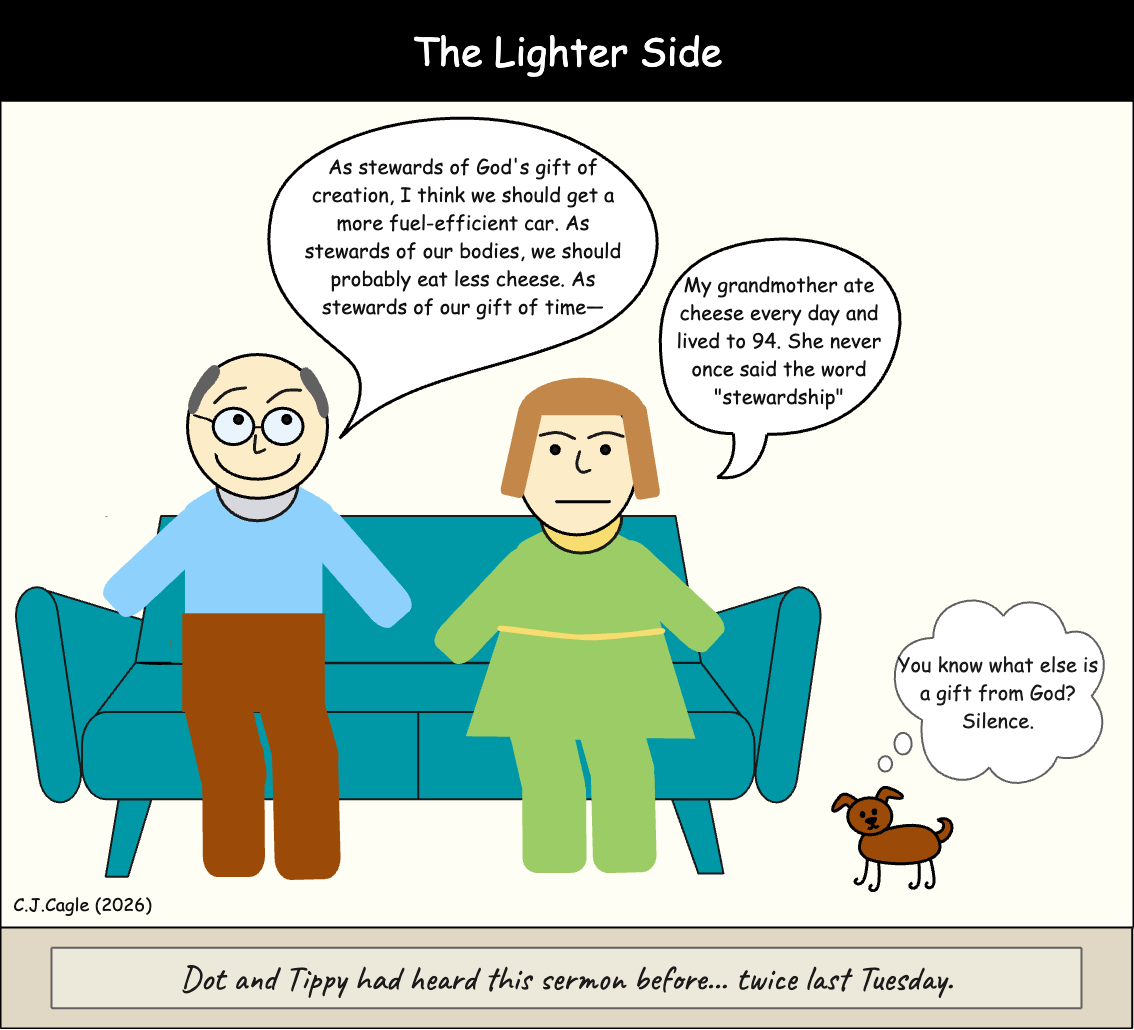
If you’ve spent any time around Christians who take money seriously — especially pastors, teachers, deacons, and writers like me — you’ve noticed something: we really love the word stewardship. We put it on book titles and seminar banners. We name giving campaigns after it. We work it into sermons, small-group discussions, and financial-planning conversations. We even work it into arguments about whether a fuel-efficient car is a spiritual obligation or just a preference. Ask Earl—he has strong opinions.
I even coined a phrase — and a blog title — that you don’t hear very often: Retirement Stewardship. Which, if I’m honest, sounds a little like I’m managing the retirement of a small country. But stick with me.
The average Christian doesn’t use the word nearly as often as I do. When was the last time you got up on a Monday morning and said, “By God’s grace, I’m going to practice wise stewardship today”? It also gets grammatically strange in ways people don’t always notice. As a noun, it’s fine — “stewardship.” As a verb, it gets wobbly — “I’m going to steward this well.” And as an adverb, it goes completely off the rails — “I’m going to handle this in a stewardly way.” I’ve actually never heard or said that last one—I want that on the record.
For some who hear it, the word simply evokes I have no idea what you’re talking about. Others hear it and instinctively hold on to their wallets. And it strikes particular fear into anyone without a budget who has a car loan, because it immediately conjures up Dave Ramsey wagging his finger at them across the screen, delivering his verdict: Bad steward. Bad steward.
The word sounds strange partly because it’s old and used mostly by Christians — and by people on cruise ships, where a steward brings you a towel. It comes from the Old English stiward, meaning “manager of a household or estate,” and the biblical concept behind it is genuinely profound. Scripture is remarkably consistent: everything we have belongs to God, and we are managers, not owners. Our money, our time, our possessions, our bodies, our relationships — all of it held in trust, all of it to be handled with care and accountability. “Moreover, it is required of stewards that they be found faithful” (1 Cor. 4:2). That is not a small idea. That is a complete reorientation of how we think about everything we think we own.
The problem—and Earl knows this problem personally, from both sides of it—is that a big idea applied without wisdom or proportion can become its own kind of burden. When stewardship becomes the lens through which every single decision must be filtered, and every choice must be justified theologically, it stops being liberating and starts being exhausting. For the people around you, anyway. Dot has a word for this. It isn’t stewardship. Tippy also has thoughts, which he keeps mostly to himself, which is one of the things that makes him the wisest creature in the room.
The truth is that faithful stewardship isn’t primarily about using the word correctly or applying it comprehensively to every line item in your budget with the grim determination of a theological auditor. It’s about a posture—a wise, peaceful, grateful, loving, faith-filled daily orientation toward God that says: everything I have belongs to Him, and I want to handle it in a way that honors that. That posture shows up in the big decisions and the small ones. In the car you drive, and yes, arguably, in the cheese you eat. Though I would argue—and I feel strongly about this—that stewardship means saving money where you can and should, but scrimping on cheese is not one of those places (just ask my wife), nor are your children’s or grandchildren’s birthday presents, for example, or your giving to your local church.
The point is that it shows up quietly, in wise and generous choices made from a heart of gratitude, not as a lecture series delivered to your family every Saturday afternoon while they’re trying to watch the ball game or a movie.
Even Tippy knows when enough is enough. He once ate an entire wheel of brie off the counter without a moment of theological reflection on stewardship. And honestly, he seemed at peace with that.