
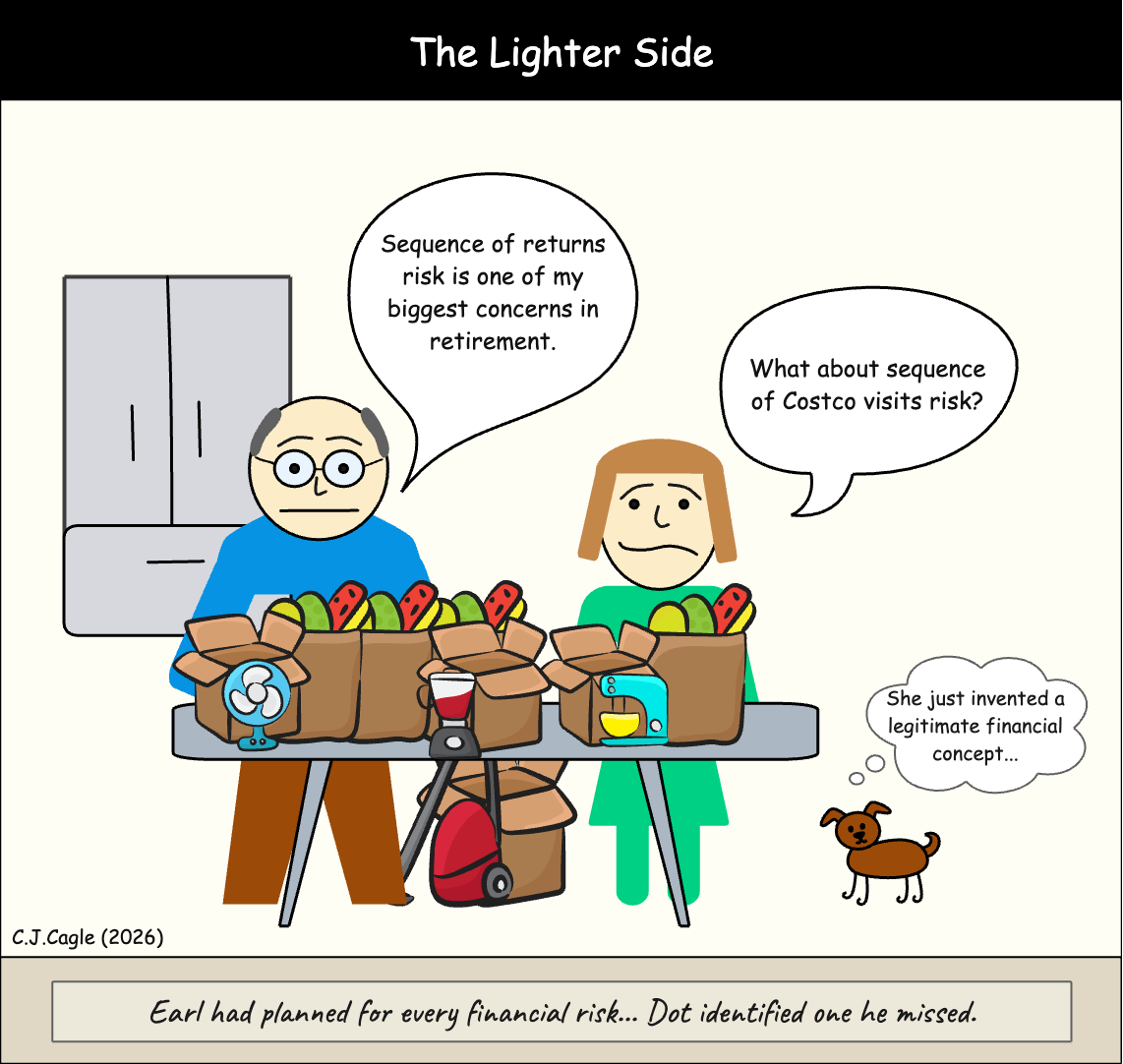
Earl is concerned about “sequence of returns risk,” and the “safe withdrawal rate” typically guides every spending decision in his life with clockwork precision. But it doesn’t appear to apply inside the Costco building.
I generally don’t like shopping, but I don’t mind going to Costco. I sometimes go with my wife to get a case of seltzer water (I like the citrus flavors) and a “tube” of tuna cans, as I really like tunafish salad (I don’t know…it’s just the way they package it), and we enjoy it until we get to the cash register, which can take a while. Earl doesn’t mind either. There’s something about a warehouse with its own zip code, stocked floor-to-ceiling with every conceivable product in quantities sufficient to supply a mid-sized army, that short-circuits the rational financial brain entirely.
Something happens at the entrance—perhaps it’s the 85-inch 4K Ultra HD TVs, or the free food samples (although you have to get further into the store to encounter them, then you can make the rounds and basically have lunch on Costco’s dime), or maybe it’s the sheer gravitational pull of a 40-pound bag of rice marked 18% below retail—we walk in and a typically cautious and frugal shopper becomes a different person entirely. A grocery cart is not big enough; they need a flatbed cart, perhaps one with sides and a trailer hitch. That’s because they’re now seriously considering the stand-up paddleboard, new patio furniture, a year’s supply of toilet paper, and a 10-gallon jar of roasted cashews (which is my greatest temptation). And why not some tires while they’re at it? You can even book a cruise if you want to.
Dot thinks of Costco visits as a risk because you can’t just visit; no one “runs into Costco to pick up some bread and milk” (unless they have a forklift). Earl doesn’t have a spreadsheet for it, but he probably should.
The psychology behind this is well documented, even if it rarely appears in the retirement planning literature. Bulk buying triggers what behavioral economists call the “savings illusion” — the feeling that you are being financially responsible because the per-unit price is lower, regardless of whether you actually need forty-seven pounds of mixed nuts or will consume them before the expiration date printed somewhere on one of the industrial-serving-sized cans. The membership fee, which Earl can justify to the penny in paper towel savings alone, becomes the psychological permission slip for everything else in the cart. You paid for the membership. You might as well get your money’s worth. The paddleboard was basically free.
For retirees specifically, the impulse to bulk buy is worth examining. During the accumulation years, cash flow is relatively steady, and storage space is often more abundant. In retirement, both of those change. A fixed income portfolio requires the same disciplined, sustainable approach to spending that the 4% rule brings to withdrawals, which means that the perceived savings on bulk olive oil need to be weighed against the actual cash leaving the account today, the storage space being consumed, the spoilage risk on perishables, and the very real possibility that you are buying things you would not otherwise buy simply because they are available in impressive quantity at an attractive per-unit price. The savings are real. The question is whether they are as large as they feel in the moment, which is very difficult to ask clearly while standing in front of a display of seventeen varieties of trail mix.
None of this is an argument against Costco, which genuinely offers meaningful savings on staples that retirees buy regularly, such as paper goods, household supplies, certain pantry items, and, within reason, granola bars. A Costco membership can absolutely justify itself for a retired household that shops intentionally and sticks to a list. The key phrase sticks to a list, which is a discipline that requires bringing Dot. Dot brings a list. Dot does not deviate from the list. Dot has never once purchased a stand-up paddleboard.
The deeper stewardship principle underlying all of this applies well beyond the walls of any warehouse store: the difference between frugality and wisdom is not always obvious in the moment. Frugality says that the per-unit price is lower; therefore, buy more. Wisdom asks whether you actually need it, whether the cash is better deployed elsewhere, whether the storage and spoilage costs change the math, and whether you are making a genuine financial decision or simply responding to the psychological environment that a very large, very well-designed store has created around you. Proverbs has quite a lot to say about the person who plans carefully and acts deliberately, and considerably less to say about the person who comes home with four gallons of mayonnaise because it was marked down.
Earl knows all of this. He is intentionally disciplined in his spending, most of the time. He is also the person who bought the paddleboard at Costco. These two facts coexist in his life with a certain peaceful tension that Dot has learned to accept and Tippy to observe astutely but without comment.
The 4% rule will protect your portfolio for thirty years. But bring a list to Costco just in case.