
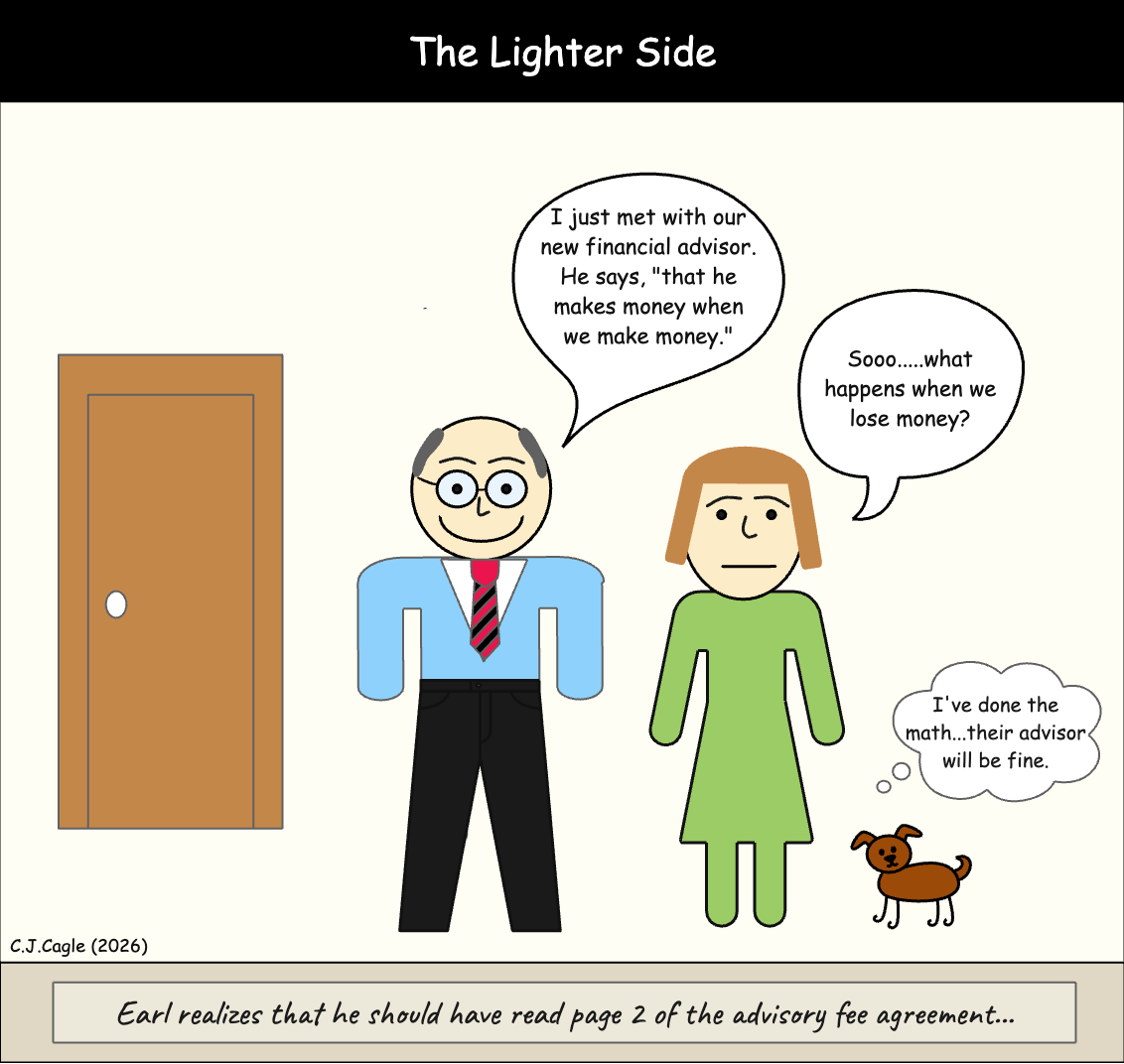
When a financial advisor tells you he “only makes money when you make money,” it sounds like a perfect alignment of interests. And in a narrow sense, it’s true; if your portfolio grows, so does his fee. As one advisor TV commercial explains it, “We do better when you do better.”
But here’s what that reassuring phrase quietly leaves out: they also make money when you make less money, when you make no money, and in most cases when you lose money too. That’s because the standard fee structure in the advisory world is called an “AUM fee”—Assets Under Management—typically running somewhere between 0.5% and 1.5% of your total portfolio value, usually charged quarterly or annually, regardless of your portfolio’s performance.
If you have a $500,000 portfolio and your advisor charges 1%, that’s $5,000 per year. The amount goes up when your portfolio grows and down when it shrinks, but the fee never goes away, even if you lose half your money. The meter is always running—it’s always 1% of your portfolio balance, and it’s in addition to any fund fees or other fees you might have.
The AUM model is often sold as “fair,” “proportional,” or “aligned” because when your portfolio grows, so does the advisor’s fee. Fair enough. The opposite is also true, but this arrangement has limits. If your portfolio drops 30%, you’ve lost a significant chunk of real wealth, but your advisor loses only a small amount of fee revenue.
For example, if their AUM fee is 1%, a 30% drop in your account cuts their revenue by that same 30% since their fee scales directly with your balance. On a $500,000 account, they’d normally collect $5,000 a year (1% of $500,000). After a 30% loss, your balance falls to $350,000, and their fee drops to $3,500, a loss of $1,500 for them (1% × 30% = 0.3% of your original balance).
Notice the size of what’s actually at stake for each of you: they stand to lose $1,500 a year in reduced fees; but you lost $150,000 in actual account value. And unlike you, they don’t need the market to do anything special to get paid; they collect a fee every year regardless of performance, just a smaller one when your balance is down. You, on the other hand, need a 43% gain just to get back to even, because losing 30% leaves you with 70 cents on the dollar, and getting from $0.70 back to $1.00 requires a gain of 30/70 ≈ 42.9%. They share in your downside only modestly; you absorb it in full.
I have often thought it would be better if the advisory profession moved to something I’ll call the “proportional AUM fee.” In this structure, the standard 1% AUM fee adjusts each quarter or year (depending on when it’s paid) by the same percentage as your portfolio return. If your portfolio gains 20%, the advisor’s fee increases 20%. If your portfolio loses 20%, the advisor’s fee decreases 20%. The flat year (0% return) is the only scenario where the fee is identical. In strong years, the advisor earns more, which is the fair and honest trade-off of true proportional alignment. In down years, the client saves money in fees, and the advisor shares the pain. I don’t know of anyone who currently offers this. Which is, perhaps, the point.
I also like the “fee for service” that some independent planners and advisors are moving to. This pay-as-you-go arrangement puts them on par with attorneys, CPAs, and other professionals. Some charge a flat annual fee—like a “retainer”—usually less than 1% of assets, and I like that fee structure also.
What really matters about fees isn’t just the amount; it’s also the compounding effect over time, which works just as powerfully against you as it does for you in accumulation. A 1% annual fee on a $500,000 portfolio doesn’t just cost you $5,000 this year; it costs you everything that $5,000 would have earned over the next ten or twenty years as well. Studies have estimated that advisory and fund fees, combined, can consume between 25% and 33% of a retirement portfolio’s terminal value over a long investment lifetime. That’s not a rounding error.
As popular financial columnist and author Jason Zweig wrote, “Investors who keep fees as low as possible will, on average, earn the highest possible returns. The opposite may be true for their financial advisors, although that is still not widely understood.” This is a not-so-subtly worded observation that the financial advice industry has historically and institutionally had a structural incentive to work against clients’ best interests, and most clients never figured that out.
All that said, things have gotten a lot better. There are more fiduciary firms. Commissions are almost non-existent. And management fees have come down. Furthermore, none of what I’ve said should be taken to mean that I don’t think good professional financial advice isn’t worth paying for; for many people, it genuinely is, particularly in complex tax, estate, and income-planning situations. And many financial advisors do act in their clients’ best interest, even if they charge an AUM fee, because of the industry’s structural fee models—it’s how they get paid. But that doesn’t mean the question is simply, “Do I pay a fee, and if so, how much?” It’s also “what am I getting for it, and is the fee worth it?”