
I recently listened to a podcast, and one topic was conspiracy theories, especially those about the primary elections and the upcoming midterms. Both political camps seem to have conspiracy theories about the other; only the theories vary—certainly not the fervor with which they are espoused.
I’ve also been hearing a lot about AI conspiracies. Are the Chinese creating the fear and disdain for AI data centers so that they can slow U.S. companies down and overtake us in the AI race to “super intelligence?” Are they doing the same about the existential threat of AI? Are data centers really that harmful to local communities? Is there really some truth to the claim that there’s a 10% to 20% chance that AI will kill us all?
When it comes to such things, I am generally of a “where there’s smoke, there may be (probably is) fire” frame of mind. Because we live in a fallen world, cheating in elections (among other things) is certainly possible, even likely. Numerous large data centers could cause problems, and AI will likely be used for nefarious purposes (it already is), and there’s more than a zero chance it will do great harm to humanity.
I don’t like to get “political” or engage in the “culture wars” on this blog, but it’s reasonable to think that some forms of voting, such as mail-in ballots, are more susceptible to falsification than in-person voting. But specific claims about voter fraud must be evaluated on evidence, if available, not on accusations driven by political rhetoric and lacking substance. (That said, I’m not a big fan of mail-in voting except under specific qualifying circumstances. Still, that doesn’t mean that I think it’s been proven that mail-in ballots are massively fraudulent.)
And when it comes to AI, we should probably pay attention to the so-called industry “insiders” sounding the alarm (though another conspiracy theory says they’re doing it just to get free advertising—that their AI models are so powerful they need regulation). Again, some of this concern is probably warranted; these tools need guardrails, or they will be misused, or even used for destructive purposes. And even with guardrails, there’s no guarantee.
You’d think that living in today’s information age would mean we wouldn’t have to worry about conspiracies. With everything videoed, audio recorded, and so many facts at our fingertips, all truths would be easy to see. We all know this isn’t true. In fact, conspiracies seem more rampant today than in most eras of history, or at least the claims multiply and spread faster than ever before.
This proliferation likely stems in part from the fact that any basement-dwelling young adult can now write their own blog or website for pennies, reaching thousands or even millions without editorial oversight or accountability. Add to that our crumbling academic culture, where schools no longer teach formal rhetoric and logic, and proper argumentation and honest debate are no longer the norm. People make bombastic statements, and we see them as worth exploring rather than dismissing them as foolish entertainment. In an era where engagement metrics matter more than truth, sensationalism wins.
For Christians, particularly the more “seasoned” ones (don’t you love that term—makes it sound like we’re a good steak), this poses a unique challenge. We have more time to consume information; we’ve lived through enough history to be appropriately skeptical of even “official” narratives, and we care deeply about the direction of our nation and the world our grandchildren will inherit. These are well and good, but they can also make us particularly vulnerable to conspiracy thinking that distracts us from what really matters.
What’s a “conspiracy”?
The word conspiracy has been twisted in our modern lexicon, so we must define it at its root. If we asked the average person what conspiracy means, she would likely say, “someone with a crazy idea about something—often a paranoid fantasy disconnected from reality.” But by definition, that is not a conspiracy at all—it’s, well, a paranoid fantasy.
A conspiracy, properly defined, is a secret plan by a group to do something unlawful or harmful. It’s about coordinated action, so it requires actual plotters working toward actual harmful ends.
Do you see how those two definitions differ, even though they can overlap? The first definition assumes that the narrative is false from the beginning and that the believer is less than intelligent, if not mentally unstable. The second definition has nothing to do with whether a narrative is true or false, but everything to do with whether nefarious things are actually happening behind closed doors. The ancient Hebrew word for this is qeser, and it can also be translated as “treasonous alliance”—something quite different from unfounded speculation.
Therefore, the major difference between the two definitions is whether you assume the claim is true. Popular usage assumes conspiracy claims are inherently false and that believers are gullible. Or, for those most susceptible, it means that if so-and-so said it, or if I read it on Facebook, it must be true. The biblical and historical usage simply describes coordinated secret plotting for harmful purposes, whether it happened or not, based on evidence, not on our prior assumptions about the intelligence of those making the claim.
If we define conspiracy only by the first definition, we will easily dismiss real threats, jumping to the conclusion that they are false simply because they sound outlandish. If we embrace the second definition without discernment, we’ll believe everything sounds plausible because “evil people exist.” A wiser approach is to examine the evidence (if possible) and not just the claim, no matter how authentic or authoritative it may sound.
There are real conspiracies
Extremely naive people may believe there is no such thing as a conspiracy—that everything happens in the open, that powerful people never coordinate behind closed doors, and that institutions are always transparent. This view of how the world works and how power operates is remarkably naive.
The Christian should know better. Not only do conspiracies exist, but Scripture explicitly tells us that it was the most evil conspiracy of all time that resulted in Jesus being nailed to a cross. Even though that outcome provided salvation for us—working all things together for good according to God’s sovereign plan—it doesn’t negate the fact that a group had a secret plan to harm Christ. The religious leaders plotted and planned and manufactured charges against Him. They manipulated the crowd and the Roman governor. This was a conspiracy in its truest sense. And it worked—or at least they thought it did. God had his own “conspiracy,” which was revealed in due time.
When Peter and John were released from prison in Acts 4:23-31, they told the people that a conspiracy put Christ on the cross—that “kings of the earth set themselves, and the rulers were gathered together, against the Lord and against His Anointed.” This wasn’t paranoid speculation. This was documented historical fact, foretold in Psalm 2 and fulfilled in their generation.
The reality is that conspiracies exist. Some plan and plot behind closed doors to do nefarious, harmful things to people, groups, and nations. History is replete with proven conspiracies: Watergate, the Tuskegee experiments, NSA mass surveillance, MKUltra mind control experiments, corporate price-fixing scandals, cigarette addictiveness and carcinogenicity, and Enron’s accounting fraud that devastated employees’ retirement accounts. We should not be so naive as to think conspiracies don’t exist simply because acknowledging them makes us uncomfortable or because some conspiracy theories have proven false.
But not everything is a conspiracy
While there are conspiracies, and a conspiracy was indeed what was used to crucify our Lord Jesus, Christians should be exceedingly careful that we don’t buy into every conspiracy claim labeled as such, even if it plays directly into our closely held presuppositions and beliefs about people, their motives, and what they are willing to do to achieve their goals—and that’s where I see many in our community, particularly fellow older Christians, stumbling.
Isaiah commends discernment here when he says in 8:12, “Do not call conspiracy all that this people call conspiracy.”
Read that again carefully. Isaiah isn’t saying there are no real conspiracies but rather reminding us that not every conspiracy claim we hear is true. Rumors are always around, and false prophets and sensationalists have always looked to stir up trouble, gain followers, or profit from fear. Some, perhaps, are sincere but mistaken, whereas others are deliberately deceptive.
I imagine most of us have heard an alleged conspiracy and perhaps even shared it with friends or family, only to find out it wasn’t true—what we thought would come to light never did.
Isaiah is warning us not to follow or listen to everything we hear without critical thinking, even if it sounds possible or likely. I think Christians tend to put more stock in what they hear from other Christians, but we can be just as wrong as anyone else.
This is especially important now, in our current cultural milieu, because social media and news feeds show us more of what we already believe (or at least what they think we believe), creating echo chambers where false narratives are quickly accepted as truth. The fear and outrage that we feel when we see or hear something then cause us to impulsively share it with others before we take the time to actually verify it because it was shared by another Christian and it aligns with our existing worldview.
Our vulnerability in the retirement years
Most readers of this blog are Christian pre-retirees and retirees. Just as I have written about online fraud and scams and our vulnerability to them, I think we can also be vulnerable to conspiracy thinking. There are reasons for that:
We know we live in a broken, fallen world. We start from a place of human fallenness and sin, not the “most people are actually good and would not do that” line of thinking. In many cases, someone’s more likely to have conspired to do something than not, especially when there’s reasonable evidence to support the claim.
We have more time to consume information. When you’re no longer working 40, 50, or 60 hours a week, it’s easy to spend hours daily consuming news, podcasts, YouTube videos, and social media. We deceive ourselves if we think reading and listening to more content leads to greater wisdom; it can be the opposite.
We have experienced enough “fallenness” to be understandably skeptical. If you’re around my age, you’ve lived through Watergate, Iran-Contra, the Iraq WMD debacle, the 2008 financial crisis, the Coronavirus pandemic, and numerous other events where official narratives proved incomplete or false. A healthy degree of skepticism is understandable, but it can easily morph into overall distrust of government, social institutions, and the “official” information they put out.
We are concerned about our financial security. After a lifetime of (hopefully) wise stewardship, we know that fraud, heavy taxation, or economic upheaval can threaten whatever resources God has entrusted to us. This can make us good targets for conspiracies that basically amount to financial fear-mongering.
We can be subject to cognitive impairment. With so many of us living longer, this is always a possibility. With these kinds of difficulties, separating fact from fiction can be harder, which can lead to impulsive or unwise actions.
AI is making this more challenging for all of us. The ability for those who want to deceive and mislead others is made easier with AI. It can drum up a good conspiracy and articulate it quite compellingly in just a few minutes. How many times have you seen something outrageous online and thought, “that must be AI” (which, when you think about it, is itself a type of conspiracy theory, but I prefer to think of it as healthy skepticism)?
I’ve seen many godly, intelligent Christian retirees become consumed by conspiracies, to the detriment of their witness, their relationships, and their own spiritual, emotional, and mental health. Their conversations and Facebook posts center on the latest conspiracy, often in politics, finance, or health. Their focus shifts from the Kingdom of God to the evil schemers and power brokers in this world’s kingdoms. Fear seems to drive many of these cases.
Are some claims true and worth exploring? Yes, perhaps, but many just aren’t. But how can we know?
Using wisdom and discernment
The Bible is our best source of wisdom for finding balance and objectivity as we process conspiracy theories. As I’ve often said, “I can’t comment on a conspiracy I haven’t heard of”; you would have to be completely off the grid not to hear about one at least once in a while.
I’ve already pointed out that because we live in a fallen world with people who want to do evil, there are true conspiracies—real, conceived, planned, and coordinated evil—but that there are also people who just like to get attention online or at social gatherings by stirring the pot, plus those who profit from web traffic and clicks, or who want to seem smart by sharing things they cannot verify and often have not even seriously investigated.
So, we must “be careful how we walk, not as unwise but as wise, making the best use of the time, because the days are evil” (Eph. 5:15-16). There are evil people and evil spiritual forces who look to destroy the idea of God, God’s people, and godly things. So, we are not called to take a “head-in-the-sand” approach to these things while the world rages around us. Wisdom requires a reasonable level of awareness about what’s going on.
At the same time, we need to be careful not to believe or share every conspiracy theory we’re presented with. Why? Because not everything called a conspiracy is one, even if it sounds concerning and convincing.
I’m going to cite one “conspiracy” theory because I have written about it and because it hits close to home for many retirees. Here’s how it goes: “The government is ‘stealing’ our Social Security funds, spending payroll taxes on other social and welfare programs and will eventually leave nothing behind.”
Some of the facts behind this are real (the trust fund is being depleted), but the “theft” framing (which makes it sound like a conspiracy) is misleading. Here’s what’s actually happening:
By law, Social Security invests any surplus taxes it collects in special-issue U.S. Treasury securities, the same thing the Treasury does when it borrows money from anyone else (like you and me when we invest in T-Bills or TIPS). The trust fund, instead of holding cash, holds an IOU stating that the U.S. Treasury owes it the borrowed money plus interest. We may not like it, but Congress put this arrangement in place, and the trustee’s report fully discloses it every year. It’s not a secret or a fraudulent scheme; it’s the law.
The legitimate concern is that the combined trust funds are projected to run dry in 2034 (the retirement-only fund even sooner, perhaps in late 2032), but demographics, not corruption, are driving it, since an aging population means fewer workers pay in relative to retirees drawing benefits.
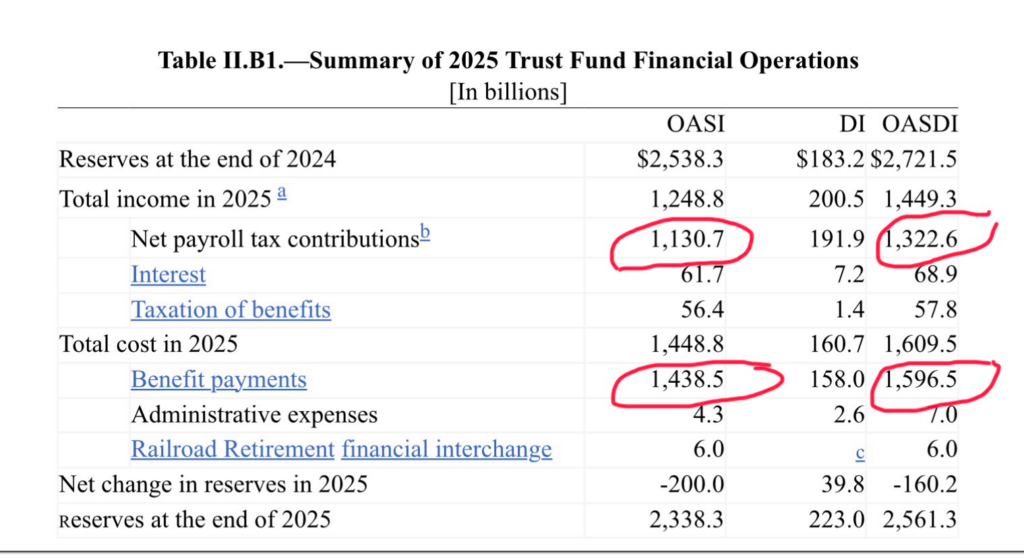
Note in the above table net payroll tax revenue (contributions) and then compare with benefit payments. Benefit payments far exceed FICA payroll tax revenue. That’s a legitimate problem. Note the corresponding change in the trust fund (reserve): a negative $200 billion ($160 combined trust). That’s an even bigger legitimate problem. It also shows that reserves are being tapped significantly to pay current benefits, meaning the trust is redeeming Treasury bonds to pay them.
Also note the $61.7 billion in interest income. As bonds are redeemed (which began regularly in 2021) and no new ones are purchased, interest income will decline.
Finally, note the $56.4 billion in trust income from income taxes paid on Social Security benefits. Any changes to that taxation reduce trust revenue and accelerate depletion of the trust reserve. This includes the changes made by the OBBBA.
Taken together, these factors, along with changing demographics, are contributing to shortfalls in Social Security tax revenue and the depletion of the trust’s reserves. (Equally concerning, I recently read that according to the Congressional Budget Office, the U.S. could reach “negative mortality,” i.e., more deaths than births, within 4 or 5 years. That means even fewer younger workers paying into the system.) It has absolutely nothing to do with the theft of money from the trust and transfer to other government programs
You may also often hear people say we are going to “lose our Social Security” if nothing is done. Again, there are legitimate concerns, but even if Congress doesn’t act, incoming payroll taxes alone would still cover roughly 78 to 83 percent of scheduled benefits, so the real risk is a benefit cut, not the program disappearing altogether—certainly not for those who are already receiving benefits and relying on them as a large part of their retirement income.
I see these conspiracy claims quite often on Facebook, and I’m amazed at how many people affirm them, comment on them, and share them, often with great, shall we say, “enthusiasm.” We need to be well informed, but we also need to exercise wisdom so we don’t bear false witness against others (the ninth commandment still applies on Facebook) by making serious claims we cannot confirm and haven’t seriously researched or studied.
Are there real problems with Social Security funding at its current and projected levels? Has the government done things that have exacerbated the problem? Yes, there are. Is there a vast government conspiracy by the “welfare state” to steal yours and my Social Security benefits to fund their plans? No, there isn’t.
Practical tests
So, with all that said, as wise Christians who want to steward the truth and avoid false conspiracies, what can we do? I think we should apply rigorous standards of evaluation before embracing or sharing any conspiracy claims:
1. Check the source. Since things tend to get passed around, this can be difficult. Still, try to find out who is making this claim. Do they have a track record of accuracy? Do they have expertise in the relevant area? Do they show their work and cite verifiable sources? Do they have a conflict of interest (i.e., are they profiting from fear and clicks)? Anonymous social media posts and sensationalist websites should raise immediate red flags.
2. Evaluate evidence quality. This is closely related to #1 above. Is there actual evidence, or just speculation and a lot of “connecting the dots”? Can the evidence be verified independently? Are primary sources cited, or is everything hearsay—secondhand and thirdhand? Extraordinary claims require extraordinary evidence—”I heard from someone who knows someone” doesn’t cut it.
3. Logical coherence: Does the conspiracy theory require an implausibly large number of people to maintain perfect secrecy? Does it assume superhuman competence while also assuming the conspirators leave obvious clues? Does it rely on “absence of evidence is evidence of absence” reasoning?
4. Predictive power: Has this source made predictions before? How did those turn out? If every predicted crisis fails to materialize, why should we trust the next one?
5. Fruit examination: What fruit does believing and sharing this produce in your life and witness? Does it produce fear, division, and constant anxiety? Or does it produce wise preparation, informed prayer, and opportunities to share the gospel? “You will know them by their fruits” (Matthew 7:16) applies to information sources too.
6. Alternative explanations: Could this be explained by normal human incompetence, bureaucratic dysfunction, or the complexity of large systems rather than coordinated evil? Never attribute conspiracy to what ordinary human failings can adequately explain.
7. The silence of serious people: If this conspiracy were real and provable, why aren’t credible journalists, lawyers, and investigators all over it? The absence of serious coverage might mean the evidence isn’t there.
The financial dimension
As someone who writes primarily about retirement stewardship, I must address how conspiracy thinking intersects with financial decision-making. I’ve seen some (and heard of) pre-retirees and retirees make catastrophically poor financial decisions based on conspiracy-driven fear.
The financial services industry knows that fear sells. Every market downturn brings a fresh wave of “the dollar is collapsing” pitches, “hyperinflation is guaranteed” warnings, and “the only safe haven is [whatever product we’re selling]” marketing. Some of this shades into or fully embraces conspiracy narratives: secret plans to confiscate retirement accounts, insider knowledge about coming crashes, suppressed information about precious metals, etc.
Because of such claims, retirees can be tempted to:
- Cash out retirement accounts at market bottoms, paying massive taxes and penalties, based on predictions of imminent collapse that never came
- Invest heavily in gold or other “crisis hedges” at exactly the wrong time, buying high and selling low
- Pay exorbitant fees for “alternative investments” marketed on fear
- Make radical portfolio changes based on geopolitical conspiracy theories
- Claim Social Security benefits too early based on fear it will collapse “any day now”
Here’s the truth: good stewardship means staying grounded in reality, not speculating about secret plots. Yes, we should be wise about real risks—inflation, market volatility, policy changes, geopolitical instability. But we should respond to actual verifiable, measurable conditions and probabilities, not to fearful narratives about hidden agendas.
Your retirement security doesn’t depend on being “in the know” about secret conspiracies. It depends on faithful stewardship of what God has entrusted to you, grounded in sound principles, appropriate diversification, realistic expectations, and trust in God’s sovereignty over all things—including markets, governments, and global events.
The focus for the Christian
The question is: when it comes to conspiracies and the endless stream of alarming information, what should the Christian focus on?
Isaiah gives us the answer in the same passage where he calls us not to label everything a conspiracy. The rest of Isaiah 8:12-13 says: “Do not fear what they fear, nor be in dread. But the LORD of hosts, Him you shall honor as holy. Let Him be your fear, and let Him be your dread.”
Our focus should not be fearing what man can do to us—whether through secret plots, open persecution, economic manipulation, or any other means. Our fear should be of God Himself, the One who is actually sovereign over all human history and all human scheming.
Remember, “the fear of the Lord is the beginning of wisdom” (Proverbs 9:10). Our focus should be to “fear God and keep His commandments,” which, according to Ecclesiastes 12:13, is man’s whole duty—the entire point of human existence.
If we are wrapped up in every conspiracy that comes along, we will miss who we really need to fear: God Almighty. We’ll spend our emotional energy on shadowy cabals rather than on God, who actually holds all power. We’ll spend our time trying to decode hidden plans rather than submitting to God’s revealed will. We’ll invest our resources protecting ourselves from imagined threats rather than advancing the Kingdom.
What proper fear of God produces
When we fear God rightly rather than fearing conspiracies obsessively, we can experience:
Peace in uncertainty. We don’t need to know every secret plan or hidden agenda because we know the One who works all things according to the counsel of His will (Ephesians 1:11). We can rest in His sovereignty even when we don’t have all the information.
Wisdom in preparation. We can be prudent and prepared without being paranoid. We can take reasonable steps based on real probabilities without catastrophizing based on speculative scenarios.
Focus on our calling. Instead of spending hours daily consuming conspiracy content, we can invest that time in prayer, Scripture, relationships, service, and the mission God has given us.
Credibility in witness. When we’re not known as the Christian who’s always sharing the latest alarming theory, people are more likely to listen when we share the gospel. Our witness isn’t compromised by association with repeatedly disproven claims.
Freedom from manipulation. Many conspiracy narratives are designed to manipulate us—to get our clicks, our money, our votes, or our allegiance. Fear of God frees us from fear-based manipulation.
Contentment in what we have. The conspiracy-industrial complex thrives on making us feel our current situation is untenable and we must act NOW. But if God is sovereign and we fear Him, we can be content with what He has provided while wisely stewarding it.
Common objections
Some reading this may be thinking: “But Chris, aren’t you just advocating for blind trust in corrupt institutions? Shouldn’t we question authority? Isn’t this just ‘don’t worry, be happy’ theology?”
Okay, fair question; let me be clear: I am not advocating for:
- Blind trust in any human institution
- Uncritical acceptance of official narratives
- Passive disengagement from civic responsibility
- Ignoring real documented patterns of corruption and abuse
- Failing to be wise as serpents while innocent as doves
I am advocating for:
- Rigorous standards of evidence before embracing serious claims
- Proportionate concern based on actual documented threats
- Spending our limited time and emotional energy on what we can verify and what we’re called to do
- Maintaining Christian witness that isn’t compromised by association with false claims
- Trusting God’s sovereignty more than we fear human scheming
A vast middle ground exists between naive trust and conspiracy obsession. I believe that’s where biblical wisdom calls us to live.
What about you?
What is your working definition of conspiracy? Are you naive to the fact that real conspiracies exist and that powerful people sometimes do coordinate for harmful purposes? Or do you latch onto every conspiracy theory without solid evidence, letting fear and speculation dominate your thoughts and conversations?
At the end of the day, what do you fear most in life? Is it shadowy groups, geopolitical machinations, economic collapse scenarios, or God Himself?
This doesn’t mean being uninformed or unconcerned about the world. It means being properly informed and properly concerned—neither naive nor obsessed, neither ostrich nor alarmist.
As we navigate retirement, we have a precious opportunity. We have time, resources, and often influence with younger generations. We can spend that opportunity consumed by fear of what enemies might be plotting, or we can invest it in what God has clearly called us to do: love Him, love others, make disciples, serve faithfully, steward generously, and rest in His sovereign goodness.
The choice is ours. Choose wisely. Choose truth. Choose trust in God over fear of man. The peace and fruit in your life—and your witness to a watching world—depend on it.