
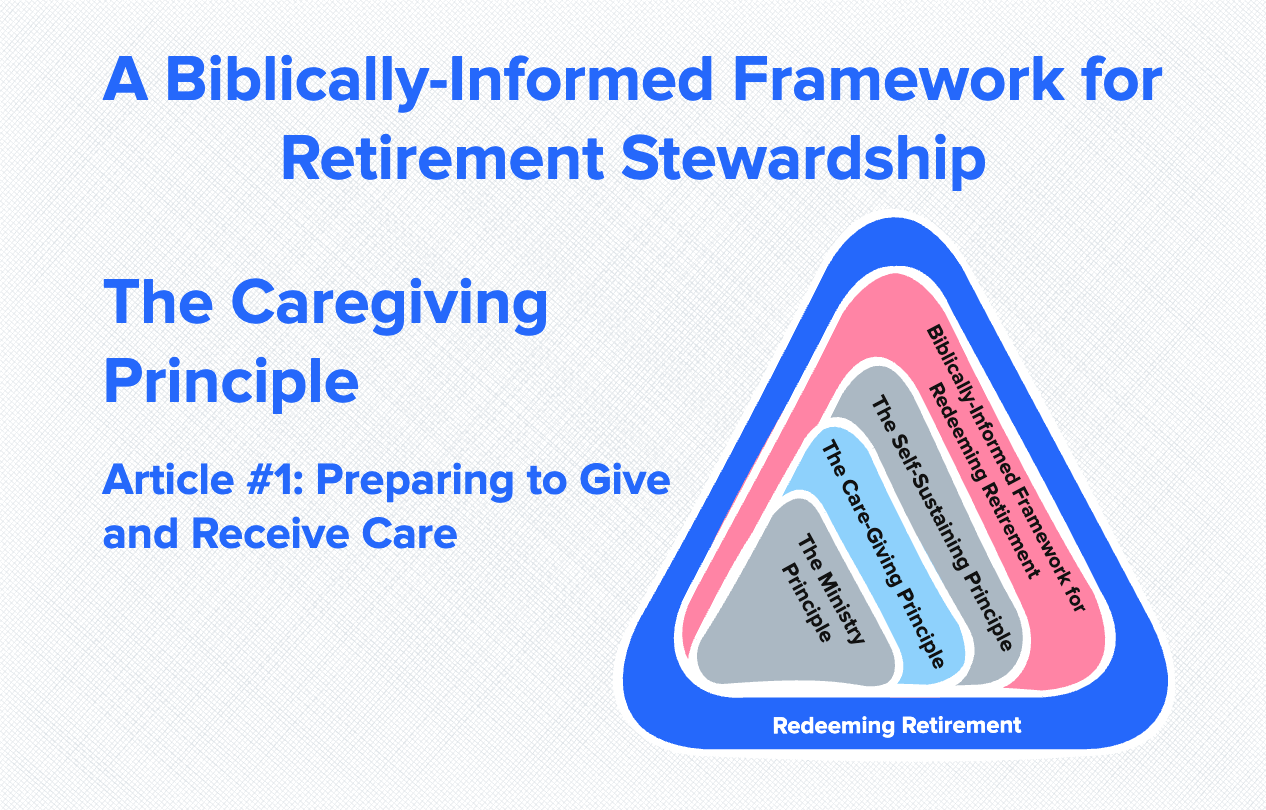
This article is part of the Biblically-Informed Framework for Retirement Stewardship (BIFRS) series.
In the previous series of articles, we explored the Self-Sustaining Principle, which is the biblical call to plan wisely so we don’t become an unnecessary burden on others. We discussed saving adequately, generating sustainable retirement income, managing expenses, and building wealth responsibly. These are essential components of faithful retirement stewardship.
But the Self-Sustaining Principle doesn’t tell the whole story.
What happens when financial self-sustainability (I use those terms deliberately but with a view toward something deeper, which is our total dependency on God) isn’t enough—when age, illness, or disability strips away our independence? When a spouse develops dementia? When a parent can no longer live alone? When the careful plans we’ve made meet the harsh realities of human weakness and frailty in a fallen world?
This is where the Caregiving Principle enters—the second pillar of the Biblically-Informed Framework for Retirement Stewardship (BIFRS). We first introduced this principle in the BIFRS introduction article.
The reality we can’t avoid
We will all need healthcare in some form before and in retirement. Most of us will need some form of care in our later years, no matter how well we’ve planned financially.
According to the U.S. Department of Health and Human Services, about 70% of people turning 65 will need some form of long-term care during their remaining years. Women will need care for an average of 3.7 years; men for 2.2 years. About 20% will need care for longer than five years.
These aren’t just statistics about nursing home stays. They include the everyday realities of aging: help with bathing, dressing, preparing meals, managing medications, getting to medical appointments, and handling finances when our minds aren’t as sharp. They include the slow decline that most of us will face if we live long enough.
The question isn’t whether we’ll need care. The question is who will provide it, how we’ll receive it, and whether we’ve prepared our families—and ourselves—for that reality.
The biblical foundation
At its core, caregiving is based on love.
When Jesus was asked which commandment was greatest, he answered without hesitation:
“Love the Lord your God with all your heart and with all your soul and with all your mind… And love your neighbor as yourself.” (Matthew 22:37-39, ESV)
This command to love—expressed as practical, sacrificial care for elderly family members—runs from one end of the New Testament to the other. Lovingly caring for family members and others is an expression of what it means to follow Christ.
But the New Testament vision goes even further than family obligation. John writes simply:
“We love because he first loved us.” (1 John 4:19, ESV)
This means that every act of genuine caregiving flows from the same source: the prior, initiating love of God poured into our hearts through Christ. We don’t care for others to earn something or to fulfill a duty. We care because we have been cared for—extravagantly, at great cost—and that changes everything about how we view the aging, the vulnerable, and the dependent people in our lives.
The Caregiving Principle also draws from explicit biblical teaching about family responsibility, particularly in Paul’s first letter to Timothy:
“But if anyone does not provide for his relatives, and especially for members of his household, he has denied the faith and is worse than an unbeliever.” (1 Timothy 5:8, ESV)
That’s strong language. Paul doesn’t say neglecting family is a minor oversight or a regrettable lapse in judgment. He says it’s a denial of the faith worse than the behavior of unbelievers.
A few verses later, he reinforces this principle:
“If any believing woman has relatives who are widows, let her care for them. Let the church not be burdened, so that it may care for those who are truly widows.” (1 Timothy 5:16, ESV)
The biblical order of responsibility
Notice the order of responsibility that Paul establishes:
First, family members care for one another. This is the primary obligation. Children care for aging parents. Spouses care for each other. Siblings help siblings when needed. This isn’t optional; it’s fundamental to living out our faith.
Second, the local church supports those with no family. When there’s genuinely no family to provide care—when someone is “truly a widow” with no relatives to help—then the church steps in. The church community becomes the family.
Third, the broader society provides a safety net. Programs like Medicare, Medicaid, and Social Security exist partly because of deeply rooted Christian influence in our culture. As John Piper notes in his framework, “I suspect that the existence of legally mandatory Social Security in the wider society is owing to deeply rooted Christian influence that says we won’t throw away our old people but find a way to care for them.”
This biblical order—family, church, society—shapes how we think about caregiving in retirement and into later life.
The tension we must deal with
Here’s where things get complicated. We’ve just spent a series of articles on the Self-Sustaining Principle, emphasizing the importance of not burdening others. Now we’re talking about the Caregiving Principle, which acknowledges that we will need help and that family and healthcare providers should provide it.
Isn’t this a contradiction?
Not at all. It’s a both/and, not an either/or.
The Self-Sustaining Principle focuses primarily on financial provision. It says: plan wisely so that, if at all possible, you can pay your own bills, cover your own expenses, and maintain your own household without requiring financial support from family, church, or society.
The Caregiving Principle focuses on personal care. It acknowledges that there’s a difference between needing someone to pay your bills and needing someone to help you bathe. Between hiring help with your savings and imposing unpaid caregiving duties on family. Between maintaining financial independence and maintaining physical independence.
Financial self-sustainability creates the context in which care can be both given and received as an expression of mutual love rather than imposed as a crisis born of poor planning.
Let me illustrate with two scenarios:
Scenario A: An 82-year-old father has saved adequately for retirement. He receives Social Security, has a comfortable nest egg, and has planned for healthcare costs. When he develops mobility issues and can no longer safely live alone, his daughter helps him transition to assisted living. His savings pay for the facility. His daughter visits regularly, manages his medical appointments, and advocates for his care. This is the Caregiving Principle in action, enabled by the Self-Sustaining Principle.
Scenario B: An 82-year-old father never saved for retirement, spent freely during his working years, and has only Social Security. When he develops the same mobility issues, he can’t afford assisted living. His daughter must either take him into her home (disrupting her own family) or cobble together inadequate in-home care she can barely afford while also supporting her own family. Both father and daughter feel the strain—he feels like a burden; she can be tempted to feel resentful and exhausted.
In both scenarios, caregiving happens. But in the first, financial preparation transforms caregiving into an expression of love and honor. In the second, lack of financial preparation turns caregiving into a crisis that may strain both relationships and resources.
The Self-Sustaining Principle and Caregiving Principle work together. Financial sustainability doesn’t eliminate the need for care, but it changes the nature of that care from desperate obligation to loving service.
Care goes in two directions
The Caregiving Principle operates in two directions, and we need to prepare for both:
1. Preparing to give care
If you’re in your 40s, 50s, or 60s, you may already be facing this reality. Perhaps your parents are aging, your in-laws need more help, or a sibling has health challenges. You’re in what demographers call the “sandwich generation”; i.e., caught between caring for children while also caring for aging parents.
The statistics are sobering. According to AARP, more than 53 million Americans provide unpaid care to an adult with health or functional needs. Family caregivers provide an estimated 80% of long-term care in the United States. The economic value of this unpaid care is estimated at $470 billion annually.
If you’re not in this season yet, you likely will be. Very few of us will navigate our middle years and early retirement without facing caregiving responsibilities for aging parents or a spouse.
Preparing to give care means having honest conversations with aging parents about their wishes, plans, and resources. It means coordinating with siblings about shared responsibilities. It means understanding Medicare, long-term care options, and local resources. It means recognizing the physical, emotional, and spiritual toll of caregiving and knowing when to ask for help from the church, community, or professional services. It means setting appropriate boundaries to protect your own health and family. And fundamentally, it means viewing caregiving as ministry and worship, not mere duty.
We’ll explore all these topics in detail in upcoming articles. But the first step is acknowledging that caregiving for aging parents or a spouse isn’t an unlikely scenario you might face—it’s a probable reality you should prepare for.
2. Preparing to receive care
This is often harder to think about than giving care. We don’t want to imagine ourselves as dependent, weak, or burdensome. American culture prizes independence and self-sufficiency. The idea of needing help with basic daily activities feels like a weakness or even a failure.
But here’s a biblical truth we need to embrace: There is dignity in dependence when that dependence is rooted in our created nature as relational beings made in God’s image.
From birth to death, we are designed for interdependence. Babies can’t survive without care. Toddlers need help learning to walk, eat, and dress. Children need guidance and protection. Even in our strongest years, we depend on others—for food grown by farmers, for medical care from doctors, for friendship, fellowship, and community from the church.
Why do we assume that needing help in old age is somehow different? Why do we view it as a loss of dignity rather than as the natural rhythm of human life?
The Bible never equates physical strength with spiritual value. In fact, Paul writes:
“Therefore I will boast all the more gladly of my weaknesses, so that the power of Christ may rest upon me.” (2 Corinthians 12:9, ESV)
Our weakness can display God’s strength. Our dependence can deepen our faith and provide opportunities for others to serve.
Preparing to receive care means rejecting the cultural lie that needing help equals loss of dignity. It means planning ahead so our care needs don’t create a financial crisis for the family. It means communicating clearly about our preferences and values. It means creating legal documents—powers of attorney, advance directives—while we’re still competent. It means choosing people we trust to make decisions if we can’t. It means developing the spiritual maturity to receive care with gratitude rather than shame. And it means understanding that accepting help graciously is itself a gift to the caregiver.
The most loving thing you can do for your future caregivers is to prepare well. That preparation includes financial planning (the Self-Sustaining Principle), honest conversations, legal documents, and the spiritual work of learning to receive care with grace.
What the Caregiving Principle Is NOT
Before we go further, let me clarify some misconceptions.
The Caregiving Principle does NOT mean:
- Adult children must always provide hands-on physical care for aging parents
- You should never use professional caregivers or facilities
- Financial assistance to parents should have no limits
- You must sacrifice your own family’s well-being to care for aging parents
- Receiving care means you’ve failed at self-sufficiency
- You can’t use Medicare, Medicaid, or other government programs
- The church should solve all caregiving needs
- Caregiving is exclusively a family burden with no community support
The Caregiving Principle DOES mean:
- We honor biblical priorities: family first, then church, then society
- We plan ahead so care can be given as love rather than crisis management
- We prepare financially so our care needs don’t devastate our family
- We have honest conversations about aging, preferences, and resources
- We recognize that giving and receiving care are both acts of worship
- We ask for help when we need it—from family, church, and community
- We view aging and dependence as normal parts of the human experience, not failures
- We steward our bodies, resources, and relationships to prepare for this season
The four major areas for planning
Over the next several anchor articles in this Caregiving Principle series, we’ll dive deep into four major caregiving and care-receiving areas. Let me preview what’s coming:
1. Healthcare planning before Medicare—the “gap”
If you retire at age 65 or later, you transition directly from employer-based health insurance (or COBRA continuation coverage) to Medicare. The transition is relatively straightforward—you enroll in Medicare Parts A and B around your 65th birthday, add Part D prescription coverage, choose either a Medigap supplement or Medicare Advantage plan, and you’re covered.
But what if you retire at 62? Or 60? Or 55? What do you do for health insurance during those years before Medicare eligibility? This is one of the most significant—and most underestimated—challenges facing early retirees.
The costs can be staggering. A couple retiring at age 62 and purchasing individual health insurance through the Affordable Care Act (ACA) marketplace could easily pay $1,500-$2,500 per month in premiums—$18,000-$30,000 annually—even with relatively high deductibles and copays. Over three years before Medicare eligibility, that’s $54,000-$90,000 just for premium costs, not including actual healthcare expenses. For a couple retiring at 60, add another 2 years and $36,000-$60,000 to those totals.
These numbers can make or break early retirement plans. I’ve seen people delay retirement specifically because they couldn’t afford the healthcare coverage gap. I’ve seen others retire early and then return to work part-time—not primarily for income, but for employer-sponsored health insurance. The healthcare coverage gap between early retirement and Medicare eligibility at 65 is one of the most important planning considerations if you’re considering retirement before 65, yet many people don’t fully understand their options or realistically budget for the costs until they’re already committed to retiring.
2. Healthcare planning: Medicare and beyond
In article #2 in the Caregiving Principle series, we’ll walk through the main options for healthcare coverage before Medicare, the costs you can expect, and how to plan for this challenging transition period.
Healthcare is the foundation of caregiving. Medicare becomes the primary health insurance for most Americans at age 65, but understanding it requires navigating a bewildering alphabet soup of parts, plans, and premiums.
Medicare has four parts:
- Part A covers hospital stays, skilled nursing facility care, hospice, and some home health care
- Part B covers doctor visits, outpatient care, medical equipment, and preventive services
- Part C (Medicare Advantage) is an alternative to Original Medicare, offered by private insurers
- Part D covers prescription drugs
But that’s just the beginning. You also need to decide between Original Medicare (Parts A and B) plus a Medigap supplement, or Medicare Advantage (Part C). You need to understand IRMAA surcharges that can add thousands to your annual costs. You need to budget for dental, vision, and hearing care, which Medicare doesn’t cover. You need to plan for the years between retirement and Medicare eligibility if you retire before age 65.
According to Fidelity’s 2025 Retiree Health Care Cost Estimate, a couple retiring at age 65 can expect to spend approximately $315,000 on healthcare costs throughout retirement. That’s an average; your actual costs could be significantly higher or lower depending on your health, your coverage choices, and how long you live.
Healthcare planning for aging parents is equally important. Do your parents have adequate Medicare coverage? Do they understand their options? Are they paying too much for supplemental coverage they don’t need, or do they have dangerous coverage gaps? Can they afford their medications? Do they need help navigating the healthcare system, coordinating multiple specialists, or understanding complex medical decisions?
In the upcoming healthcare planning article, we’ll walk through all of this in detail. We’ll explain how each Medicare part works, how to choose between Original Medicare and Medicare Advantage, how to budget for healthcare costs, and how to help aging parents navigate their healthcare coverage. We’ll provide decision frameworks, cost comparisons, and practical action steps for different life stages.
Healthcare planning isn’t optional; it’s foundational to the Caregiving Principle. You can’t give or receive care effectively without understanding how healthcare coverage works and what it costs.
3. Long-Term Care planning: Beyond Medicare
Here’s what catches most people by surprise: Medicare doesn’t pay for long-term care.
Medicare covers medical care, such as doctor visits, hospital stays, and rehabilitation after surgery. But it doesn’t cover the ongoing personal care that most of us will eventually need: help with bathing, dressing, eating, toileting, transferring from bed to chair, and managing continence. These are called Activities of Daily Living (ADLs), and when you can’t perform two or more of them independently, you need long-term care.
Long-term care comes in several forms, each with dramatically different costs:
- In-home care: Aides come to your home to help with ADLs and household tasks
- Adult day care: Daytime programs providing supervision, activities, and meals
- Assisted living: Residential facilities providing housing, meals, and assistance with ADLs
- Memory care: Specialized facilities for those with dementia and Alzheimer’s
- Skilled nursing facilities: 24-hour medical care for those who need constant supervision
- Continuing Care Retirement Communities (CCRCs): Campuses offering independent living, assisted living, and skilled nursing all in one location
The costs are staggering. In 2026, the median annual cost for a private room in a skilled nursing facility is approximately $120,000 to $140,000. Assisted living averages $60,000 annually. Even in-home care can exceed $75,000 per year if you need full-time help.
And remember: 70% of people turning 65 will need some form of this care. The average duration is 3.7 years for women, 2.2 years for men who do. About 20% of them will need care for longer than five years. Do the math: a typical long-term care episode could easily cost $150,000-$300,000. A longer episode, especially one involving memory care or skilled nursing, could exceed $500,000.
How do people pay for this? There are essentially five options:
- Personal savings and income from Social Security, pensions, and investments
- Long-term care insurance (traditional policies)
- Hybrid life insurance/long-term care policies that combine death benefits with care coverage
- Medicaid for those who qualify (which requires spending down most assets)
- Family caregiving (unpaid, which shifts the financial burden from money to time)
Each option has advantages and disadvantages. Long-term care insurance can be expensive and has become harder to find. Self-insuring requires substantial assets. Medicaid planning raises ethical questions about intentionally impoverishing yourself to qualify for government benefits. Family caregiving can be rewarding, but it is also exhausting and can derail careers.
Long-term care is perhaps the most financially dangerous risk in retirement. It’s also one of the most emotionally and spiritually challenging aspects of aging. Planning for it is essential to faithful stewardship.
4. Family communication and caregiving responsibilities
This may be the most challenging area. How do you have “the conversation” with aging parents about their plans, their resources, and their wishes? How do siblings share caregiving responsibilities fairly? What do you do when one sibling provides hands-on care while another provides financial support? How do you care for parents without enabling poor decisions? How do you balance caring for aging parents with raising your own children and maintaining your marriage?
These questions don’t have simple answers, but we’ll explore biblical principles and practical wisdom to navigate these complex family dynamics in a future article.
5. Legal and estate planning for caregiving
Advance planning dramatically reduces family stress and conflict. We’ll discuss the essential legal documents everyone needs: wills, powers of attorney (financial and healthcare), advance directives, and living wills. We’ll help you understand when you need an attorney versus when online documents are sufficient.
We’ll also discuss how to approach aging parents about whether they have these documents, where they’re located, and who they’ve designated to make decisions for them. And we’ll explore the Christian perspective on topics like Medicaid planning and spend-down strategies.
Preparing for your coming weakness
Preparing to receive care also means taking practical steps now to make it easier for your family to help you later. Cognitive and physical decline will affect every retiree who lives long enough. The question isn’t whether weakness will come, but whether we’ll prepare for it while we’re still capable.
Your Coming Weakness and Retirement Stewardship (Updated 2026) addresses this reality. In that article, I present eight specific action steps you can take to protect yourself and your family before decline makes managing your affairs difficult:
- Simplify your finances by consolidating accounts at one or two institutions
- Write everything down in comprehensive checklists and password managers
- Put finances on autopilot through the automation of bills, deposits, and routine transactions
- Delay Social Security to maximize guaranteed income during a potential cognitive decline
- Build a support network through church and community relationships
- Establish powers of attorney and trusted contacts at financial institutions
- Engage professional help, like elder law attorneys and daily money managers, when needed
- Consider trusts only when they truly make sense for your situation
The 2026 update to that article includes my perspective seven years later (at age 78 versus 71), updated Alzheimer’s statistics (7 million Americans 65+ in 2026, projected to reach 12.7 million by 2050), FBI fraud statistics ($3+ billion annually targeting seniors), and an “Act Now Before It’s Too Late” section with age-based timelines.
The central message: These preparations must happen in your 50s, 60s, and early 70s—not in your 80s when decline may have already begun.
Where we go from here
The Caregiving Principle might feel overwhelming. Healthcare planning. Long-term care costs. Difficult family conversations. Legal documents. It’s a lot to think about, plan for, and prepare.
But remember: this is also about stewardship, and stewardship isn’t just about money; it’s about wisely managing everything God has entrusted to us, including our bodies, our relationships, and our later years.
As we work through this series, we’ll break down each major area into practical, actionable steps. We’ll provide decision frameworks, checklists, and resources. We’ll help you have the conversations you’ve been avoiding. We’ll show you how to prepare financially, legally, and spiritually.
Most importantly, we’ll ground everything in biblical truth: You are made in God’s image. Your dignity doesn’t depend on your independence. Your weakness can display God’s strength. Receiving care graciously is an act of faith. Giving care sacrificially is an act of worship.
Whether you’re in your 40s, anticipating caring for aging parents, in your 50s or 60s, planning for your own future care needs, or already navigating the complexities of caregiving, the Caregiving Principle provides a framework for approaching this season with wisdom, grace, and faith.
The Self-Sustaining Principle asks: “How can I provide for myself so I don’t burden others?”
The Caregiving Principle asks: “How can I prepare to both give and receive care in ways that honor God, honor family, and reflect biblical priorities?”
Both questions matter. Both require planning. Both reflect faithful stewardship.
In the next article, we’ll begin with healthcare planning—understanding Medicare in detail, realistically estimating costs, and making wise decisions about coverage. It’s the foundation of caregiving preparation, and it affects nearly everyone who reaches age 65.
Until then, I encourage you to start having conversations. If you have aging parents, ask them about their Medicare coverage, their long-term care plans, and their legal documents. If you’re approaching retirement yourself, start thinking about who you’d want making decisions if you couldn’t. If you’re married, discuss these questions together.
The Caregiving Principle isn’t about creating fear or anxiety. It’s about faithful preparation. It’s about loving your family well by planning ahead. It’s about stewarding the gift of life—all of it, including the seasons of weakness and dependence.
And ultimately, it’s about reflecting the character of God, who cared for us when we were utterly helpless and continues to sustain us through every season of life.
I recently published a book on this subject, and the broader topic of later life concerns, which includes the biblical and theological foundations of “Legacy,” as well as many of the practical areas that will be covered in the next series of anchor articles: