
Some retirees don’t love being asked how they’re spending their time. They were accountable for their time while working, so having to “give an account” in retirement feels a little uncomfortable, even in informal conversation. Still, people are curious. Or they’re just making polite retirement chit-chat because they have absolutely nothing else to talk about. Or maybe they’re just nosey.
But if you do ask a retiree whether they’re staying busy, you could get a variety of answers. The question seems to imply, at its core, that retirees are generally not busy. That their days are a blur of napping, going to the movies, early-bird dinner specials, and watching the Weather Channel. That may describe occasional days for some of us (I like watching the Weather Channel, but usually when something is “brewing”—it comes from growing up in Central Florida), but not every day for sure.
“Busy” also means different things to different people. For some, the question “Are you staying busy?” is really a polite way of asking, “What the heck do you do all day?” to which some might respond with a hint of indignation, “Whatever I want!” Others may stare blankly until they muster, “Lots of things — I just try to stay busy.” And then some offer a seven-point answer that begins with a brief historical overview of retirement and somehow ends with the Levitical priesthood, quoting Numbers 8:24-26. You were just trying to get from the lobby into the church service. You may not make it.
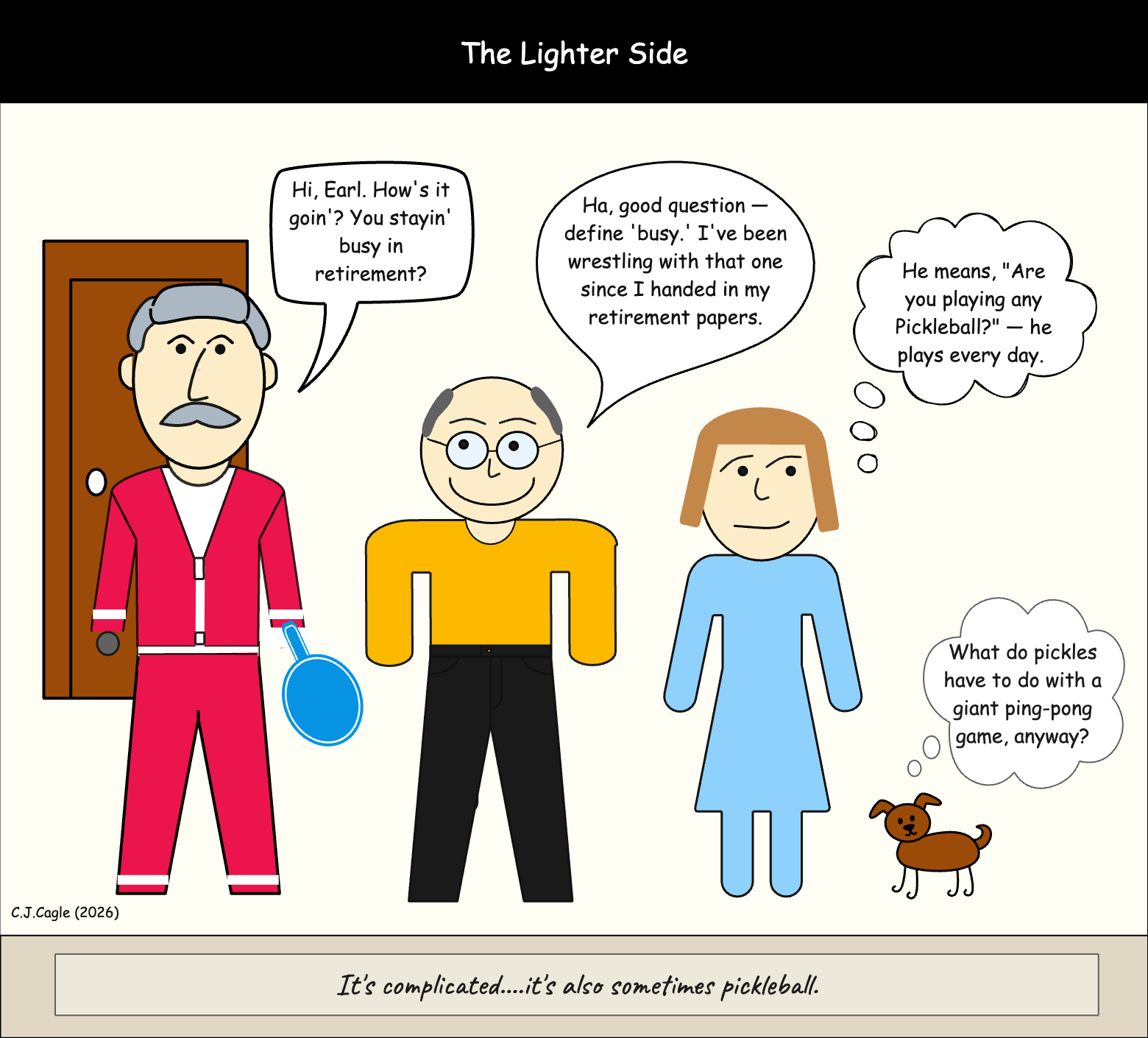
Or you might also get a simple, thoughtful, honest answer like Earl’s.
This cartoon introduces Norm, Earl’s neighbor and occasional foil. Norm is not a bad guy, even if he looks a little silly in the bright red athletic suit, which, in my rendering, looks a lot like pajamas. (Do people even wear “sweat suits” anymore? Maybe they’re called “sweat outfits,” but that doesn’t sound right.) He’s just relentlessly, exhaustingly, and enthusiastically retired in the most performative way possible. He is the person retirement magazines are written for and about. He is the “after” photo in a retirement-planning brochure, complete with styled hair, a well-groomed mustache, and fewer facial wrinkles from using Particle Facecream for Men, which he saw advertised on Fox News.
Norm’s retirement embodies the cultural default answer: get busy and stay busy. Being busy is respectable; it signals that you are still active, still achieving, and still relevant. The retirement magazines are full of fit, tanned people with excellent hair (perhaps graying, like Norm’s) and unnaturally white teeth. (Seriously, how do they do that teeth thing? Probably another product seen on Fox News.) These are people who are kayaking, volunteering, traveling, launching second careers, and running half-marathons. The implicit message is that the goal of retirement is to replicate the pace of working life with more fun and interesting activities. Stay busy, and whatever you do, don’t slow down. Don’t sit down. And don’t, under any circumstances, admit that you took a nap.
To be fair, there is something to this “staying active in retirement” thing. Staying active has generally been shown to benefit people physically, mentally, and socially. But what “active” looks like for one person can be very different from what it looks like for another. Comparing your retirement to a magazine cover is about as useful as comparing your portfolio to Warren Buffett’s. Instructive, perhaps, but encouraging?—not particularly. As Buffet once said, “People buy Berkshire [Hathaway] to invest like me. Then they call their broker every week to ask why it isn’t doing anything. That’s not investing like me. That’s the opposite of investing like me.”
Here’s the more important distinction: just being busy is fairly easy (unless you’re just really, really lazy, of course). It requires nothing more than a full calendar and a basic unwillingness to sit still. Being thoughtful and intentional about what you do and why you do it is considerably harder. It requires knowing what actually matters to you, to God, and to others, which in turn requires the kind of unhurried reflection that busyness tends to crowd out. Some people use the newfound flexibility of retirement beautifully. Others fill it immediately with frenetic activity and then, six months later, wonder why they still feel vaguely unsatisfied. Pickleball is fun, but it’s not the total answer.
The biblical perspective adds a dimension that retirement magazines tend to gloss over, possibly because it doesn’t photograph as well as kayaking in Alaska. A genuinely purposeful retirement will include some meaningful service to others: mentoring, volunteering, giving generously, and serving the local church with the time and wisdom that working life never quite allowed. This is the natural outflow of a life shaped by gratitude and grace and, for many people, the answer to the nagging dissatisfaction that a full calendar alone can’t provide.
This is consistent with what a kind subscriber recently wrote about this topic after suggesting it to me for a cartoon after his conversation with a friend—who was not retired—asked him about how he was spending his time in retirement:
Rather than “busy,” my main goal in retirement is to be “fruitful,” I told him. To grow personally while being of use to those around me. This seemed to satisfy him, but it left me with the same feeling it always does: Why do I have to justify my existence in this way? People in demanding active careers have built-in “justification.”
I think part of being the “fruitful” retiree that he aspires to is something else that the Bible teaches we should embrace: the activity of abiding. Jesus was direct about this in John 15. The branch that bears fruit is not the most frantically active one. It’s the branch that stays connected to the vine. Abiding is unhurried time in Scripture, in prayer, and in quiet attentiveness to the Holy Spirit. It isn’t the absence of productivity. It is the source of it. Everything else—including fruitfulness— flows from a better and deeper place when abiding comes first.
And then there is rest—actual, intentional, guilt-free rest. Many retirees are remarkably bad at this, having spent forty years treating rest as something you do only after everything productive is finished rather than as a gift to be received. Rest is biblical. The Sabbath principle didn’t retire when you did.
Retirement looks different for everybody, and it should. Physical health, financial margin, personality, spiritual gifts, and local church needs all shape what a faithful and flourishing retirement looks like for any particular person. There is no template. There is no magazine cover to match. There is just the daily question of whether you are living your days with gratitude, intentionality, and a genuine awareness of the One who has numbered them all.
Norm has his view of retirement. Earl is carefully working his out. Dot makes a reasonable assumption. And Tippy’s mind has wandered. But then he has never once been asked what he does all day, has never felt the need to justify his schedule to anyone, sometimes sleeps twelve hours without interruption, and wonders where in the world the name “pickleball” came from.