
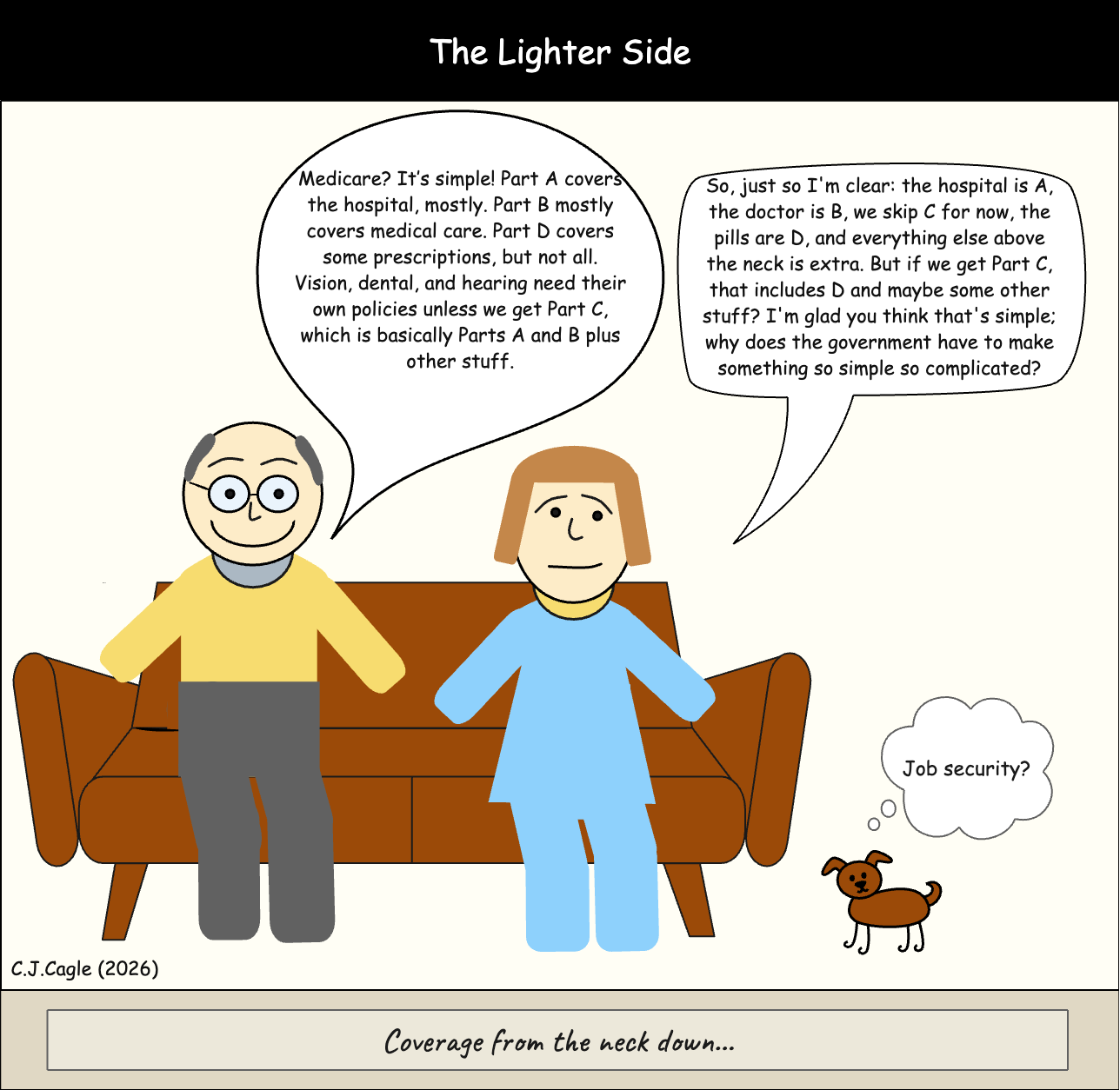
Well, as it turns out, a LOT of things are easier to understand and enroll in than Medicare.
If this hasn’t already happened, at some point in the months approaching your 65th birthday, you’ll receive a piece of mail from the federal government explaining that it is time to enroll in Medicare. This letter will be accompanied by a booklet as thick as an old Sears and Roebuck catalog (some of you may remember those), very official-looking but printed on real cheap paper. The booklet will refer you to a website. The website will remind you that you’re getting close to your Medicare enrollment window and tell you to call a 1-800 number or enroll online (which is a whole different ordeal).
If you call the number, someone will answer and then put you on hold. While you’re on hold, you’ll have time to read the letter and the booklet and wonder why you didn’t enroll online; by the time you get through, you’ll be more confused than when you started, so you hope the announcements and music stop soon so you can talk to a real person.
If you skip the phone call and go straight to the Medicare enrollment website, you’ll have to answer questions you never have before, so you’ll get confused there too – maybe even more than you were when you read the booklet. Welcome to Medicare. It’s not simple or easy, but you’ll get used to it.
Once you’re enrolled and in the program, you’ll have the opportunity to re-enroll in a different Medicare program once a year if you qualify. (That period usually begins in October and ends in November.) This is when things get really crazy. You’ll hear that you may be missing all kinds of free stuff, things you’re entitled to, and if you don’t want to keep missing out, you should call this or that 800 number, which will be different from the 800 number you called to enroll in the first place. You’ll wonder who’s on the other end of the call, as you should.
Confused? Well, it may not be that bad, at least not all the time, but be prepared for a bumpy ride just the same. The initial enrollment and recurring annual enrollment options are real, and the commercials alone can drive you crazy.
Let’s talk about basic Medicare—”Original Medicare” as it’s sometimes called. It has two parts: Part A and Part B. This is fairly straightforward. Part A covers hospital stays—inpatient care, skilled nursing facilities, hospice, and some home health services. Part B covers outpatient medical services—doctor visits, preventive care, lab work, and durable medical equipment, the government’s term for things like wheelchairs and walkers. Simple. Clean. Logical. Two parts, two letters, two purposes. But the government didn’t stop there; it made everything much more complicated. Job security, as Tippy surmises.
Next, we turn our attention to Part C, which you don’t automatically get if you’re enrolled in Parts A and B, also known as Medicare Advantage. It’s not really its own thing, which is why you don’t automatically get it when you sign up for Parts A & B (known as “regular Medicare “). But what’s really weird is that you must enroll in Part A or Part B to get Part C and continue paying your Part B premium.
Part C is more like “special Medicare” (you can decide how “special” it is)—a package deal that combines Parts A and B into a private insurance plan. (Sometimes, Part D is also included, and you might even get extras like dental and vision coverage, or a free gym membership that you’ll probably use a couple of times before forgetting about it, and maybe free trips to the Bahamas—just kidding.) The thing is, Part C can be a bit of a chameleon—it can be just Parts A and B, or it can be Parts A, B, and D all at once, depending on the plan you choose and where you live. And to make matters worse, the rules can vary from state to state, so it’s not like you can just memorize the basics and be done with it.
Honestly, it’s pretty confusing, and even the government’s attempts to explain it in simple terms can’t cut through the complexity. It’s like trying to navigate a maze, and no matter how many brochures you read, you may still end up feeling a little lost.
Continuing through the alphabet, next up is Part D, which covers prescription drugs and exists separately from Parts A and B unless you have Part C, in which case it may or may not be included depending on your specific plan, your medications, your pharmacy, and factors that the government calls a “formulary” and that normal people call a list of drugs they will actually cover, subject to change without notice. Part D also features something called the coverage gap, historically known as the donut hole, which is exactly what it sounds like: a hole in your coverage that appears after you spend a certain amount on prescriptions and disappears again after you spend considerably more. Recent legislation has largely closed the donut hole, but Medicare kept the name because, at this point, why not? Everybody knows what a donut hole is, and a lot of people eat them.
And then there’s Medigap, which isn’t technically part of Medicare at all (which is why it doesn’t have its own “Part”), but a private supplemental insurance policy designed to cover the gaps Original Medicare leaves behind—the deductibles, copayments, and coinsurance that Parts A and B don’t fully cover. Now the fun really starts. There are ten standardized Medigap plans, labeled Plan A through Plan N, excluding Part F, which is only available to individuals who were eligible for Medicare before January 1, 2020. Now we have two entirely separate alphabetical systems operating simultaneously, and neither lines up with the other.
Plan A in Medigap has nothing to do with Part A in Medicare. In fact, before you can get a Plan A, you have to enroll in Part B, but Part B doesn’t automatically give you Plan A or Plan B; you have to choose. You also have to choose which private insurance company you’ll buy it from. This isn’t a mistake; it’s just how it is. Parts are parts and parts are not plans; some plans have parts and some plans that aren’t parts may have plans—that’s government job security in a nutshell.
On top of all of this, there is IRMAA — that’s not a friendly person on the phone when you call the 1-800 number; it’s the “Income-Related Monthly Adjustment Amount” — which is the government’s way of telling higher-income retirees that they will pay more for Parts B and D because they saved responsibly during their working years and now must be penalized for it. IRMAA is calculated based on your income from two years ago, which means you can be surprised by a surcharge based on financial decisions you made before you even retired. So keep an eye out for IRMAA—she may be coming for you.
Then there are fun television commercials and online ads, delivered about once every four minutes during the enrollment season. You’ll hear the word FREE at least a half dozen times in each one. Former football players, former talk show hosts, and a rotating cast of silver-haired actors on sailboats or on a golf course will inform you, with great urgency, that you may be leaving money on the table, that extra benefits are available at no additional cost (there’s the FREE part), and that you should call right now before your enrollment window closes. This isn’t the government keeping you up to date on your benefits, even though these commercials are actually advertising for Medicare Advantage plans (Part C). Private insurers sell them, which may or may not be appropriate for your situation, and the helpful person on the other end is highly motivated to sell you. Tread lightly here.
The honest truth underneath all of this alphabet soup is that Medicare, for all its complexity, represents a valuable benefit that you paid taxes to have (even though you still have to pay premiums in most cases) — one that most retirees could not afford to replace on the open market. Parts A and B together cover a substantial portion of most medical expenses. Supplemental coverage fills most of the remaining gaps. For many retirees, especially those on multiple medications, Part D provides meaningful financial protection. And you should definitely consider a Part C Medicare Advantage plan if it’s right for you, but do your homework.
The system works, more or less, once you understand it. Understanding it, however, requires either a qualified Medicare counselor, a very patient insurance broker, or being willing to sit through Earl’s explanation of the difference between Parts C and D about four times before everything clicks. Dot was willing, but she needed to sit down after about 5 minutes. Tippy is thinking about working for the government; he likes the job security.