
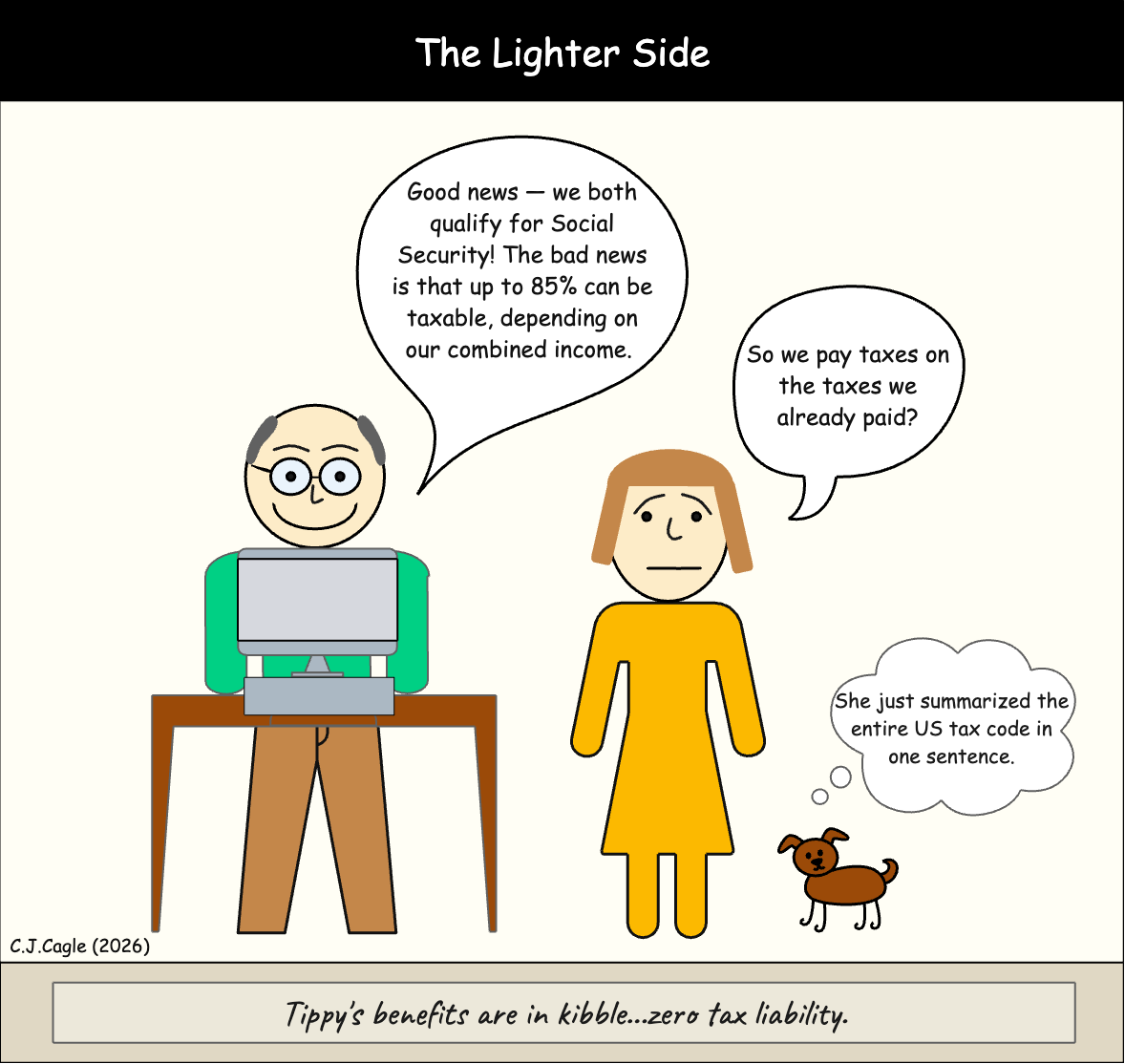
Dot’s confusion about Social Security taxation is understandable. Yes—in a very real sense—you spent forty years paying taxes into a system that will turn around and tax you again when you collect the benefits you paid for in the first place. It’s like paying for a buffet, eating your dinner, and then getting a bill in the mail for a “digestion tax.” Or you join a gym, pay your dues, and then get charged extra every time you actually show up to use it
If this also strikes you as a little strange, or perhaps even unfair, you’re not alone. If you’re a retiree now, you have to deal with it—Congress has moved on to other things.
The technical response to Dot is that she is partially right: You may have to pay taxes on your Social Security, but Social Security benefits aren’t literally the return of tax money you paid in and kept in an account in your name. In fact, the money you and I contributed when we were working went to pay benefits for someone older than us. And that’s still happening today—workers younger than us pay for some of our benefits (the rest comes from the Social Security Trust Funds).
Still, many retirees find it strange that we pay a tax to receive a benefit that is also taxed (not 100% of the time, but quite often, especially for higher-income retirees).
When Social Security benefits became taxable in 1983—a development the original program’s designers in 1935 would never have considered—Congress decided higher-income retirees should include a portion of their benefits in taxable income. Of course, the program was not originally designed for high-income retirees; it was for those barely getting by.
In 1983, it seemed fair to tax up to 50%. But Congress changed that in 1993, raising the limit to 85%, which seems less fair. Some would say that any tax on Social Security is unfair. They also set income thresholds but never adjusted them for inflation, a clever way to raise revenue without needing a vote to increase the tax. Since 1993, the thresholds have stayed the same, while everything else has changed. Those clever congressmen.
Here’s the short version of how this tax works: depending on your total income—which includes withdrawals from traditional retirement accounts, investment income, part-time earnings, and half of your Social Security benefit—a formula is used to determine if some portion of your Social Security benefit gets added to your taxable income. If your combined income is low enough, none of it is taxable. If it’s moderate, up to 50% is. If it’s above a threshold that Congress set in 1983 and apparently thinks is “good enough forever,” up to 85% is taxable.
The formula takes half your Social Security benefit and adds it back to your income to determine how much of your Social Security benefit gets taxed. The IRS calls this “provisional income.” Mathematicians might call it circular calculating (although I’m not sure there is such a thing…I have heard of “circular reasoning”). Your accountant just calls it “the worksheet.” He or she is no fun.
The only good news with this is that 15% of your benefit remains permanently untaxable. Congress left that to you as a courtesy, I guess—how generous of them.
The taxation part of this is a little unsettling. You paid income tax on your wages. Then you paid Social Security tax on those same wages — a tax that, unlike your 401(k) contribution, gave you no deduction. The government probably considers this “sound fiscal policy.” Your retired self might call it something else.
The part that tends to produce the strongest negative reactions — stronger even than the basic concept of taxing a benefit you already paid taxes to receive — is the interaction between Social Security and Required Minimum Distributions. RMDs are the mandatory annual withdrawals the IRS requires from traditional retirement accounts beginning at age 73. They count as ordinary income. Which means a larger RMD doesn’t just generate its own tax bill; it simultaneously pushes more of your Social Security benefit into taxable territory. Financial planners call this a “tax torpedo.”
And then there are state taxes, because federal taxation apparently wasn’t enough. About a dozen states also tax Social Security benefits to varying degrees, with rules that differ enough from state to state that summarizing them coherently would require more space than this article has and more patience than most readers possess. The takeaway is that where you retire can matter a lot for your tax bill, which, in my opinion, is either a useful planning insight or a depressing commentary on the complexity of the American tax system, depending on your disposition.
There are legitimate ways to reduce the damage: Roth conversions before you claim, careful withdrawal sequencing, and Qualified Charitable Distributions (QCDs) if you are charitably inclined and over 70½, but they all require advance planning, ideally with a qualified tax advisor, before the tax torpedo is already launched.
The truth is, Social Security was never just about getting back what you put in. It’s a program that helps people in need, and it’s changed a lot since it started in 1935. People working now pay into it, and retirees receive benefits. The rules on taxes and how the money is used keep getting more complicated. Knowing this doesn’t make a tax bill any easier to accept, but it might make it a little less surprising, and that’s about the best we can hope for right now.
Tippy has no taxable income, gets all his compensation in kibble, and has never once thought about provisional income thresholds. He seems completely at peace with his financial situation.
The correlation is hard to ignore, as always.