
This article is part of the Biblically-Informed Framework for Retirement Stewardship (BIFRS) series.
Our culture has been selling a version of retirement for decades. You have seen it in commercials: the silver-haired couple on the sailboat, the foursome finishing the back nine in the Florida sunshine, the grandparents laughing on the beach while the grandchildren run in the surf. It looks fun and peaceful, and in many respects it is. There’s nothing wrong with sailing, golf, or beaches (and certainly not grandkids). But if that image is the whole picture of retirement, something important is missing.
The Bible doesn’t use the word “retirement,” but it speaks extensively about life’s final season and what it requires of those who live in it. What it describes looks nothing like a permanent vacation. Ps. 92:14 says the righteous shall “still bear fruit in old age.” Titus 2 calls older men and women to actively teach and model godliness for the generations behind them. 2 Tim. 4:7 frames the end of life not as a retreat but as the finish line of a race. In the Parable of the Talents, the servant who buried what he was given was not commended for playing it safe; he was rebuked for his lack of stewardship.
The Ministry Principle is built on the conviction that retirement, rightly understood, is not the end of intentional, productive, purposeful living. It begins a new and uniquely fruitful season.
Boats, Seashells, Softball, and Retirement Stewardship recounts John Piper’s famous “seashells message,” delivered at the 2000 Passion Conference, in which Piper described a couple who retire to Florida to cruise on their boat, play softball, and collect seashells — and held that image up as a picture of wasted Christian life. Drawing on Piper’s book Don’t Waste Your Life and his concept of “the folly of retirement,” the article argues that the modern cultural vision of retirement as a decades-long leisure pursuit is both unbiblical and spiritually dangerous, because it centers on personal comfort rather than on the kingdom purposes God calls believers to pursue all their days. Alongside Piper, the article brings in Randy Alcorn and Jaime Munson to reinforce the same conviction that transitioning out of paid work is legitimate and even good, but only if those years are spent living for Jesus rather than for ease, while also making clear that enjoying the beach or a round of golf is not the problem; the problem is when personal pleasure becomes the organizing principle of one’s entire retirement.
What It Really Means to “Retire With Dignity” (Updated 2026) argues that the popular phrase, often used in a purely financial sense, misses the deeper point: financial dignity alone leaves people wondering if there’s more to retirement than the fun and relaxation it brings, since true dignity is rooted not in net worth but in being made in God’s image and restored to relationship with him through Christ. The article contrasts the world’s leisure-centered vision of retirement with a biblical one, offering a list of marks of dignified Christian living in retirement organized around relationship with God, relationship with others, and a right view of self, and closes by drawing on Ecclesiastes and C.S. Lewis to argue that earthly pursuits are good gifts that point beyond themselves, with genuine satisfaction found in God rather than in retirement itself.
What the Ministry Principle is
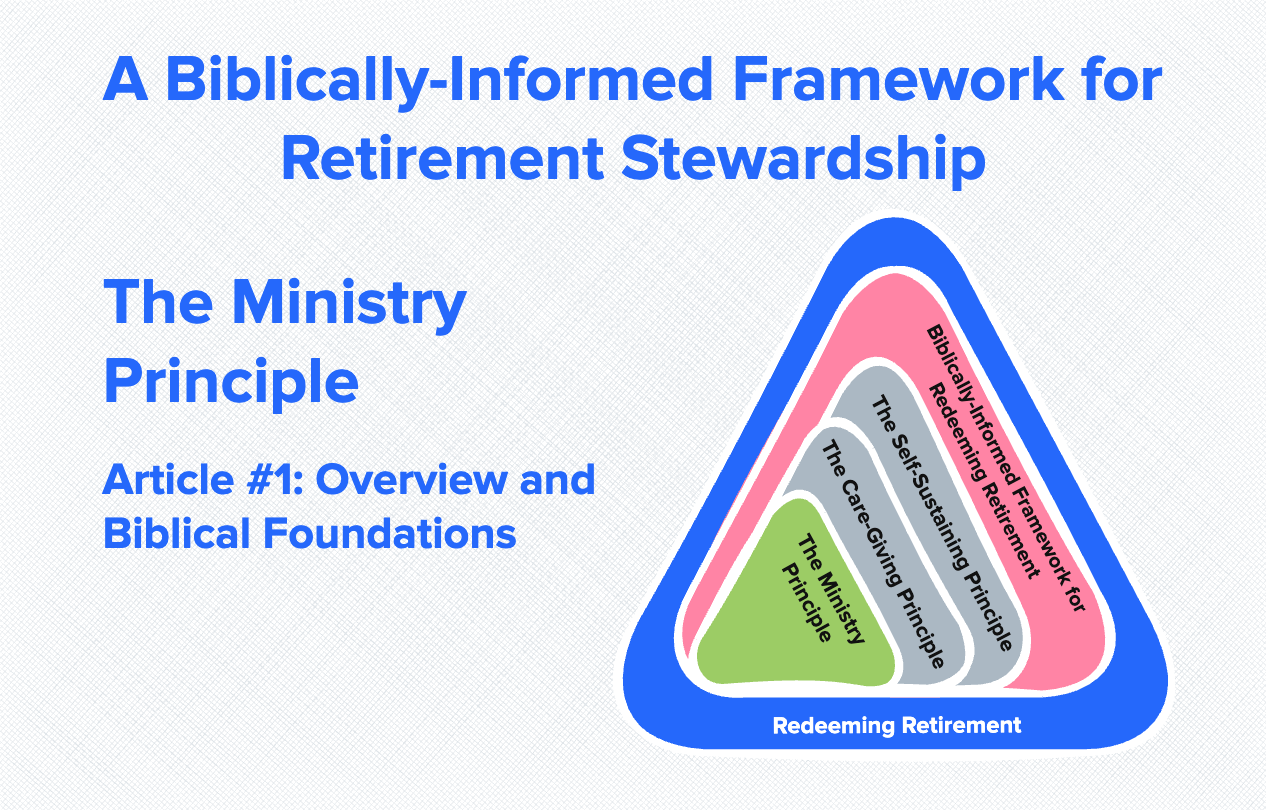
The Biblically-Informed Framework for Retirement Stewardship (BIFRS) is organized around three principles derived from a framework articulated by John Piper. The first, the Self-Sustaining Principle, addresses the obligation to plan and save wisely so that we do not become an unnecessary burden on others. The second, the Caregiving Principle, addresses our responsibilities to care for aging family members and to plan for our own potential care needs. The third—and, in many ways, the most distinctly Christian—is the Ministry Principle: deploying your time, talents, and resources for kingdom purposes in retirement.
Piper’s description of the ministry principle in action in the later years of life is worth recalling:
So finishing life to the glory of Christ means using whatever strength and eyesight and hearing and mobility and resources we have left to treasure Christ and in that joy to serve people—that is, to seek to bring them with us into the everlasting enjoyment of Christ. Serving people, and not ourselves, as the overflow of treasuring Christ makes Christ look great. — John Piper, Rethinking Retirement
Notice what Piper does not say. He does not say that older believers must take on crushing ministry burdens or that fun and relaxation are sinful. He says whatever we have left—whatever strength, mobility, or resources—should be oriented around treasuring Christ and serving people. That offers a broad set of possibilities, not a narrow set of obligations. It includes everything from teaching a Sunday school class to writing to trips with grandchildren; from volunteering at a food pantry or homeless shelter to discipling a younger couple; from giving to your church to giving generously to kingdom work around the world.
It does not include idleness that treats retirement as life’s final goal rather than its final season of service.
The High Calling of Retirement Stewardship builds a theological case that the Christian life is fundamentally a “called life,” and that this calling does not expire at retirement. Drawing on pastor and author Andy Crouch’s framework of three callings: to bear the image of God, to restore the image of God through gospel proclamation, and to make the most of today’s contingent gifts and opportunities, the article argues that retirement stewardship is simply the faithful expression of those callings in life’s final season. Because our time, talents, and resources are contingent (they may diminish as we age), we are not called to pull back from life but to stay engaged, serving others through family, church, neighborhood, and community, using whatever God has given us while we still have it. The article also draws on Hebrews 3 to warn against the spiritual drift that retirement can invite: the hardening, withdrawal, and self-centeredness that can quietly take root when the structure of working life is gone, and calls believers instead to daily mutual encouragement and perseverance in their God-given identity as image-bearers and restorers, right to the end.
The problem this principle addresses
A spiritual hazard waits on the other side of the retirement transition, and financial planning conversations rarely address it. It is the hazard of purposelessness. Decades of identity wrapped up in a career title or professional role can leave a newly retired person genuinely disoriented, unsure of who they are now that the job is gone, and uncertain what they are for.
Our culture offers a ready answer: now is your time. After all those years of giving to your employer, your family, and your obligations, retirement is your reward. You have earned the right to do whatever you want for as long as you can. The idol of leisure, dressed in respectable clothing, presents itself as a hard-won prize.
The gospel tells a different story. It tells us that we were not created for ourselves in the first place, and retirement does not change the terms of our existence before God. We are image-bearers made to reflect God’s character in the world through our work, relationships, and worship. That fundamental calling does not expire when the last paycheck clears. In retirement, the context and freedom change—more time, fewer obligations, and often more resources than in the years of raising a family. Those are not invitations to turn inward. They are amplified opportunities to turn outward.
A gospel-centered vision for the final season
Everything in the Ministry Principle flows from a single conviction: the gospel changes everything, including how we understand and live out retirement.
To say the gospel changes everything is not an abstract concept. It means Christ’s finished work does not merely alter our eternal destination; it reshapes our loves, priorities, and present sense of purpose. Tim Keller, commenting on 1 Corinthians 15, observed that Paul felt it necessary to trace the gospel’s implications into every corner of the Corinthians’ lives, including their attitudes, relationships, and cultural engagement. The same is true for us. A retirement genuinely shaped by the gospel will look different from one that is not; not because gospel-shaped retirees are busier or more religious, but because their hearts have been reoriented toward God and others rather than themselves.
What does that reorientation produce in practice? The gospel changes what we love and, therefore, what we treasure. Jesus told us that whatever we most treasure will captivate our hearts (Matthew 6:21). When the gospel has done its work, the treasures that organize a person’s retirement are not primarily the accumulation of experiences, comfort, or security—they are the glory of Christ and the good of others. From that reorientation, everything else follows: how we use our time, how we serve, how we give, and how we think about the legacy we are leaving behind.
First Corinthians 15:58, one of the most important verses for the Ministry Principle, frames this call with both urgency and hope: “Therefore, my beloved brothers, be steadfast, immovable, always abounding in the work of the Lord, knowing that in the Lord your labor is not in vain.” Paul writes those words in the immediate context of the resurrection — because Christ has been raised, our work in his name will not evaporate into nothing. That hope makes purposeful retirement not merely admirable but joyful. We are not grinding away at obligations. We are investing in something that will last.
A Gospel-Centered Retirement makes the case that the gospel — defined through Tim Keller’s formulation as the finished work of Christ that rescues sinners, restores creation, and unleashes kingdom power into every domain of life — is not merely the entry point to salvation but the transforming force that reshapes how a believer approaches retirement itself. Drawing on D.A. Carson’s observation that Paul found it necessary to work out the gospel’s implications across every corner of the Corinthians’ lives, and on Piper’s vision of finishing life by using whatever remains to treasure Christ and serve others, the article identifies three specific ways the gospel changes retirement: it changes our hearts (what we love and treasure, redirecting us from leisure and self-comfort toward God and others), our priorities (how we use our time, talents, and resources, orienting us toward the local church and gospel ministry rather than toward self-directed freedom), and our purpose and mission (making clear that for believers, the calling in retirement is already defined — to invest in others and persevere in godly zeal toward a faithful finish). Practically, the article argues this requires actual financial and spiritual planning so that one is freed, rather than forced, to pursue ministry; and it closes with the image of running the race to the end not by standing still but by pressing forward, with “Well done, good and faithful servant” as the only finish line that ultimately matters.
How the Ministry Principle relates to the other two principles
Reading the Ministry Principle in isolation would be a mistake, as if the call to kingdom service exists independently of financial provision and physical care. In the BIFRS framework, the three principles aren’t competing priorities; they are integrated, each supporting the others. That’s one of the main things I loved about how John Piper framed this.
The Self-Sustaining Principle matters precisely because financial instability undermines the freedom to serve. Someone who hasn’t planned well for retirement income, tax efficiency, and sustainable withdrawals can find financial anxiety crowds out bandwidth for ministry. The Piper quote on this is exactly right:
Put a governor on your life. Make as much as you can, give as much as you can, and save what you need to in order to be a responsible non-borrower. Then do retirement with some minimalistic plan that frees you up for gospel ministry till the day you drop. – John Piper: “Should I Invest for Retirement?
Sound financial stewardship isn’t separate from the Ministry Principle; it enables it.
The Caregiving Principle connects even more directly. Caring for an aging parent, a spouse with declining health, or a child with special needs is one of its most concrete expressions of the Ministry Principle. First Timothy 5:8 plainly says that those who do not provide for their own household have denied the faith. The caregiving responsibilities many retirees carry do not obstruct kingdom living. They shape kingdom living for a particular season of life.
The Ministry Principle, then, is not a third layer added on top of financial and caregiving concerns. It is the animating vision that gives the other two their purpose and their meaning. We plan financially so we can serve freely. We care for family because it is itself an act of faith and love. Through it all, we bear witness to a Savior who came not to be served but to serve.
Some Thoughts on Saving Retirement (Updated 2026) was written in 2019 as a response to a Christianity Today cover story and updated with 2025-2026 data. The article works through five themes from author Jeff Haanen’s piece on why the cultural vision of retirement as an endless vacation has failed, and what a more biblically faithful alternative looks like. It traces the growing disenchantment many retirees feel with the leisure-only model (reinforced by current Transamerica data showing a notable shift toward purposeful, work-inclusive retirement), confronts the sobering financial reality that most Americans remain underprepared (with Northwestern Mutual’s 2025 figures showing a $1.26 million target most won’t reach and 51% fearing they’ll outlive their savings), addresses the loneliness epidemic that hits retirees who lose the relational bonds of work, and argues that purposeful living, rooted not in self-directed “purpose” but in the Christian’s calling to love God and serve others, is what gives the retirement years their meaning. The article closes with the CT piece’s own conclusion: retirement needs not a new story but a very old one, the gospel story of creation, fall, redemption, and restoration, lived out faithfully to the end.
Retirement in the Age of Expressive Individualism uses Herman Bavinck’s theology of humanity as a launching pad to diagnose a pervasive cultural ideology that Carl Trueman calls “expressive individualism,” the belief that the authentic self is defined by inner feelings and that happiness comes from expressing that inner self outward, and then systematically dismantles the three retirement myths it produces: that your inner self will lead you to truth, that it will lead you to fulfillment, and that retirement is fundamentally your time to focus on yourself. Against each myth the article sets a biblical counter-witness: Scripture as the external, unchanging source of truth rather than the fluid inner life (Proverbs 14:12, John 17:17); Christ as the source of fulfillment rather than self-actualization (Matthew 16:24); and retirement as a fresh season of stewardship and service rather than a long-deserved reward for self-indulgence (Philippians 2:4) — grounding the whole argument in the Reformed anthropological conviction that our identity is God-given and God-ordered, not self-invented, and that rightly ordered loves — toward God and neighbor rather than toward the self — are the only path to the joy and flourishing that expressive individualism promises but cannot deliver.
What this series will cover
The following anchor articles and associated blog posts will explore the Ministry Principle more in depth, each addressing a distinct dimension of living purposefully for God’s kingdom in retirement. Together, they provide the theological grounding and practical guidance needed to move from intention to action.
Calling and vocation in retirement: The most urgent question many newly retired people face is one they may not have expected: Who am I now? Career titles and professional roles can quietly become identity, and when the job ends, the person can feel strangely undefined. This article addresses that disorientation directly, grounding the believer’s identity and purpose in their primary calling—their relationship with God through Christ—rather than in the secondary calling of vocation or career. It offers a practical discernment framework to identify how God has gifted you, what opportunities surround you, and what constraints define your season, with the goal of helping you find a faithful, fruitful expression of calling in retirement. Calling in this season isn’t invented from scratch; it grows from decades of accumulated wisdom, relationships, and experience that God intends to use.
Serving through church and community: Retirement brings something most working years do not: time. This article explores how you can invest that gift of time in service through the local church, the community, and the marketplace of ordinary relationships. It begins with the conviction that the local church is the primary context for Christian service, not merely a place to attend on Sunday mornings but a community to pour yourself into through teaching, hospitality, pastoral support, administration, and prayer. It also takes the Titus 2 model of intergenerational ministry seriously, calling older believers to teach and model godliness for the generations that follow. It also addresses the rhythm question every retiree who wants to serve must eventually face: how do you structure your time so service is sustainable, joyful, and life-giving rather than draining and obligatory?
The stewardship of generosity: For many people, retirement is the season of life when they can give most generously. The mortgage is paid, the children are launched (hopefully), and the income that once supported a household of four or five or more now supports two. This article addresses stewarding that capacity, not as a financial obligation to minimize but as a spiritual opportunity to embrace. It covers the biblical theology of generosity, a giving strategy, and tax-efficient tools available to retirees, including Qualified Charitable Distributions (QCDs) from IRA accounts, Donor Advised Funds (DAFs), and giving appreciated securities. The goal is to help you give wisely and generously, in a way that reflects the transformed priorities the gospel produces.
Discipleship, legacy, and finishing well: The final article in this series is also, in a real sense, the final anchor article of the entire BIFRS framework. It addresses the questions that become more urgent as the years accumulate: What am I leaving behind? Who will carry the faith forward after me? And how do I run the last miles of this race with the same faithfulness I brought to the first ones? Spiritual legacy is broader than estate planning. It includes the faith you have modeled, the wisdom you have shared, the stories you have told, and the younger people whose lives you have poured yourself into. It also includes the hope that makes finishing well possible: the resurrection of Jesus Christ and the certain promise of a new creation in which every act of faithful service will be remembered and rewarded. Paul’s testimony in 2 Timothy 4:7 is not a boast; it’s an invitation: “I have fought the good fight, I have finished the race, I have kept the faith.”That is the finish line we are all running toward.
Before we begin
In John Bunyan’s Pilgrim’s Progress, Christian, already burdened and far from home, catches sight of the Celestial City on the horizon. He does not stop there. But seeing it changes how he walks the rest of the road. The Ministry Principle is something like that. It is not a strategy to execute or a program to complete. It is a vision of the finish line, a glimpse of what it looks like to spend the final years of life in a way that will one day be worth having lived.
The articles that follow in this series (and the previously published ones referenced in them) are practical and specific. They address the topics above with the kind of detail that helps you move from good intentions to faithful action. At their root, they all apply a single conviction: retirement years are a gift from God, entrusted to us as stewards, and the most faithful use of that gift is to spend it for him.