
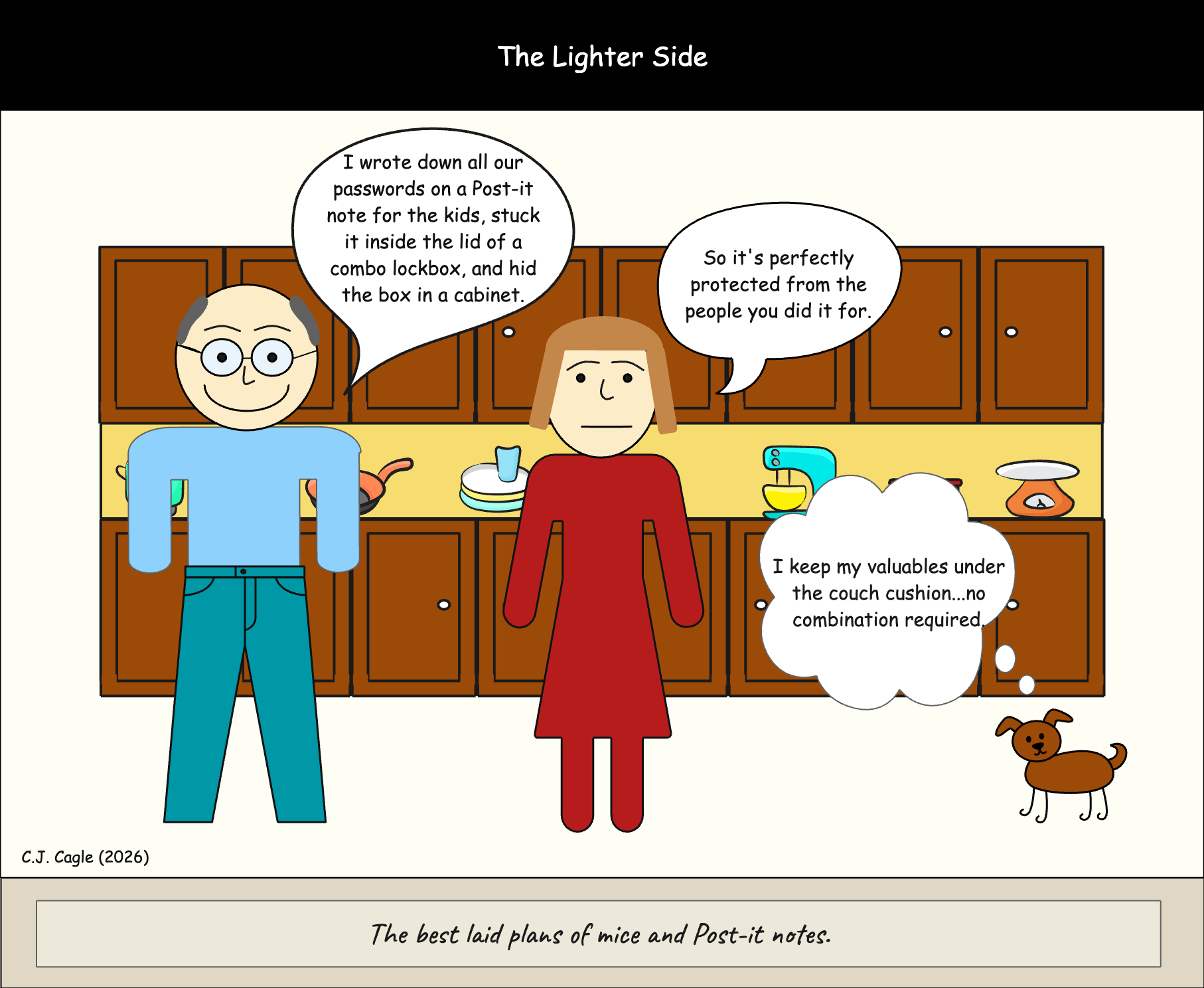
Earl has a plan (he always does), and he mostly works them through to some stage of completion. He’s reallocated his retirement portfolio, run his Monte Carlo simulations (about 20 times and counting), updated his beneficiary designations, and recently had his and Dot’s wills and other documents reviewed by a professional who charged by the hour and had a very nice office, but with a half-dead plant in the corner that nobody had watered since the previous presidential administration. Earl is, by most reasonable measures, a thoughtful, rational, and well-prepared guy. One of his favorite verses is “The simple believes everything, but the prudent gives thought to his steps” (Prov. 14:15). Earl doesn’t just think about his steps; he tracks them on a spreadsheet.
But his online account user IDs and passwords are on a Post-it note that’s stuck to the inside of the top of a small combination lockbox hidden somewhere in a cabinet in the house. He told Dot he did that. He did not tell her which cabinet. He also didn’t tell her the combination to the little “password lockbox.” He didn’t write the combination down anywhere, either. Or perhaps it’s on the Post-it-Note. Let’s hope he remembers it. The prudent man has given thought to his steps—the combination is not among his thoughts at present.
This is, it turns out, the state of estate planning in a surprisingly large percentage of otherwise well-intentioned, well-organized, and well-managed households. The important documents exist: the will, the trust, the powers of attorney, and the healthcare directive. They are in a folder, a safe, a filing cabinet, or—heaven forbid—possibly a box in the garage. The attorney was helpful, so the paperwork is technically complete. But somewhere between the attorney’s office and the actual execution of the plan, a Post-it note and a combination lockbox entered the picture, “hidden” in a cabinet that has not been identified to anyone else who might actually (and urgently) need to find it someday.
Love them or hate them, passwords were a genuinely useful invention. They protect your digital assets, accounts, financial life, and identity. But here’s what a password also does, which the inventors perhaps didn’t fully consider: it keeps out everyone who doesn’t know it; which, as it turns out, includes nearly everyone who would need to find the paper you wrote it on, open the cabinet it’s hidden in, figure out the combination to the box the paper is sealed inside, and finally access the very accounts the whole arrangement was meant to protect. A password is, in this sense, solving and creating the same problem simultaneously. Earl finds this puzzling. Dot finds it just another day in Earl-retirement-land.
The deeper issue—and as regular readers of The Lighter Side have come to expect, there’s always a deeper issue underneath the funny things—is that estate planning has two entirely separate problems that most people solve at entirely different times and in entirely different ways. The first problem is the legal one: the documents, the designations, the trustees, the executors, the distribution instructions. Most reasonably diligent people eventually address this one, usually after a health scare or a particularly sobering conversation with a friend whose family went through probate without a will and is still not speaking to each other. The second problem is the practical one: making sure the people who need to find things can actually find them, understand them, and access them without a full-scale archaeological expedition through the kitchen cabinets or the entire house. Or was it the den cabinets? The kitchen cabinets? Or the garage? Or, heaven forbid, buried in the backyard since the box was advertised as “waterproof.”
And if the box is actually found, can it be opened without a hammer or a stick of dynamite? Most people never fully solve the second problem.
What actually needs to exist—alongside the will, the trust, and the powers of attorney—is something called a letter of information and instructions <= Click the link for a sample template. It’s not a legal document, just a plain-language letter that tells your family where everything is, how everything works, who to call, what accounts exist, where the passwords are, and—critically—which cabinet. It doesn’t require an attorney. It doesn’t need to be notarized. It doesn’t need seventeen tabs. It just needs to be written, updated occasionally, and located somewhere more findable than inside a combination lockbox inside an unspecified cabinet somewhere in a house with a lot of cabinets. A fireproof box with a label on it is a reasonable start. Telling at least one other person where the box is specifically would be considerably better. Writing the combination somewhere other than on a Post-it note inside the box would be ideal.
For passwords in particular, setting up a digital password vault (products like 1Password or Bitwarden are good candidates) is an excellent modern digital solution that eliminates the Post-it note, the box, and the cabinet entirely and makes everything accessible to the right people at the right time. One important note: do not write the master password for your password vault on a Post-it note and hide it somewhere in the house. Earl has been meaning to set this up since last spring. The spring before that, actually. His progress is slow on certain things.
Earl actually knows all of this. The Post-it note was always a temporary measure—a placeholder, a transitional solution, a bridge to the more permanent (and complex) system of password vaults, passcodes, and authentication apps he fully intends to implement. Yet the box is still in the cabinet; the cabinet remains unidentified; the combination to the box has been forgotten; and the note inside the box includes passwords that have been changed but not updated.
Tippy knows which cabinet. He has always known which cabinet because he pays close attention to all of the cabinets in the house, several of which contain things he cares about deeply. He also knows that Earl probably won’t remember the combination, that it’s at least possible that he wrote it down on the Post-it-Note that’s locked in the box, that Dot doesn’t know which cabinet it’s in, and that the kids may eventually need to find it. He hopes Earl realizes he’s forgotten the combination if he remembers to get the box to change the password on the post-it note after he changed it online. But that could start this whole thing all over again.
He is not telling because nobody has asked him directly, and also because he’s a dog, and this is not how any of this works. The kids will figure it out. Probably. Maybe. Hopefully. Or maybe, just maybe, Earl will remember.