
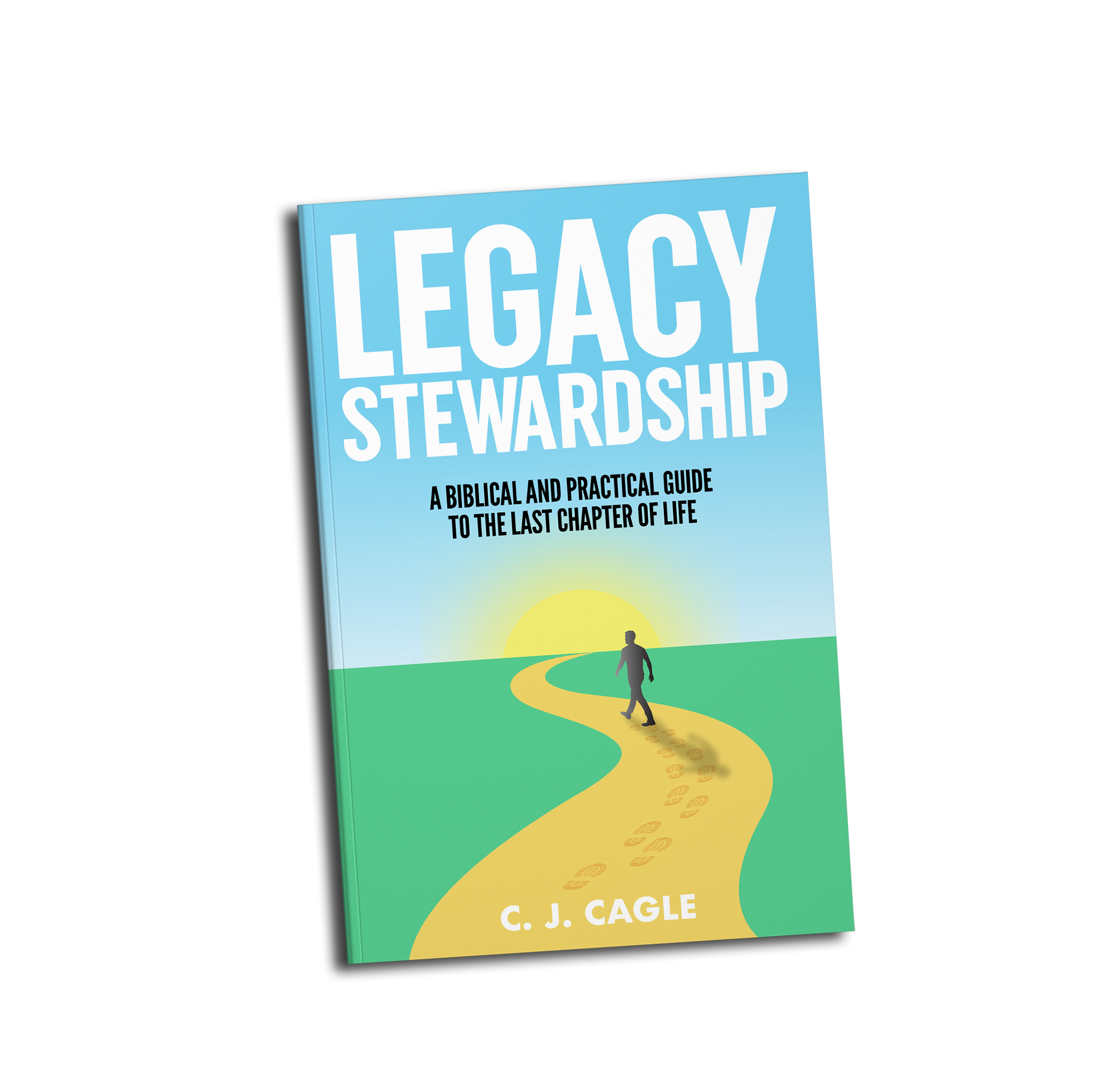
After almost ten years of writing about retirement stewardship—this blog and four other books—I’ve written a book about living and planning for what comes next.
If you’ve followed this blog for any length of time, you know that I write about retirement from a particular angle. It’s not just about the numbers—though the numbers matter—but about the whole God-created-and-redeemed person from a distinctly Christian perspective. I cover the financial, the spiritual, the relational, and the eternal.
Retirement stewardship, as I’ve come to understand it, isn’t just about saving, investing, and making your money last. Those things are important, but it’s more fundamentally about making your life count for the Kingdom of God—stewarding everything: your time, talents, treasure, and testimony for your good, the good of others, and the glory of God.
The eternal dimension
You may have noticed that when I listed everything I “cover,” I included the eternal. What I mean is that by the time we reach our 60s, 70s, and 80s, we need to think more seriously about heaven and eternity. That’s not being morbid, it’s reality, and for the Christian, it’s our glorious hope: “…in hope of eternal life, which God, who never lies, promised before the ages began” (Titus 1:2).
The truth is, most of us spend the first half of our lives barely thinking about eternity, and the second half slowly realizing we probably should have thought about it sooner. Moses prayed, “Teach us to number our days, that we may gain a heart of wisdom” (Ps. 90:12, ESV), not to counsel us to despair but as a path to clarity. There is something clarifying about the later decades that no amount of financial planning can replicate: the growing awareness that this world, for all its goodness and wonder, is not our final home.
Paul captured that awareness perfectly: “For to me, to live is Christ and to die is gain” (Phil. 1:21, ESV). That posture doesn’t diminish the present; it redeems it. It loosens our grip on things that were always meant to be held loosely, shifts our attention toward what actually lasts, and frees us from spending energy on things that don’t ultimately matter. Paradoxically, the Christian who thinks most clearly about heaven is often the most fully alive in the present.
How this book came to be
These convictions are what eventually led me to write what will probably be my final book: Legacy Stewardship. No, I’m not going anywhere—at least not yet—I just don’t know what else I would write about.
For years, I’ve written extensively about the financial side of retirement: the accumulation and decumulation of assets, as well as budgeting, saving, investing, withdrawing, and planning. I’ve also written about living in retirement with a focus on stewardship of time, talents, and testimony. But I haven’t always connected the idea that, rightly understood, retirement isn’t a destination but a doorway, and that how we live it is our final, most visible act of stewardship before we step through it.
I know, none of us likes to think about that. But what if we did? We’d live better today, plan better for the inevitable, and face the end with joyful anticipation rather than dread, knowing that, as Paul said, “we would rather be away from the body and at home with the Lord” (2 Cor. 5:8), and that those who live by faith “desire a better country, that is, a heavenly one. Therefore God is not ashamed to be called their God, for he has prepared for them a city” (Heb. 11:16).
I’ve written extensively on this blog about what to do with what you’ve accumulated beyond just making it last. But I’ve only occasionally addressed other questions: How do I think about inheritance in a way that’s both generous and wise? How does the gospel shape the way I hold my possessions in these final decades? What kind of person am I becoming — and what kind of legacy am I actually leaving — as I grow older?
Those questions belong to a different category than withdrawal strategies and Medicare planning. They define the territory of legacy, and I decided they deserve their own book. Legacy Stewardship is both a logical sequel to Reimagine Retirement and Redeeming Retirement and a book that stands fully on its own.
Legacy is theological before it’s practical
The word stewardship is familiar to most believers. We apply it to our finances, time, and spiritual gifts. But rarely do we apply it to the final season of life itself, to stewarding our remaining years, relationships, estate, and ultimately our witness.
Scripture has much to say about finishing well. From the patriarchs of Genesis to the apostolic letters of the New Testament, the Bible consistently frames the end of life not as a retreat but as a culmination — a final, meaningful act of faithfulness. The last chapter is not a footnote. It is part of the story.
What this book is about
Legacy Stewardship is organized around a simple but important distinction: the difference between the legacy you leave and the legacy you live.
Most books about legacy focus on the leaving: the estate plan, the will, the inheritance, and the distribution of assets. That content is thoroughly covered in Part Three. But the book’s deeper argument is that by the time those documents come into play, your legacy will already be largely written in the memories, habits, and convictions of those who watched you live.
The book is divided into three parts:
Part One: The Theology of Legacy lays the biblical and theological foundation. What does Scripture say about legacy, inheritance, and stewardship? How does the gospel reshape our understanding of what we own and what we leave behind? These chapters establish the why before addressing the what.
Part Two: Living Your Legacy addresses the active, relational, and spiritual dimensions of legacy in the later years. How do you remain fruitful when physical capacity is diminishing? What does it mean to transmit wisdom and faith to the next generation? How does a well-lived later life become its own form of witness? Long-term care planning is here too, because deciding in advance how you want to be cared for — and relieving your family of impossible decisions made in crisis — is one of the most loving things you can do. It is stewardship. It is love.
Part Three: Leaving Your Legacy is the practical section—estate planning essentials, wills and trusts, inheritance decisions, beneficiary designations, Social Security survivor benefits, the ethics of how much to leave children, charitable giving strategies, and more. Comprehensive and written for ordinary readers, not legal professionals.
The book closes with an Epilogue — a meditation on the question I hope every reader carries with them: What will they say when you’re gone?
Who this book is for
Legacy Stewardship is for Christians who are on the “back nine” of life who are serious about finishing well, living and leaving in ways that bless others and honor the Lord. It is for the adult child trying to help an aging parent think through these things. It is for the pastor, financial planner, or eldercare professional looking for a resource grounded in biblical faith.
You don’t have to be wealthy to benefit from it. Some of the most important legacy questions have nothing to do with the size of your estate. You do need to be willing to think honestly about mortality, about what you own and why, and about the kind of person you’re becoming in these final decades.
If you’ve ever wondered:
- Am I handling my finances in a way that reflects what I actually believe about God?
- How much should I leave my children — and is that even the right question?
- What’s the difference between a will and a trust, and do I need one?
- How do I give generously without jeopardizing my own financial security?
- What kind of legacy am I actually leaving — and is it the one I intend?
Then this book was written for you.
A word about the approach
Consistent with everything I write, I approach Legacy Stewardship from a Reformed theological perspective, meaning I take the entire Bible —both Old and New Testaments —seriously, reading it as one unified story of creation, fall, redemption, and restoration—by, in, through, and for the glory of Jesus Christ.
He is the image of the invisible God, the firstborn of all creation. For by him all things were created, in heaven and on earth, visible and invisible, whether thrones or dominions or rulers or authorities—all things were created through him and for him. And he is before all things, and in him all things hold together. And he is the head of the body, the church. He is the beginning, the firstborn from the dead, that in everything he might be preeminent. For in him all the fullness of God was pleased to dwell, and through him to reconcile to himself all things, whether on earth or in heaven, making peace by the blood of his cross (Col. 1:15-20, ESV).
This framework shapes everything in the book, from how I interpret the inheritance passages in Proverbs to how I think about generosity, estate planning, and the eternal horizon that gives it all its meaning.
But the book is also intensely practical. After I retired from more than thirty years in IT financial services, I’ve been personally navigating the questions of retirement stewardship for nearly a decade, not just writing about them, but living them.
A word about what this book isn’t: I am not an attorney, and nothing here constitutes legal advice. I am not a licensed financial advisor, and nothing here should be taken as personalized financial counsel. What the book will give you is a biblical framework, conceptual clarity, and practical vocabulary for better conversations with the attorneys, financial advisors, and family members involved in your legacy planning.
Where to buy it
You can purchase the book in either the Kindle or paperback version on Amazon:
If you do buy it and find it helpful, I’d be genuinely grateful if you’d leave a review on Amazon. For independently published books, reader reviews make an enormous difference in helping others find them. And if you’d like to go deeper on any topic covered in the book, the RetirementStewardship.com blog has hundreds of articles that complement and expand on the material, many of which were the original source material for the chapters themselves.
Thank you for reading. And may God grant us all the grace to finish well.