
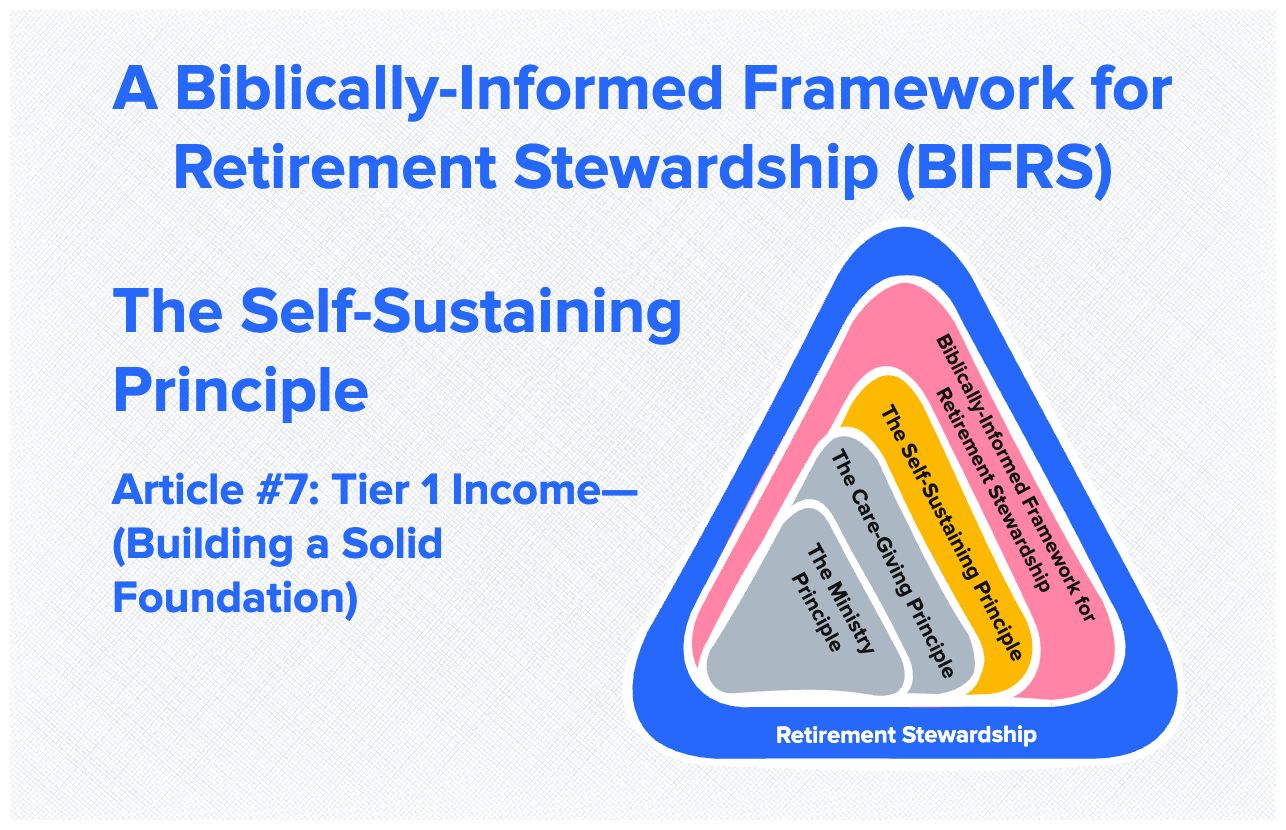
This article is part of the Biblically-Informed Framework for Retirement Stewardship (BIFRS) series.
In the previous article in this series, we explored retirement income and its three-tiered structure. We established that income is arguably the most critical component of the Sustainability Principle, which is the idea that your retirement will be financially sustainable when your reliable income sources can consistently cover your ongoing expenses and obligations throughout your lifetime, adjusted for inflation and accounting for major risks.
Now we dive deeper into the first and most important tier: Tier 1 Guaranteed Income. This is your sustainability foundation, the income floor that you cannot outlive, regardless of what happens in the markets or economy. This approach is characteristic of what is sometimes called a “safety-first” retirement income strategy.
As a reminder, retirement income consists of three tiers:
- Tier 1: Guaranteed Income (Social Security, pensions, annuities)
- Tier 2: Reliable Income (bonds, dividends, rental income)
- Tier 3: Variable Income (portfolio withdrawals, RMDs, part-time work)
In retirement, achieving sustainability isn’t primarily about growing your wealth; it’s about converting your current wealth into reliable income and then combining it with other income sources, such as Social Security, to create a sustainable income-generating system.
That’s the fundamental shift from accumulation to distribution, and it’s why understanding each income component—especially Tier 1—is critical to sustainable retirement.
Why Tier 1 Income Is Your Sustainability Foundation
This is the most important type of retirement income because it’s your income “floor”—income you can’t outlive, regardless of what happens in the markets or economy. From the Sustainability Principle perspective, Tier 1 income is the bedrock upon which all retirement sustainability is built.
Tier 1 income provides the foundation of financial security and sustainability in retirement because it’s not subject to market volatility, sequence-of-returns risk, or premature depletion. Once established, this income stream continues for life, creating a foundation you can build upon with confidence.
The larger your Tier 1 income relative to your expenses, the more sustainable your retirement becomes. This is the core insight of the Sustainability Principle: guaranteed income that covers your essential expenses creates true financial sustainability that market fluctuations cannot undermine.
Tier 1 Components
Social Security: The Cornerstone of Sustainable Retirement
Social Security forms the foundation of most Americans’ income structure, including that of individuals with substantial investment portfolios. Understanding how it works, when to claim it, and how it integrates with your other income sources is essential to building sustainable retirement and faithful stewardship.
Even for wealthier retirees with multimillion-dollar portfolios, Social Security serves as the bedrock of guaranteed income within a sustainable retirement framework. It offers four irreplaceable characteristics that no investment portfolio and virtually no other financial product can fully replicate:
It’s not “guaranteed” but more of a “promise” under current federal statutes. You are given some assurance, but not a lifetime guarantee, that your Social Security check will keep coming. Social Security is in some trouble, and it remains to be seen what the Congress does. But it is—and has been for decades—excellent protection against longevity risk and contributes in a significant way to sustainable lifetime income.
It’s inflation-adjusted annually. Through Cost-of-Living Adjustments (COLAs), your benefit maintains its purchasing power even as inflation erodes the value of fixed pension payments or bond interest. This inflation protection is essential for multi-decade sustainability.
It’s unaffected by market risk. While your investment portfolio fluctuates with market conditions, your Social Security benefit remains stable regardless of whether stocks are soaring or crashing. This stability is critical to retirement sustainability during market downturns.
It provides survivor protection. When one spouse dies, the surviving spouse continues to receive the higher of the two benefits, providing crucial income sustainability during an already difficult transition.
These features make Social Security the most critical building block for sustainable retirement—not necessarily the largest income source, but the most reliable and enduring foundation.
Understanding the Fundamentals
Before you can make informed claiming decisions that support long-term sustainability, you need to understand how the system works. Many retirees operate on outdated assumptions, misconceptions, or incomplete information, which can cost them tens of thousands of dollars over their lifetimes and undermine their retirement sustainability.
Social Security Mythology—Part One (Updated 2025) addresses the most common misconceptions about Social Security—myths about how benefits are calculated, what happens if you work while collecting, whether Congress can take away your benefits, and how the program is actually funded. Understanding the truth behind these myths helps you make sustainability-focused decisions based on facts rather than fear or misinformation.
Social Security Mythology (and Misunderstandings)—Part Two (New) continues debunking widespread myths, focusing on claiming strategies, spousal benefits, and taxation. This article clarifies the difference between what some people commonly believe and what the program and rules actually state, helping you avoid costly mistakes that could compromise your retirement sustainability.
What Your Social Security Benefits Are Really Worth (New) helps you understand the actual financial value of your Social Security benefit by comparing it to what you’d need to save and invest to generate equivalent guaranteed, inflation-adjusted lifetime income. Most people dramatically underestimate this value—a $30,000 annual benefit might be worth $750,000 or more in present value terms. This perspective helps you appreciate Social Security as the sustainability asset it truly is.
Is Social Security Going Broke? (New) addresses the anxiety many pre-retirees feel about the program’s long-term solvency. While Social Security faces funding challenges, understanding what those challenges mean—rather than the catastrophic scenarios often portrayed in the media—helps you plan realistically for sustainable retirement rather than make fear-based decisions. The article explains the mechanics of the trust fund, likely legislative fixes, and why benefits are unlikely to disappear.
Understanding and Navigating Social Security Survivor Benefits (Updated 2025) provides crucial information for widows, widowers, and married couples planning for the possibility that one spouse will die first. Survivor benefits follow complex rules that interact with your own retirement benefit, and making the wrong choice can permanently reduce your lifetime income and undermine the surviving spouse’s retirement sustainability. This article walks through the decision points and strategies for maximizing survivor benefits.
Your Claiming Decision: The Foundation of Sustainability
One of the most consequential financial decisions you’ll make for retirement sustainability is when to claim Social Security benefits. Unlike investment decisions that you can adjust over time, your claiming age creates permanent effects that last for decades and fundamentally shapes your retirement sustainability.
You can claim Social Security benefits at any point between age 62 and 70, but three key ages matter most:
Age 62 (Early Claiming): You can start receiving benefits as early as 62, but your monthly benefit will be permanently reduced by 25-30% compared to waiting until Full Retirement Age. This reduction lasts for life and affects survivor benefits as well—potentially undermining both your own and your spouse’s long-term sustainability.
Full Retirement Age (66-67): This is the age when you receive your full, unreduced benefit. It’s 66 for those born before 1955, gradually increasing to 67 for those born in 1960 or later. Claiming at this age means no reduction and no delayed retirement credits.
Age 70 (Maximum Benefits): For each year you delay claiming beyond Full Retirement Age, your benefit increases by approximately 8% per year until age 70. This guaranteed 8% annual return is among the best risk-free returns available and significantly strengthens your retirement sustainability foundation. There’s no benefit to delaying past 70.
This decision warrants careful thought, prayer, and, often, professional guidance. It’s not something to make on a whim based on what your neighbor did or what an article recommended as a one-size-fits-all solution. Your claiming decision will either strengthen or weaken your retirement sustainability for the rest of your life.
Why You Should Consider Delaying Collecting Social Security Benefits (Updated 2025) presents a comprehensive case for delayed claiming from a sustainability perspective, walking through the mathematics of the 8% annual increase, the insurance value of higher lifetime benefits, and the often-overlooked survivor benefit implications. The article also addresses common objections and helps you think through whether delaying makes sense for your specific situation and sustainability goals.
Social Security Claiming Strategies—Which Camp Are You In? (Updated 2025) recognizes that retirees fall into different “camps” based on their circumstances, health, resources, and priorities. Rather than prescribing a single strategy, this article helps you identify which camp you’re in and what claiming approach typically works best for people in similar situations seeking sustainable retirement. It provides a framework for making decisions that align with your circumstances rather than following generic advice.
How Your Claiming Decision Affects Retirement Sustainability
Social Security isn’t an isolated decision—it’s the foundation upon which your entire sustainable retirement income system is built. Your Social Security claiming strategy affects sustainability in multiple ways:
Current Wealth: Whether you tap your portfolio heavily in early retirement (if delaying Social Security) or preserve it longer (if claiming early). Delaying Social Security and drawing down portfolio assets early can actually enhance long-term sustainability by building a stronger guaranteed income floor.
Income Foundation: The guaranteed baseline that determines how much variable income you need from other sources and how sustainable your overall retirement income will be.
Tax Efficiency: How much of your Social Security becomes taxable based on your other income, and how your claiming decision affects lifetime tax liability and therefore your net sustainable income.
Essential Expenses Coverage: Whether your guaranteed Tier 1 income covers essential expenses (high sustainability) or whether you need to rely on portfolio withdrawals for basic needs (lower sustainability).
Generosity Capacity: How much margin you have for generous giving, both now and in later retirement, when other income sources may decline. Sustainable generosity requires sustainable income.
Healthcare Costs: How IRMAA surcharges might affect your Medicare premiums based on the income from your claiming decision, and whether rising healthcare costs will threaten your sustainability.
Sequence Risk Protection: How protected you are against poor early market returns if you don’t need to withdraw heavily from investments. A strong Social Security foundation dramatically reduces sequence risk and enhances sustainability.
Longevity Risk Management: Whether you’re building a strong enough guaranteed income foundation to support you if you live to 95 or 100. This is perhaps the most important sustainability consideration.
Understanding Social Security in this holistic way—as the foundational element of sustainable retirement rather than as an isolated benefit to claim at your convenience—is essential to responsible retirement stewardship.
The articles referenced in the previous section provide the necessary detail to make informed decisions. But the Sustainability Principle framework matters too: see Social Security as the cornerstone of Tier 1 guaranteed income, make claiming decisions that strengthen your sustainability foundation rather than weaken it, and recognize that this single choice will affect your financial security and stewardship capacity for the rest of your life.
Pensions: Strengthening Your Sustainability Floor
If you’re fortunate enough to have a traditional defined-benefit pension, this provides additional guaranteed lifetime income that strengthens your sustainability foundation. Some pensions include inflation adjustments (which significantly enhance long-term sustainability); many don’t.
No matter what your pension’s features are, you have some important decisions to make that will affect your retirement sustainability.
What to Do with Your Pension at Retirement (New) discusses the critical choice retirees face between receiving their pension as a guaranteed monthly income for life or as a lump sum to manage themselves. While lump-sum payments offer control and legacy options, monthly pension payments provide longevity protection, simplicity, and spousal security, which usually serve retirees better from both financial sustainability and stewardship perspectives. The article examines this decision through the lens of building sustainable retirement income.
From the Sustainability Principle perspective, preserving your pension as lifetime income typically strengthens your foundation more than taking a lump sum—unless you have compelling reasons related to health, legacy, or exceptional financial resources that would make the lump sum more valuable to your overall sustainability plan.
Annuities: Creating Additional Guaranteed Income
Annuities are financial products you can purchase that convert a lump sum into guaranteed lifetime income. They essentially create a private pension, strengthening your Tier 1 income and enhancing retirement sustainability. Immediate annuities start paying right away; deferred annuities begin at a future date.
There are also other, more costly and complex annuity “flavors” that most retirees don’t need and that often don’t add meaningfully to retirement sustainability while introducing unnecessary complexity and costs.
Should I Include Annuities in My Retirement Plan—Part 1 (Updated January 2026) examines immediate income annuities as a potential bond replacement strategy in retirement portfolios, finding that they can provide superior guaranteed lifetime income that enhances sustainability—especially in today’s higher interest rate environment where payout rates have increased from 5.83% (2019) to approximately 8.1% (2025) for a 73-year-old. However, the article identifies inflation risk as the most significant drawback of fixed annuities from a sustainability perspective, as purchasing power can erode significantly over 20-30 years.
Should I Include Annuities in My Retirement Plan—Part 2 (Updated January 2026) looks at fixed-index annuities (FIAs), which promise market participation with downside protection but deliver returns somewhere between CDs and stock market investments (typically 3-6% annually) due to caps, spreads, and the exclusion of dividends from index calculations. While FIAs have improved since 2019 with higher cap rates (now 10-11% vs. 5-6%), my conclusion is that they’re most suitable for people who don’t need liquidity for 5-10 years, want principal protection, and are comfortable with mid-single-digit returns—but cautions that complexity, embedded fees, and lack of guaranteed inflation protection remain significant concerns that keep me from recommending them for most people seeking sustainable retirement income.
Should I Include Annuities in My Retirement Plan—Part 3 (Updated January 2026) delves into variable annuities, which are complex hybrid products combining mutual fund investments with insurance features like guaranteed income riders and death benefits, but concludes they make little sense for most retirees seeking sustainable income due to their high costs (often 2-3% or more), complexity, performance limitations, and questionable value proposition—especially when purchased inside already tax-deferred IRAs. From a sustainability perspective, the high costs significantly erode the value proposition.
Should You Purchase an Indexed or Variable Annuity? (Updated January 2026) serves as a comprehensive buyer’s guide warning that indexed and variable annuities, while marketed as offering “guaranteed income with stock market returns and no risk,” are complex products with significant costs (fees can total 2-3% or more annually) that may not be suitable for most retirees seeking sustainable income. The article emphasizes the importance of understanding total costs including rider fees, sales commissions (which can be 7-10%), surrender charges, and insurance company solvency risk, and advises readers to read contracts thoroughly, choose advisors wisely, and consider whether a simple SPIA might better serve their sustainability needs before committing to these complicated products that many buyers later regret purchasing.
Why Am I Reluctant to Purchase a Lifetime Income Annuity? examines why, despite advice from financial experts, I remain hesitant to purchase a lifetime income annuity, with inflation being his primary concern. I did a detailed analysis comparing a nominal single premium immediate annuity (SPIA) paying 7.7%, a 3% COLA annuity paying 5.8%, a hypothetical CPI-adjusted annuity, and a 4% safe withdrawal rate (SWR) portfolio strategy, to demonstrate how inflation—particularly during high-inflation periods like the 1970s-80s—can dramatically erode the purchasing power of fixed annuity payments over a 20-30 year retirement. While acknowledging that annuities provide guaranteed lifetime income and eliminate longevity risk, I concluded that without true CPI-indexed annuities available, all options carry significant inflation risk, leaving me uncertain whether to purchase an annuity despite being in the “sweet spot” age range (early 70s) with historically attractive payout rates.
I’m Not as Reluctant Toward Annuities, But I’m Still Not Sure I Need One uses Monte Carlo simulation analysis to compare three retirement income strategies: a safe withdrawal rate (SWR) portfolio alone, a hybrid approach with a nominal immediate annuity, and a hybrid approach with a 3% COLA annuity. Running 10,000 simulations through age 95 with a 40/60 stock/bond allocation, I found surprisingly similar residual portfolio values across all three strategies (0.80x-1.80x at various percentiles), though the SWR-only strategy performed slightly better at the 50th and 80th percentiles. However, the COLA annuity hybrid strategy offered a critical advantage: guaranteed lifetime income that nearly doubles (1.97x) by age 95, providing insurance against portfolio failure despite requiring a 27% larger initial purchase. While the analysis suggests that my portfolio would likely survive to age 95 without an annuity (meeting the 80% success threshold), I uncertain about purchasing one, noting that nearly two years later I still haven’t acted despite improved 8.1% payout rates, continuing to weigh the trade-off between portfolio flexibility and the “income floor” security an annuity would provide.
Building Your Sustainability Foundation
Tier 1 income—your guaranteed, lifetime income floor—is the single most important element of retirement sustainability. It’s what allows you to sleep at night during market crashes, to maintain your standard of living regardless of economic conditions, and to live with confidence rather than constant anxiety about running out of money.
The strength of your Tier 1 foundation determines almost everything else about your retirement sustainability:
If your Tier 1 income covers 80-100% of your essential expenses, you have extraordinary sustainability. Market downturns become inconvenient rather than catastrophic. You can afford to maintain equity exposure for growth. You have genuine freedom to be generous. This is the ideal sustainability position—and it’s achievable through a combination of maximized Social Security (delaying to 70), pension income, and, if appropriate, strategic partial annuitization.
If your Tier 1 income covers 50-70% of your essential expenses, you have good sustainability with manageable portfolio dependence. You’ll need sustainable withdrawal strategies and appropriate cash reserves, but you’re not living on the edge. Most middle-class retirees fall into this category, and with wise planning, it provides adequate sustainability for 30+ years of retirement.
If your Tier 1 income covers less than 50% of your essential expenses, your sustainability is more fragile. You’re heavily dependent on portfolio performance and vulnerable to sequence-of-returns risk. This doesn’t mean sustainable retirement is impossible, but it does require more conservative withdrawal rates, larger cash buffers, greater spending flexibility, and, in some cases, consideration of strategies to strengthen your income floor—whether through delayed Social Security claiming, partial annuitization, or other approaches that enhance your sustainability foundation.
The articles referenced throughout this piece provide the detailed analysis you need to make informed decisions about each Tier 1 component. But here’s the Sustainability Principle framework to guide those decisions:
1. Maximize Social Security First
For most people, delaying Social Security to age 70 (at least for the higher earner in a married couple) is the single best decision you can make to strengthen retirement sustainability. It creates guaranteed, inflation-adjusted, survivor-protected lifetime income at a guaranteed 8% annual increase. No investment or annuity can replicate all those features.
From the Sustainability Principle perspective, maximizing Social Security strengthens your foundation in ways that no portfolio strategy can match. Every dollar of increased Social Security benefit is a dollar of sustainable, inflation-adjusted, guaranteed lifetime income that you can never outlive.
2. Preserve Pensions as Lifetime Income When Possible
The temptation to take lump sums is understandable—you want control, flexibility, and the ability to leave assets to heirs. But for most retirees, the guaranteed monthly income provides more sustainability value than the lump sum, especially when you account for longevity risk and the difficulty of self-managing longevity insurance.
From a sustainability perspective, pension income strengthens your Tier 1 foundation and reduces your dependence on portfolio withdrawals, thereby enhancing the overall sustainability of your retirement plan. Unless you have compelling reasons (poor health, exceptional wealth, specific legacy goals), preserving the pension as lifetime income typically serves sustainability better.
3. Consider Annuities Strategically, Not Reflexively
Annuities can serve a valuable purpose in building sustainable retirement income—specifically, filling gaps in your income floor that Social Security and pensions don’t cover. But they’re not suitable for everyone, and the more complex varieties (indexed and variable annuities) are rarely worth their costs and complications from a sustainability perspective.
If you’re going to annuitize to strengthen your sustainability foundation, simple immediate annuities (SPIAs) usually serve retirees better than the heavily marketed alternatives. They provide straightforward guaranteed lifetime income without the complexity, high costs, and questionable features of more exotic annuity products.
The key question from the Sustainability Principle perspective is: Does this annuity meaningfully strengthen my guaranteed income floor relative to its cost and the loss of flexibility? If yes, it may enhance sustainability. If not, you’re likely better off maintaining investment portfolio flexibility.
4. Build the Foundation Before Worrying About the Upper Floors
Many retirees expend significant effort optimizing their investment portfolios (Tier 2 and 3 income) while making suboptimal decisions about their Tier 1 foundation. This is backwards from a sustainability perspective.
Get the foundation right first. Maximize Social Security, preserve pension income, and understand your guaranteed income floor. Only then does it make sense to focus heavily on portfolio optimization. A strong Tier 1 foundation creates the sustainability that allows you to take appropriate risks with Tier 2 and 3 income sources.
Think of it this way: Tier 1 is your sustainability foundation. Tier 2 adds stability. Tier 3 provides flexibility. You can’t build a stable structure without a strong foundation. Similarly, you can’t achieve sustainable retirement without adequate Tier 1 guaranteed income.
A Stewardship Perspective on Guaranteed Income
How should Christians think about Tier 1 income and building a sustainable retirement foundation?
First, understand that guaranteed income is a gift, not an entitlement. Social Security and pensions are mechanisms through which God provides for His people in old age. They’re not rights we’ve earned, but provisions to be received with gratitude and managed with wisdom.
Second, recognize that building a strong income foundation isn’t about hoarding or self-sufficiency—it’s about responsible stewardship. By maximizing your guaranteed income, you’re creating the sustainability that allows you to remain generous, avoid becoming a burden to others, and maintain your capacity for service throughout retirement.
“The plans of the diligent lead surely to abundance, but everyone who is hasty comes only to poverty.” (Proverbs 21:5, ESV)
Third, remember that even the strongest guaranteed income ultimately rests on God’s provision. Social Security depends on the continued functioning of government systems. Pensions rely on corporate or public entity solvency. Annuities require insurance company stability. None of these are absolutely guaranteed—only God’s provision is.
“And my God will supply every need of yours according to his riches in glory in Christ Jesus.” (Philippians 4:19, ESV)
Fourth, understand that sustainable retirement isn’t primarily for your own comfort—it’s about faithful stewardship that enables continued service and generosity. A strong income foundation frees you from financial anxiety so you can focus on kingdom purposes rather than constant worry about money.
Finally, recognize that sustainability decisions often involve trade-offs between present and future, between control and security, between legacy and lifetime income. These aren’t merely financial decisions—they’re stewardship choices that require wisdom, prayer, and sometimes godly counsel.
Moving Forward: Building on Your Foundation
Tier 1 guaranteed income is the bedrock of the Sustainability Principle. It’s the foundation upon which everything else in retirement rests. Get this right, and the rest of retirement planning becomes dramatically easier. Get it wrong, and no amount of investment sophistication can fully compensate.
In the next articles in this Sustainability Principle series, we’ll explore:
- Tier 2 Income: The reliable income sources that add stability to your sustainability foundation
- Tier 3 Income: Managing portfolio withdrawals and variable income sustainably
- Expenses: Understanding and managing your retirement spending
- Taxes: Strategies for minimizing the tax burden on your sustainable income
- Healthcare Costs: Planning for one of retirement’s most significant and unpredictable expenses
Each component interacts with your Tier 1 foundation to create the complete picture of sustainable retirement.
But for now, focus on the foundation. Understand your Social Security options and make claiming decisions that strengthen rather than weaken your sustainability. Evaluate your pension choices through the lens of guaranteed lifetime income. Consider whether strategic annuitization could fill critical gaps in your income floor.
Remember: Retirement income planning is ultimately about stewardship—managing the resources God has entrusted to you in a way that provides for your needs, protects your spouse, maintains your capacity for generosity, and honors the principle that we’re managers, not owners, of everything we have.
Build your sustainability foundation wisely, and you’ll create the security and margin that enables faithful stewardship throughout all your retirement years.