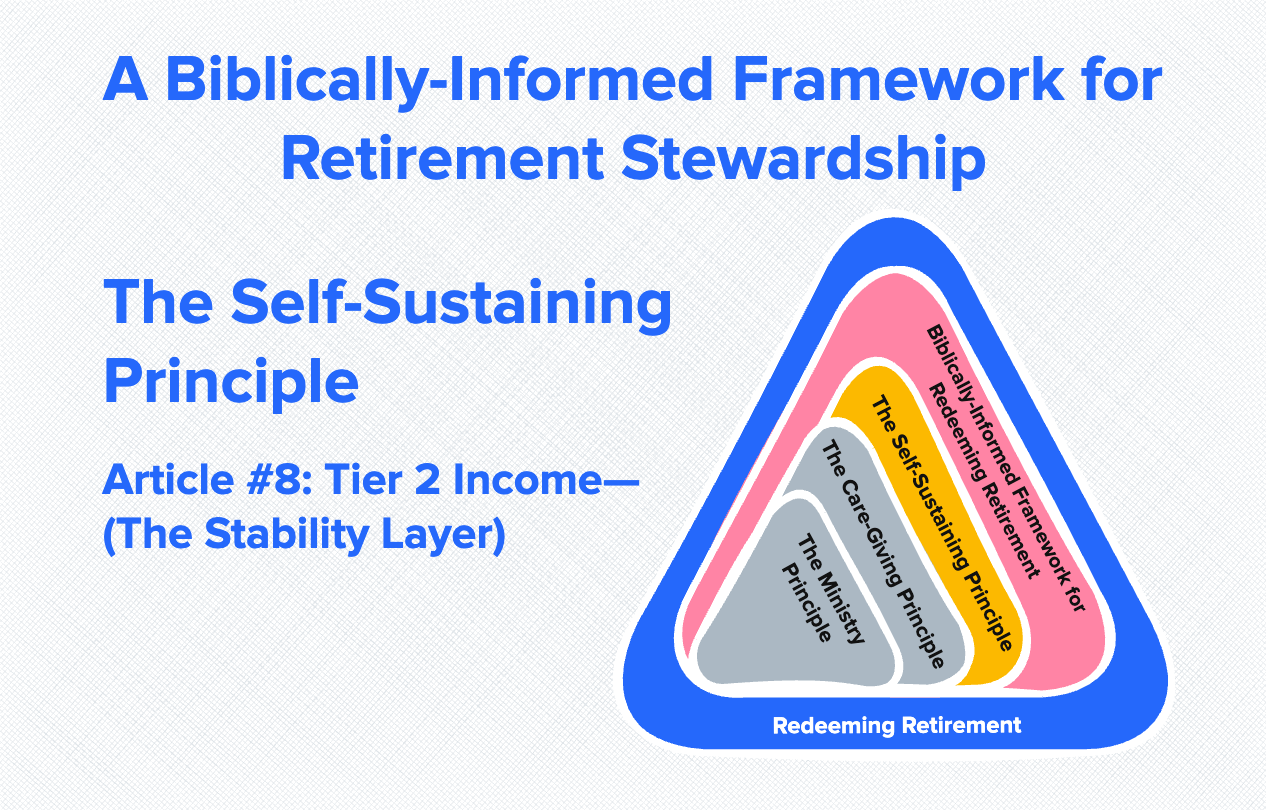
This article is part of the Biblically-Informed Framework for Retirement Stewardship (BIFRS) series.
In the previous article, we explored Tier 1 Income—your guaranteed, lifetime income floor from Social Security, pensions, and annuities. This foundation is the bedrock of a sustainable retirement, providing income you cannot outlive, regardless of market conditions.
We now move to Tier 2: the stability layer that bridges the gap between your guaranteed income floor and the growth-oriented investments in Tier 3. Think of this as the middle floor of your sustainable retirement income house—not quite as secure as the foundation, but far more stable than relying on volatile stock market withdrawals.
From the Sustainability Principle perspective, Tier 2 income enhances retirement sustainability by providing a reliable (though not guaranteed) cash flow that reduces your dependence on portfolio withdrawals, cushions against sequence risk, and maintains your income stability during market turbulence.
Tier 2 Components
Bond Interest: The Core of Tier 2
Bonds form the core of Tier 2 for most retirees seeking sustainable retirement income. When you own bonds (either individually or through funds), you receive regular interest payments, typically semi-annually for individual bonds, monthly for most bond funds.
Why bonds matter for retirement sustainability:
Predictable payments: Unlike stock dividends (which can be cut), bond interest is contractually obligated. If you own a 10-year Treasury bond paying 4.5%, you’ll receive 4.5% annually until maturity, regardless of market conditions. This predictability contributes directly to sustainable income.
Lower volatility than stocks: While bond prices fluctuate (especially with interest rate changes), they’re far less volatile than stocks. A diversified bond fund rarely loses more than 5-10% in a bad year, compared with 20-50% in a severe bear market for stocks. This stability protects retirement sustainability.
Negative correlation with stocks (usually, but not always): Historically, when stocks decline sharply, investors flee to bonds, pushing bond prices up. This relationship broke down temporarily in 2022 when both declined simultaneously, but over the long term, bonds provide valuable diversification that enhances portfolio sustainability.
Capital preservation: Investment-grade bonds almost always return your principal at maturity (for individual bonds) or maintain reasonably stable values over time (for funds), helping preserve capital and support sustainable retirement.
How Interest Rates are Impacting Retirees (Updated 2026) was originally published in September 2023 when the Fed Funds rate had peaked at 5.33% after aggressive rate increases to combat inflation, but the interest rate landscape has shifted significantly by April 2026—the Fed reversed course with three quarter-point cuts in late 2025, bringing rates down to 3.50-3.75%, though they’ve held steady since January 2026 due to persistent inflation (2.7-3.3%) and Middle East geopolitical tensions. While the rate environment remains more favorable for retirees than the near-zero rates of 2020-2021, the benefits are moderating: money market funds now yield 3.4-3.7% (down from 4.95% peaks), 5-year Treasuries around 4.0-4.2%, and immediate annuity payouts remain historically attractive at 8.2-8.4% for my age (73), though these will likely decline if the Fed continues cutting.
Individual Bonds vs. Bond Funds
This is one of the perennial debates in retirement planning. Should you own individual bonds or bond funds?
Individual Bonds or Bond Funds? (Updated 2026) compares individual bonds versus bond funds for retirees, explaining that while individual bonds provide a guaranteed principal return if held to maturity (making them ideal for specific future expenses such as college tuition), bond funds offer simplicity, instant diversification, and professional management that better serve retirees primarily seeking sustainable income. The 2026 update reveals that after holding bond funds through the painful 2022 losses, they fully recovered by 2024-2025. The article concludes that bond funds are generally superior for most retirees due to lower costs, easier management, monthly income, and professional oversight. In contrast, individual bonds are appropriate primarily for wealthy investors with specific future obligations or for those who can’t tolerate fund price volatility, even when held for income.
Bond Ladders
For retirees who prefer individual bonds, laddering is a standard approach. A bond ladder is a strategy of owning bonds with staggered maturities—perhaps maturing each year for the next 5-10 years.
The challenge with ladders is that they require significant capital ($50,000-100,000 minimum to build a proper ladder), more work to manage, and you need expertise to select appropriate bonds. This is why many retirees prefer bond funds despite giving up the maturity guarantee.
To Ladder or Not to Ladder? (Updated January 2026) examines bond ladders versus bond funds for retirement income, with a major 2026 update revealing that TIPS ladders have become one of the most compelling retirement income strategies available, driven by improved real yields and groundbreaking Morningstar research. The article distinguishes between rolling ladders (which behave like bond funds and offer no real advantages) and non-rolling ladders designed to match specific future spending needs, providing a pathway to enhanced retirement sustainability for those with sufficient capital.
(Note: There is an article with more about TIPS Ladders in the TIPS section, below.)
Types of Tier 2 Bonds
Treasury Bonds: Backed by the U.S. government, essentially zero default risk. Yields lower than corporate bonds, but maximum safety to protect retirement sustainability. Current 10-year Treasury yields are around 4.3-4.7% (as of late 2025).
Investment-Grade Corporate Bonds: Issued by financially stable companies rated BBB- or higher. Slightly higher yields than Treasuries (typically 0.5-2% more) with modest additional risk. A good balance of income and safety for a sustainable retirement.
Municipal Bonds: Issued by state/local governments. Interest is federally tax-exempt and sometimes state tax-exempt. For high earners in high-tax states, tax-equivalent yields can exceed corporate bonds. Lower nominal yields but potentially higher after-tax yields, enhancing net sustainable income.
Agency Bonds: Issued by government-sponsored entities like Fannie Mae and Freddie Mac. Not quite as safe as Treasuries but still very secure. Yields slightly higher than Treasuries.
Avoid for Tier 2: High-yield (“junk”) bonds, emerging-market debt, and long-duration bonds (20-30-year maturities). These belong in Tier 3 (if anywhere) due to higher risk and volatility that can undermine the stability essential to sustainable income.
Bond Funds
Most retirees prefer bond funds to individual bonds, although, as noted above, individual bonds are preferable in certain situations for matching specific future expenses.
Bond funds provide instant diversification (hundreds of bonds), professional management, easy buying and selling, and monthly income distributions—all features that support sustainable retirement income.
I hold a mix of intermediate-term TIPS and total bond market funds, currently yielding approximately 4.2%, more than double what they yielded in 2020-2021. This enhanced yield significantly strengthens my Tier 2 sustainable income.
The 2022 Bond “Crisis”
All bondholders learned an important lesson in 2022: Bonds can lose value in rising-rate environments, sometimes substantially. But if you’re holding them for income rather than trading them, the higher yields that follow rate increases eventually offset the temporary capital losses—patience and discipline are key to maintaining sustainable income strategies.
Do Bonds Still Belong in a Retiree’s Portfolio (Updated 2026) was written after bonds suffered unprecedented 13% losses in 2022 alongside simultaneous stock declines, argues that bonds still belong in retiree portfolios for five key reasons that support sustainable retirement: they improve risk/reward ratios when combined with stocks, provide relatively safe predictable income (especially with yields now at 4%+ instead of 2%), can be matched to future spending needs, are low-cost and easy to purchase as funds, and offer professional management and transparency. The article argues that bonds remain essential to sustainable retirement income despite the challenges of 2022.
Dividend Income: Stable Cash Flow with Growth Potential
While Tier 2 is primarily about bonds, quality dividend-paying stocks also contribute stable income—though with more risk than bonds. I hold a dividend stock ETF because I like the regular income. But I also know that there is no significant advantage to holding dividend-paying stocks versus those that reinvest their earnings from a pure return perspective.
Dividend Investing in Retirement (New) examines dividend investing in retirement from both academic and practical perspectives, acknowledging that while modern portfolio theory correctly identifies dividends as economically equivalent to selling shares, the behavioral reality differs significantly. The article presents the trade-off: dividend investing may cost 0.5-1% in annual returns but provides behavioral stability that prevents panic selling during bear markets, thereby contributing to sustainable retirement by protecting against destructive investor behavior. It concludes that dividend investing makes sense for retirees who value the sleep-at-night factor over maximum returns, are in retirement or nearing it, have lower risk tolerance, and want simplified cash flow, but is less appropriate for younger accumulators, high-tax-bracket investors, or those who can handle systematic share sales during market declines.
Dividend-Paying Companies
Dividend Aristocrats: Companies that have increased dividends for 25+ consecutive years. These blue-chip companies (think Johnson & Johnson, Coca-Cola, Procter & Gamble) have proven their ability to maintain and grow dividends through multiple recessions, providing sustainable income even during economic downturns.
High-quality dividend payers: Established companies in defensive sectors (utilities, consumer staples, healthcare) that pay consistent dividends, though perhaps without the 25-year track record of Aristocrats. Still valuable for sustainable Tier 2 income.
Dividend-Focused Funds
These are mutual funds or ETFs that hold dividend-paying stocks:
- Vanguard Dividend Appreciation (VIG): Dividend growth focus, 1.9% yield
- Fidelity High Dividend ETF (FDVV): High dividend focus with appreciation, 2.80% yield
- Schwab U.S. Dividend Equity (SCHD): High-quality dividend payers, 3.5% yield
- Vanguard High Dividend Yield (VYM): Higher current yield focus, 3.1% yield
I hold FDVV and SCHD in my portfolio specifically for Tier 2 income. They generate reliable quarterly dividends that have grown steadily, providing both current income and inflation protection over time, and also enough growth to keep up with inflation—all contributing to long-term sustainable income.
Real Estate Income: Diversification for Sustainability
Rental properties and Real Estate Investment Trusts (REITs) can generate substantial Tier 2 income, though they come with management requirements and cyclical risk.
Direct Rental Properties
This investment involves purchasing a property and renting it out for income. It offers potentially high income (5-8% net rental yield in many markets), inflation protection, and many tax advantages. However, it comes with significant overhead (or expense if you outsource it to a management company). You also have limited liquidity and may incur high capital costs due to maintenance/repairs.
Is Purchasing a Rental/Vacation Home Wise Stewardship? (Updated 2026) examines whether buying a vacation home is wise stewardship, distinguishing among three approaches: pure lifestyle (a second home for personal use only), pure investment (a rental property for income), and mixed-use (a personal vacation home that’s also rented out). Vacation homes are primarily lifestyle decisions with emotional appeal. If you must highly leverage it and depend on rental income to make ends meet, odds are financially against you, and it threatens rather than enhances sustainability. Be honest about whether you want a vacation home for enjoyment (accept the full cost) or a true investment property (buy something you won’t use personally in a strong rental market).
Who this works for: Retirees with property management experience or interest, those who enjoy being landlords, and people who already own rental properties and know what they’re doing.
Who should avoid: Retirees seeking simplicity and sustainable income without management hassles, those without property experience, and anyone who doesn’t want tenant phone calls at 10 PM about broken water heaters.
REITs (Real Estate Investment Trusts)
REITs are companies that own and operate income-producing real estate such as apartments, office buildings, shopping centers, hotels, warehouses, and healthcare facilities. By law, they must distribute at least 90% of their taxable income to shareholders as dividends, making them attractive to income-focused investors seeking sustainable retirement income. You can buy REITs like stocks through any brokerage account, gaining instant exposure to diversified real estate portfolios without the hassles of direct property ownership—no tenant calls, no maintenance emergencies, no property management responsibilities.
As of late 2025, quality REIT funds yield approximately 3.5-5.5%, providing both current income and potential for dividend growth as rents keep pace with inflation—both important for a sustainable retirement. The main drawbacks are that REIT dividends are taxed as ordinary income rather than at preferential qualified dividend rates, prices fluctuate with the stock market, and REITs tend to be sensitive to interest rate changes. They work well as a modest allocation (5-10% of the portfolio) for retirees seeking income diversification and real estate exposure without the complexity of being landlords.
Quality REIT funds:
- Vanguard Real Estate ETF (VNQ): Broad REIT exposure, 4.2% yield, 0.12% fee
- Schwab U.S. REIT ETF (SCHH): Similar to Vanguard, 4.1% yield, 0.07% fee
- iShares Cohen & Steers REIT (ICF): Actively managed, higher quality focus
Although I have invested in REITs in the past, I don’t currently hold any. And my only direct real estate investment is my house, which is a non-trivial part of our total net worth.
CD Ladders: Conservative Stability
Certificates of Deposit provide guaranteed returns for their term, making them a conservative Tier 2 option, especially for risk-averse retirees seeking absolute stability in their sustainable income plan.
CD ladders work very similarly to bond ladders; you stagger maturity dates. For example:
- $20,000 in a 1-year CD
- $20,000 in a 2-year CD
- $20,000 in a 3-year CD
- $20,000 in a 4-year CD
- $20,000 in a 5-year CD
Each year, as a CD matures, you roll it into a new 5-year CD at current rates.
CDs work great for: Very conservative retirees who value absolute safety over yield, those building short-term reserve funds, and people uncomfortable with bond market volatility.
In my opinion, CDs made more sense when bond yields were 2% and CD rates were 1.8%—the safety premium was small. Now, with bonds at 4.5% and CDs at 4.0%, I prefer bonds for their higher yield and liquidity, but CDs serve a valid purpose for those prioritizing absolute safety in their sustainable income strategy.
TIPS (Treasury Inflation-Protected Securities): Inflation Protection for Sustainability
TIPS deserve special attention as a unique Tier 2 asset that combines Treasury safety with inflation protection—both of which are critical for multi-decade retirement sustainability. TIPS are U.S. Treasury bonds specifically designed to protect against inflation by automatically adjusting their principal value in response to changes in the Consumer Price Index (CPI).
When you buy a TIPS bond, you receive a fixed interest rate (currently around 2.0-2.5% as of late 2025) that’s paid on the inflation-adjusted principal amount. For example, if you own a $10,000 TIPS with a 2% coupon and inflation runs 3% in year one, your principal adjusts to $10,300, and you receive 2% of that adjusted amount as interest. At maturity, you receive the higher of the original principal or the inflation-adjusted principal.
TIPS can be owned individually through TreasuryDirect.gov or major brokerages, or through low-cost funds like Vanguard’s VTIP or Schwab’s SCHP. They provide unique benefits, including guaranteed real returns above inflation (essential for long-term sustainability), absolute safety backed by the U.S. government, and perfect inflation hedging.
The main disadvantages are lower nominal yields than regular Treasuries, “phantom income” taxation on principal adjustments, even though you don’t receive that money until maturity (making them better suited for IRAs), and underperformance if actual inflation runs lower than expected.
TIPS work well as 15-30% of a bond allocation for retirees concerned about inflation eroding their purchasing power over a long retirement—a key threat to financial sustainability.
Why Invest in TIPS? (Updated 2026) explains Treasury Inflation-Protected Securities (TIPS) and their role in retirement portfolios, particularly during the high-inflation environment of 2022-2023. The 2023 article was written at the inflection point when TIPS real yields had just turned positive after years in negative territory. The tone is cautiously optimistic about the improving environment. The 2026 update reflects another 2+ years of experience, much higher real yields (2.0-2.2% vs. 1.3%), the incorporation of Morningstar TIPS ladder research, integration of the Sustainability Principle framework, and lessons from the complete 2022 bond crisis recovery. It ends by noting interest in TIPS ladders and promises to discuss that topic in the next article in the series (see below).
Why a TIPS Ladder? (Updated 2026) examines whether building a TIPS ladder—a series of individual TIPS bonds maturing annually—makes sense compared to holding TIPS funds. I distinguish between short-term ladders (5-10 years) and long-term ladders (20-30 years), explaining that non-rolling bond ladders work best for funding specific future spending needs with certainty (maximizing sustainability for known expenses), while TIPS funds are better suited for portfolio diversification and regular income. TIPS ladders work best for retirees with other income sources (Social Security, pensions) who need absolute certainty about future spending and can commit capital for the full ladder duration without the risk of forced liquidation. Those seeking flexibility and who already maintain sustainable withdrawal rates may be better served by TIPS funds.
TIPS funds:
- Vanguard Short-Term Inflation-Protected Securities (VTIP): 0-5 year maturities, low volatility
- Schwab U.S. TIPS ETF (SCHP): Broad maturity range
- iShares TIPS Bond ETF (TIP): Most popular, high liquidity
- Fidelity TIPS Index Fund (FIPDX): Managed index fund at a low cost
I hold a significant TIPS allocation (about 10% of my total portfolio) through FIPDX, viewing it as insurance against unexpected inflation rather than as a bet on it outperforming regular bonds—but essential insurance for protecting the long-term sustainability of my purchasing power.
Why Tier 2 Matters for Sustainable Retirement
Tier 2 income serves several critical functions in building and maintaining a sustainable retirement:
1. Reduces Portfolio Withdrawal Pressure
The more income your portfolio generates through interest and dividends (Tier 2), the less you need to withdraw principal (Tier 3). This makes a dramatic difference in sustainability.
Example comparison:
Retiree A: $500,000 portfolio generating 1.5% income = $7,500/year
- Needs $30,000 total from portfolio
- Must withdraw $22,500 of principal
- Effective withdrawal rate: 4.5%
- Sustainability concern: High withdrawal rate
Retiree B: $500,000 portfolio generating 4.0% income = $20,000/year
- Needs $30,000 total from portfolio
- Must withdraw $10,000 principal
- Effective withdrawal rate: 2.0%
- Sustainability: Much stronger
Retiree B’s portfolio is far more sustainable simply because Tier 2 income covers more of the spending need, requiring less principal withdrawal. This is the Sustainability Principle in action.
2. Provides Predictable (But Not Guaranteed) Cash Flow
Unlike stock appreciation (which is lumpy and unpredictable), Tier 2 income arrives regularly:
- Bond interest: Monthly or semi-annually
- Dividends: Quarterly
- REIT distributions: Quarterly
- CD interest: At maturity or annually
This predictability makes budgeting easier, enhances financial sustainability, and reduces the psychological stress of wondering “can I sell stocks this month or is the market down?”
3. Cushions Against Sequence Risk
If you retire and immediately experience poor stock returns, robust Tier 2 income means you’re not forced to sell stocks at depressed prices—a critical threat to retirement sustainability. Your bond interest, dividends, and other Tier 2 sources continue to flow regardless of the stock market, allowing you to wait for a recovery before selling stocks. This protection is essential for sustainable retirement.
4. Bridges Essential and Discretionary Spending
Ideally, Tier 1 covers essential expenses (housing, food, healthcare, insurance). Tier 2 then covers:
- Some discretionary spending (dining out, entertainment)
- Margin above bare essentials
- Gifts and charitable giving
- Travel and hobbies
This separation means market downturns affect wants but not needs—psychologically much easier to handle and far more sustainable financially.
How Much Should You Allocate to Tier 2 for Optimal Sustainability?
There’s no universal answer, but here are guidelines based on your situation and sustainability goals:
Conservative retiree (low risk tolerance, modest spending needs):
- 50-60% of portfolio in Tier 2 assets (bonds, dividend stocks, CDs)
- Generating 3.5-4.5% income
- Combined with Social Security, covers most spending
- Minimal Tier 3 reliance
- Sustainability: Very high
Moderate retiree (balanced approach, average spending):
- 40-50% of portfolio in Tier 2 assets
- Generating 3.0-4.0% income
- Social Security + Tier 2 income covers essentials plus some discretionary
- Tier 3 provides margin and growth
- Sustainability: Good to strong
Aggressive retiree (higher risk tolerance, larger portfolio, higher spending or growth emphasis):
- 30-40% of portfolio in Tier 2 assets
- Generating 2.5-3.5% income
- Relies more on Tier 3 (stock growth) for sustainability
- Works only if the portfolio is large relative to spending needs
- Sustainability: Adequate if the portfolio is large enough
Common Mistakes That Undermine Tier 2 Sustainability
Reaching for yield: Don’t chase 8-10% yields from junk bonds, sketchy dividend stocks, or complex structured products. Sustainable Tier 2 income means accepting moderate yields (3-5%) from quality sources. High-yield chasing often backfires and threatens sustainability.
Ignoring taxes: Bond interest is taxed as ordinary income; qualified dividends are taxed at preferential rates. Structure accordingly—bonds in IRAs, dividend stocks in taxable accounts when possible. Tax efficiency enhances net sustainable income.
All bonds or no bonds: Either extreme is problematic for sustainability. Pure bonds miss growth needed for long-term sustainability; no bonds miss stability that protects near-term sustainability. Balance matters.
Forgetting inflation: Fixed bond interest loses purchasing power over time, threatening long-term sustainability. Include some dividend-payers and TIPS for inflation protection to maintain sustainable purchasing power.
Panic-selling during volatility: 2022 taught us that bonds can lose value in the short term. If using them for income, hold through volatility—the higher yields eventually compensate. Panic selling destroys the sustainability strategy.
Over-complicating: You don’t need 15 different Tier 2 income sources. A total bond fund, a dividend stock fund, maybe some TIPS. Simple works better for sustainable income management.
A Stewardship Perspective on Tier 2 Income
From a biblical stewardship perspective, Tier 2 income represents wise management of the resources God has entrusted to us. It balances the competing goals of safety and growth, providing the stability that enables both present provision and future sustainability.
Building a robust Tier 2 income layer isn’t about greed or hoarding—it’s about creating the sustainable income stream that allows you to:
- Provide for your household without anxiety (1 Timothy 5:8)
- Maintain capacity for generosity (2 Corinthians 9:6-8)
- Avoid becoming a burden to others (2 Thessalonians 3:8)
- Exercise faithful stewardship over God’s resources (1 Peter 4:10)
The stability that Tier 2 provides creates margin—not just financial margin, but emotional and spiritual margin that frees you to focus on kingdom purposes rather than constant worry about market fluctuations.
“The plans of the diligent lead surely to abundance, but everyone who is hasty comes only to poverty.” (Proverbs 21:5, ESV)
Building Tier 2 income is an act of diligent planning—creating sustainable income streams that will serve you faithfully for decades of retirement.
The Sustainability Value of Tier 2
Tier 2 income is the often-overlooked middle layer that makes sustainable retirement work smoothly. It’s not as exciting as Tier 1’s lifetime guarantees or Tier 3’s growth potential, but it’s the workhorse that generates steady, reliable cash flow year after year—the cash flow that transforms theoretical sustainability into practical, livable reality.
By thoughtfully constructing your Tier 2 income layer—through bonds, quality dividend stocks, and perhaps TIPS or REITs—you create the stability that allows you to maintain your lifestyle during market volatility, reduces pressure on your portfolio, and bridges the gap between survival (Tier 1) and thriving (Tier 3).
From the Sustainability Principle perspective, Tier 2 is where theory meets practice. This is the layer that:
- Converts portfolio assets into regular, reliable cash flow
- Protects against sequence-of-returns risk
- Provides inflation protection (through dividend growth and TIPS)
- Reduces forced selling during market downturns
- Creates the margin that enables generous, sustainable living
In the next article, we’ll explore Tier 3 Income—the variable sources, including portfolio withdrawals, part-time work, and strategic use of home equity, that provide growth, flexibility, and margin for the unexpected blessings and challenges retirement brings, completing our examination of how to build truly sustainable retirement income.