
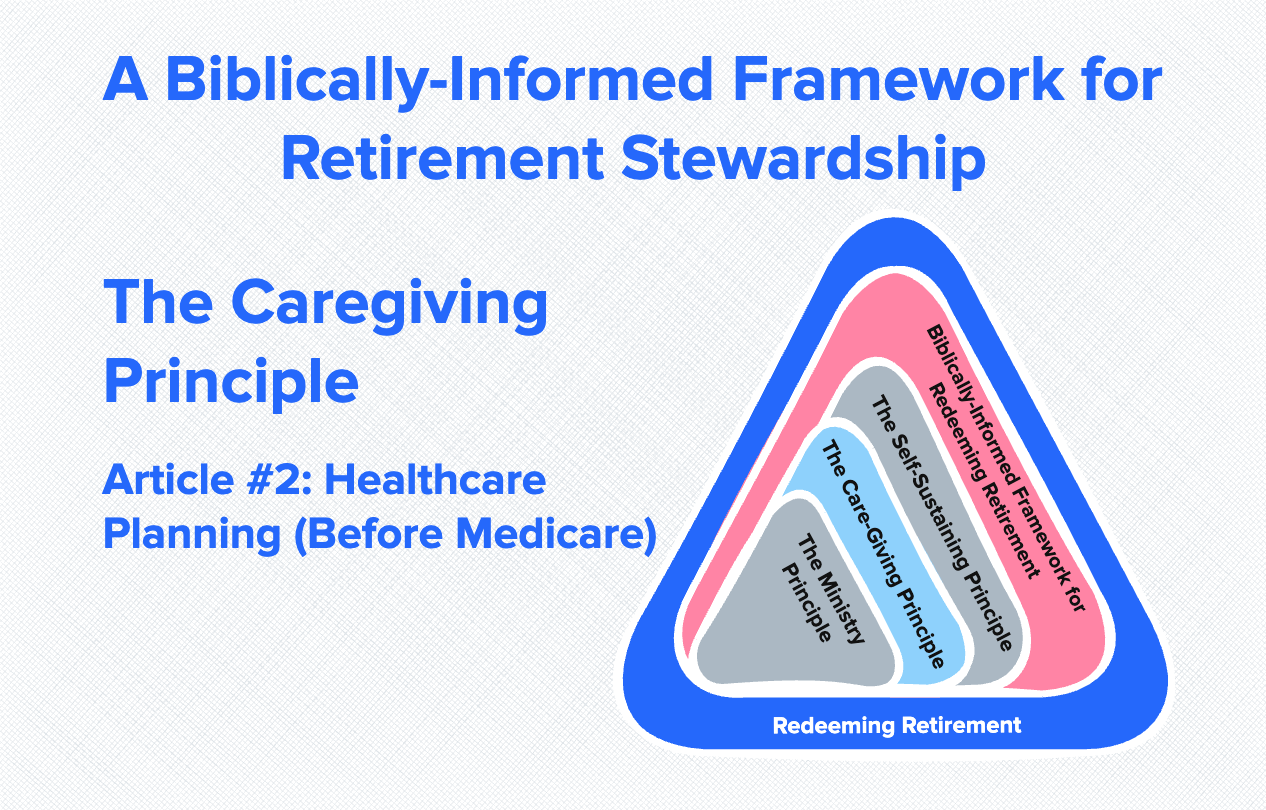
This article is part of the Biblically-Informed for Retirement Steward series (BIFRS).
Planning for healthcare, both before and in retirement, isn’t fun or glamorous. It’s not as exciting as planning for travel or hobbies in retirement. But it’s absolutely essential. Without adequate healthcare coverage and planning, a single medical crisis can severely impact your financial sustainability, inhibit your ability to be generous, and move you from self-supporting to dependent—not gradually as part of natural aging, but suddenly through preventable financial catastrophe.
The Caregiving Principle requires that we plan wisely for healthcare, both for ourselves and for aging parents, whom we may help navigate this complex system.
Biblical foundation
Some Christians feel uncomfortable with healthcare planning. Can’t we just trust God to keep us healthy? Shouldn’t we just trust God to provide for our healthcare bills when they show up? Doesn’t all this planning demonstrate a lack of faith?
Not at all. Consider these biblical truths:
God values our bodies. “Do you not know that your bodies are temples of the Holy Spirit, who is in you, whom you have received from God?” (1 Corinthians 6:19). Caring for our health is stewardship of God’s gift.
Planning is wisdom, not a lack of faith. “The prudent see danger and take refuge, but the simple keep going and pay the penalty” (Proverbs 27:12). God gave us minds to think ahead and plan accordingly.
Provision includes healthcare. The apostle John wrote, “Beloved, I pray that all may go well with you and that you may be in good health, as it goes well with your soul” (3 John 2). God cares about our physical health as well as our spiritual health.
Wise stewardship honors God. When we plan carefully for healthcare costs, we maintain our financial sustainability (the Self-Sustaining Principle), which enables us to continue serving and giving (the Ministry Principle) and reduces unnecessary burden on family (the Caregiving Principle).
Healthcare planning isn’t about trusting in insurance rather than God. It’s about viewing insurance as a gift from God, to be used wisely to steward the resources God has provided for preparing for predictable needs.
Bridging the gap
If you retire before 65, you’ll need to bridge the gap to Medicare eligibility. This can be one of the most expensive aspects of early retirement.
Here are your main options:
- COBRA: Continue your employer coverage for up to 18 months (you pay full premium plus 2% admin fee—typically $700-1,500/month per person)
- ACA Marketplace: Individual coverage through Healthcare.gov (premiums vary wildly, but subsidies are available based on income)
- Spouse’s employer plan: If your spouse is still working
- Health-sharing ministry: Christian alternatives such as Medi-Share, Samaritan Ministries, or Christian Healthcare Ministries ($200-$600/month; not insurance; payments are not guaranteed). Note: Some healthshares push members toward outside charity/aid before approving payment. It’s sometimes framed more broadly as seeking charity care, benevolence funds, or government assistance first. Check on this for any healthsharing plan you’re interested in, should this concern you.
- Private insurance: Individual plans outside the marketplace (usually more expensive, no subsidies)
Key planning point: If you retire at 62, you need 3 years of coverage until you’re eligible for Medicare. At $1,000 per person per month, that’s $72,000 for a couple. This needs to be part of your “Can I afford to retire?” calculation.
Health Insurance Options Before Medicare Updated 2026) examines the primary health insurance options available to early retirees (those retiring before Medicare eligibility at age 65), covering five main pathways: (1) COBRA continuation coverage, which allows former employees to keep their employer-sponsored health insurance for up to 18 months but requires paying the full premium plus a 2% administrative fee, making it expensive but valuable for maintaining current coverage and doctors; (2) ACA Marketplace plans purchased through Healthcare.gov, which offer comprehensive coverage with potential premium subsidies for those with lower incomes (making them often more affordable than COBRA for many early retirees); (3) Spouse’s employer-sponsored insurance, if the spouse is still working and the plan allows dependent coverage; (4) Retiree health benefits offered by some larger employers, public sector agencies, or union jobs as a separate benefit from COBRA; and (5) Medicaid for those meeting income and eligibility requirements in states that expanded coverage under the ACA.
Counting the cost
Let me be direct: Healthcare will be one of your largest expenses in retirement, and it’s not optional. The longer you live, the higher the cost is likely to be.
According to Fidelity’s most recent estimates, a 65-year-old couple retiring in 2025 can expect to spend approximately $315,000 on healthcare costs throughout retirement. That’s up from $260,000 just a few years ago. And that number doesn’t include long-term care, which we’ll address in the next article.
Think about that: $315,000. That’s roughly 15% of a $2 million retirement portfolio. For someone with $500,000 saved, it’s more than 60% of their entire nest egg.
And unlike other retirement expenses that might be discretionary—travel, hobbies, dining out—healthcare costs aren’t negotiable. You need healthcare coverage. Period.
This cost includes much more than out-of-pocket medical expenses. Here’s what that $315,000 covers:
- Medicare Part B premiums (paid monthly from the day you enroll)
- Medicare Part D premiums (prescription drug coverage)
- Supplemental insurance premiums (Medigap or Medicare Advantage)
- Deductibles, co-pays, and co-insurance
- Dental care (not covered by Medicare)
- Vision care (not covered by Medicare)
- Hearing aids (not covered by Medicare)
- Out-of-pocket expenses for services
What it doesn’t include:
- Long-term care (assisted living, nursing homes)
- Experimental treatments
- Most cosmetic procedures
- Alternative medicine
The reality is even more sobering when you consider that healthcare inflation typically runs 2-3% higher than general inflation. While overall inflation might average 3%, healthcare costs often increase at 5-6% annually. What costs $10,000 today could cost $13,000–$18,000 in 10 years, depending on whether inflation runs at 3% or 6%.
Planning and budgeting for healthcare in retirement
Regardless of when you retire, you need a plan for funding your healthcare expenses.
Some retirement planners say that living expenses will be lower than they were when you were working full-time. I’m sure that’s true for some, if for no other reason than necessity. However, for many, they are likely to be the same as or higher than. I could have referenced this article in the “Self-Sustaining” series, but I saved it for here to highlight the importance of planning and budgeting for healthcare expenses in retirement.
Does Retirement Cost Less As We Age? (Updated 2026) challenges two common retirement assumptions—that retirees can live on 70-90% of pre-retirement income and that expenses decline steadily with age—by demonstrating that retirement spending actually follows a U-shaped “retirement spending smile” pattern rather than a simple downward trajectory. While many expenses may decrease modestly (about 7-8% over ten years according to Boston College research), this is often offset by inflation, and the pattern varies significantly across retirement phases: higher spending during the “go-go years” (ages 60-75) on travel and recreation, moderate spending during the “slow-go years” (ages 75-85), and potentially rising costs again during the “no-go years” (ages 85+) due to healthcare and long-term care needs. The article emphasizes that healthcare costs—estimated at $345,000 for a couple retiring at 65 according to Fidelity—don’t decrease with age and that long-term care (which 70% of retirees will need and Medicare doesn’t cover) represents the biggest wild card, with costs ranging from $60,000-140,000 annually depending on the type of care. Additionally, senior household debt has increased dramatically (from 43% carrying debt in 1992 to 65% in 2025, with median debt rising from $7,294 to $41,000), and many retirees face unexpected expenses helping adult children or aging parents, making the simple answer to “do expenses decline with age?” a nuanced “maybe, but not as much as you hope, and not in a straight line”—requiring retirees to plan for spending variability, maintain healthcare sinking funds, address long-term care risk, and balance biblical contentment with practical financial flexibility.
Obviously, the cost equation changes when you become Medicare eligible.
Healthcare should be treated as a non-discretionary essential expense in your retirement budget, just like housing and food.
For a detailed breakdown of healthcare expense categories and guidance on building a comprehensive healthcare budget, see my article below. It walks through specific strategies for estimating your costs, using HSAs effectively, and ensuring you save enough before you become eligible for Medicare.
Planning for Health Care Expense in Retirement (Updated 2026) provides realistic healthcare cost projections and planning strategies for retirees. According to Fidelity’s 2025 estimates, a 65-year-old couple can expect to spend approximately $315,000 on healthcare throughout retirement (a 28.5% increase from 2016’s $245,000 estimate), with typical annual costs of $12,000-$15,000 consisting of Medicare Part B premiums ($185/month per person in 2026), Medigap Plan G coverage (~$175/month per person), Part D prescription drug coverage (~$50/month per person), plus out-of-pocket costs for deductibles, co-pays, dental care, vision care, and hearing aids—none of which are covered by Original Medicare. The article explains the complexities of IRMAA surcharges (income-related premium increases that can add thousands annually for higher-income retirees), details the difference between Medicare Advantage and Original Medicare plus Medigap, and provides specific action steps for three groups: pre-Medicare workers (maximize HSA contributions, plan for the coverage gap if retiring before 65), those within two years of Medicare (understand enrollment periods, compare plans, avoid late-enrollment penalties), and current Medicare beneficiaries (review coverage annually during October 15-December 7, watch for IRMAA letters, maintain healthcare sinking funds).
Healthcare planning for aging parents
The Caregiving Principle isn’t just about your own healthcare—it’s also about helping aging parents navigate their healthcare needs.
Questions to ask your parents:
- Do you have Medicare Parts A, B, and D?
- Do you have Medigap or Medicare Advantage?
- Are you aware of your IRMAA status? (Could Roth conversions or income timing reduce their Medicare premiums?)
- Do you have a list of your medications?
- Do you know which doctors/hospitals are in-network?
- Do you have supplemental dental/vision coverage?
- Who has the power of attorney for healthcare decisions?
- What are your wishes if you become unable to make medical decisions?
Ways to help:
- Attend important doctor appointments with them
- Help organize their medications (pill organizers, reminders)
- Review their Medicare statements for errors
- Assist with insurance claims and appeals
- Coordinate care between multiple specialists
- Ensure bills are being paid on time
- Help them review Medicare plan options during open enrollment
This isn’t about taking over—it’s about supporting them while they maintain independence as long as possible.
Action steps
Healthcare planning can feel overwhelming, but it doesn’t have to be. Here are specific action steps:
If you’re 5+ years from Medicare:
- Maximize HSA contributions if you have a high-deductible health plan (triple tax advantage)
- Build healthcare into your retirement budget projections ($12,000-15,000/year minimum for a couple)
- If planning to retire before 65, research ACA marketplace subsidies based on projected retirement income
- Consider how healthcare costs affect your “How much is enough?” calculation
If you’re within 2 years of Medicare:
- Mark your calendar for the Initial Enrollment Period (3 months before, the month of, and 3 months after your 65th birthday)
- Decide if you’ll delay Part B (only if you have creditable employer coverage of 20+ employees)
- Research Medigap vs. Medicare Advantage for your area
- Get Medigap quotes during your Medigap Open Enrollment Period (6 months after enrolling in Part B) while you have guaranteed issue rights
- Compare Part D plans using Medicare.gov plan finder with your actual medications
If you’re already on Medicare:
- Review your coverage every October during the Annual Enrollment Period (Oct 15-Dec 7)
- Check if your current Part D plan still covers your medications at the best price
- Verify your doctors are still in-network (Medicare Advantage)
- Budget accurately for premiums, deductibles, and out-of-pocket costs
- Watch for IRMAA letters from Social Security (based on 2-year-old tax returns)
If you’re helping aging parents:
- Have “the conversation” about their current coverage
- Offer to help review their options during open enrollment
- Organize their medical information (medication list, doctor contacts, insurance cards)
- Ensure they have healthcare power of attorney documents
- Add yourself to the HIPAA authorization so you can discuss their care with providers if needed
Peace comes from planning
Healthcare costs are real, they’re significant, and they’re not optional. But they’re also predictable enough to plan for.
When you understand Medicare, budget appropriately, and choose coverage that fits your situation, healthcare stops being a source of anxiety and becomes simply another aspect of faithful stewardship.
This is part of the Caregiving Principle: We prepare well so that when we need care—and we will need care—we can receive it without creating a financial crisis for ourselves or our families.
The Self-Sustaining Principle calls us to financial sustainability. Healthcare planning is essential to achieving that sustainability. Without adequate coverage, one serious illness could wipe out retirement savings that took decades to build.
The Caregiving Principle calls us to prepare to receive care with dignity and gratitude. That preparation includes ensuring we have the healthcare coverage to receive the medical care we need.
In our next article, we’ll tackle the even more challenging topic of long-term care—what it is, what it costs, and how to plan for it. Unlike Medicare, which is available to everyone at 65, long-term care requires more complex planning and decision-making.
But for now, focus on getting your Medicare coverage right. It’s the foundation of all your healthcare planning in retirement, and it’s worth the time to understand it well.
Because faithful stewardship includes caring for these bodies that God has given us—temples of the Holy Spirit—throughout all the seasons of our lives, including our years of weakness and dependence.