
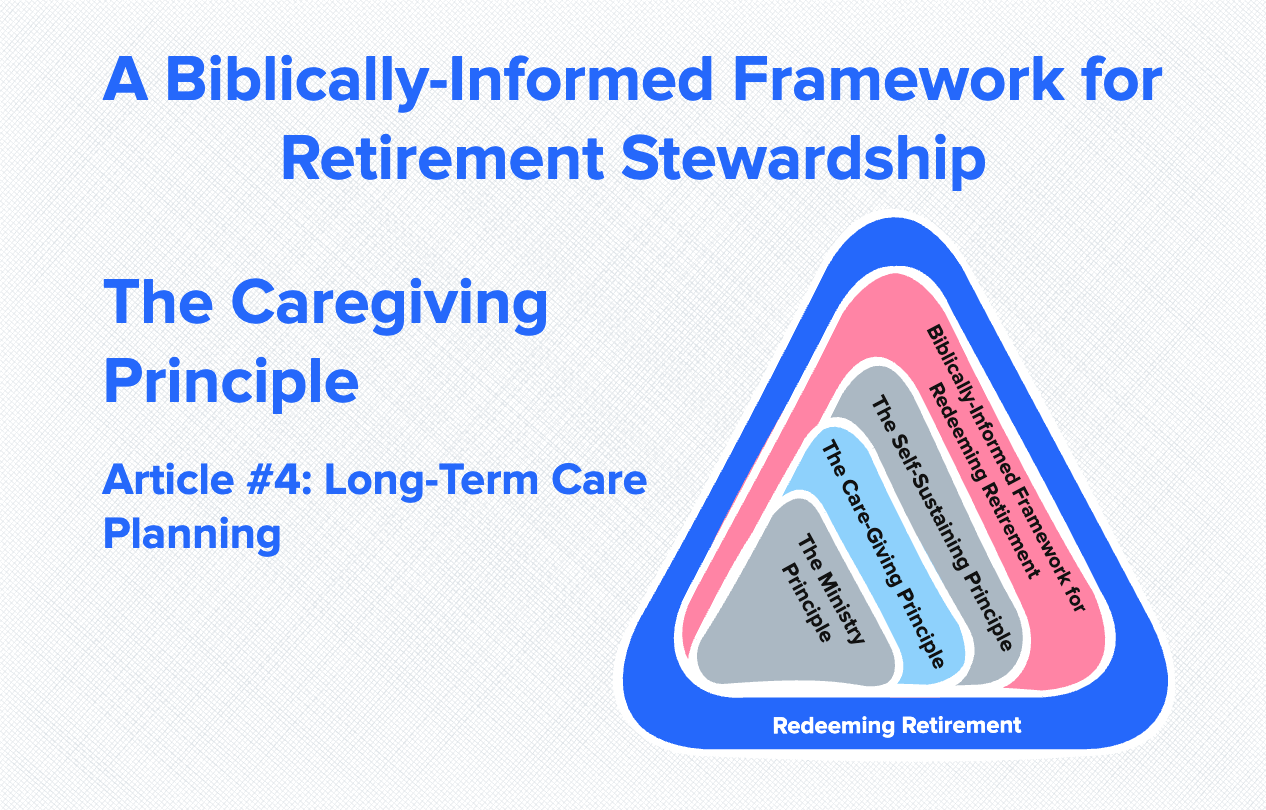
This article is part of the Biblically-Informed Framework for Retirement Stewardship (BIFRS) series.
In the first article of this Caregiving Principle series, we established the biblical foundation for preparing to both give and receive care. In the second and third articles, we explored healthcare planning before and after Medicare—the latter being the foundation of medical care in retirement.
Now we turn to one of the most challenging and often-neglected topics in retirement planning: long-term care.
Long-term care is about the season of life when we can no longer manage our daily activities independently—when cognitive decline affects our memories, when a stroke leaves us partially paralyzed, or when the accumulated frailties of age make independent living impossible. For many Christians, this topic feels uncomfortable. We don’t want to think about becoming dependent. We certainly don’t want to burden our families. And we’d rather not spend whatever money we have left on skilled memory care or medical nursing care.
But hope is not a plan. Faithful stewardship requires us to face reality with clear eyes and prepare wisely.
The biblical foundation for long-term care planning
Before we examine the practical realities, we need to ground ourselves in biblical truth because the culture around us can distort our thinking on this subject in ways that encourage either denial or shame. Neither is aligned with biblical principles.
The starting place is human dignity. You are made in the image of God (Genesis 1:27), and that dignity does not diminish when your body weakens or your mind falters. Planning well for long-term care is, at its heart, a way of honoring that dignity—both your own and that of those who will care for you.
Paul’s words in 2 Cor. 12:9 offer a striking reframe for what aging dependence can mean: “My power is made perfect in weakness.” Seasons of dependence are opportunities for God’s grace to be displayed through those who give care and through the humility of those who receive it. And Prov. 27:12 makes the stewardship case plain: “The prudent see danger and take refuge.” Planning for potential long-term care is prudence, not pessimism.
Family responsibility matters deeply. 1 Tim 5:8 establishes that caring for our own is a fundamental obligation. But honoring your parents (Ex. 20:12) does not require your adult children to personally provide all hands-on care at the cost of their own health, marriages, and finances. Arranging for appropriate professional care, paying for it, and lovingly overseeing it are just as much an expression of honor as direct physical assistance and are often more sustainable.
What is long-term care?
Long-term care is fundamentally different from the healthcare covered by Medicare. Medicare addresses acute medical needs: doctor visits, hospital stays, surgery, and treatment for illness and injury. Long-term care addresses personal care needs that arise when someone can no longer perform basic Activities of Daily Living (ADLs) without assistance, including bathing, dressing, toileting, transferring, maintaining continence, and eating.
Long-term care also encompasses assistance with Instrumental Activities of Daily Living (IADLs), such as meal preparation, medication management, financial management, and transportation. Many people begin needing IADL assistance well before they lose ADL capacity, and a realistic plan accounts for this earlier phase of care.
Long-term care exists on a spectrum: in-home care, adult day care, assisted living, memory care, and skilled nursing facilities. Understanding that spectrum—and what each level costs—is essential for planning. For a full explanation of care types and updated 2026 cost data, see:
Stewardship of Life, Part One: Long-Term Care—Understanding Your Options (Updated 2026) opens the “Stewardship of Life” series by framing long-term care planning as a biblical stewardship responsibility, then provides a practical survey of the LTC landscape. It defines long-term care by its focus on Activities of Daily Living (ADLs) rather than acute medical treatment, walks through the full spectrum of care options—in-home care, adult day care, assisted living, memory care, skilled nursing facilities, and CCRCs—with 2026 cost data for each, and outlines the key factors that should drive the decision about what type of care is appropriate and when. The article closes by grounding the subject in Scripture, arguing that prudent planning (Proverbs 27:12), family obligation (1 Timothy 5:8), and church community are all part of a faithful approach—and that the most important principle of all is to make care decisions before a crisis forces them.
The critical Medicare misconception
One of the most dangerous assumptions in retirement planning is that Medicare will pay for long-term care. It will not—at least not in any meaningful sense. Medicare covers skilled nursing care for up to 100 days under strict conditions (a qualifying hospital stay, skilled care required, and demonstrable improvement), with a $217-per-day coinsurance charge for days 21–100 in 2026. After day 100, Medicare pays nothing. It does not cover assisted living, memory care, or custodial in-home care at all.
For a clear explanation of what Medicare and Medicaid actually cover—including a critical 2026 update on Medicaid changes under the Budget Reconciliation Act—see:
Stewardship of Life, Part Two: Medicare and Medicaid—What the Government Will and Won’t Cover (Updated 2026) corrects one of the most dangerous misconceptions in retirement planning: that Medicare will pay for long-term care. It explains that Medicare covers only acute medical care, with SNF coverage capped at 100 days (and only after a qualifying 3-day inpatient hospital stay), leaving custodial care—the kind most people actually need—entirely unfunded by Medicare or any Medigap policy. Medicaid does cover long-term custodial care, but only after a person has spent down to very limited assets, subject to a five-year look-back period and complex eligibility rules. A major 2026 update covers the Budget Reconciliation Act of 2025, which enacted the largest Medicaid cuts in the program’s history, putting Home and Community-Based Services especially at risk and making Medicaid a less reliable safety net than it once was. The article closes with a biblical reflection on when using government programs is appropriate versus when aggressive Medicaid asset-transfer strategies raise ethical concerns—and points readers to Parts Three through Five for practical guidance on how to actually fund long-term care.
The reality: how likely is it?
According to the U.S. Department of Health and Human Services, approximately 70 percent of people turning 65 today will need some form of long-term care during their remaining years. Women need care for an average of 3.7 years; men for an average of 2.2 years. One in five people will need care for longer than five years. These are not worst-case projections—they are median outcomes—so 50% will need more and 50% will need less.
The question is not whether you might need long-term care. The more honest and useful question is when, for how long, what kind, and whether you will be financially prepared when it arrives.
How do people pay for it?
When long-term care is needed, there are essentially five ways to pay: personal savings and income, long-term care insurance, hybrid life/LTC policies, Medicaid, and family caregiving. Most people end up using a combination.
Long-term care costs in 2026 are substantial and rising. The national median for assisted living is approximately $65,000 per year; memory care costs $80,000 per year; a private nursing home room costs $135,500 per year. These figures have increased nearly 50 percent since 2019. Costs also vary significantly by geography, so researching what care actually costs in your area matters.
For a full treatment of each funding option—including personal savings, home equity, pensions, family caregiving, Medicaid, and how to think about which approach fits your asset level—see:
Stewardship of Life, Part Three: Paying for Long-Term Care (updated 2026) confronts the cost reality head-on, noting that LTC expenses rose nearly 50 percent between 2019 and 2024 while retiree incomes grew only 22 percent — and then walks through the six primary funding options: personal savings, traditional LTC insurance, hybrid products, home equity (including reverse mortgages), pension and annuity income, and family caregiving. It uses Mike and Debbie to illustrate how a realistic five-year memory care scenario can consume $440,000–$480,000 of a couple’s nest egg. A practical asset-based framework helps readers identify which approach makes sense at different wealth levels, from under $250,000 (likely Medicaid-dependent) up to $2.5 million or more (viable self-insurance), and closes by connecting LTC funding discipline to the BIFRS Self-Sustaining Principle.
For those considering long-term care insurance—traditional standalone policies—the next article covers how they work, what they cost in 2026, inflation protection, premium increase risk, and who the best candidates are:
Stewardship of Life, Part Four: Long-Term Care Insurance—Is It Worth It? (Updated 2026) takes a thorough, even-handed look at traditional LTCI — how it works, what the key policy terms mean (daily benefit, benefit period, elimination period, inflation protection), and what it actually costs in 2026 (roughly $3,500–$5,500 annually combined for a couple aged 55 in standard health). It addresses the two most serious concerns squarely: the premium-increase problem (traditional LTCI premiums are not guaranteed, and many policyholders have faced 20–50 percent increases) and the market-contraction problem (many major carriers have exited the market). The article identifies the ideal LTCI candidate — ages 55–65, in good health, with $250,000 to $2 million in assets — and frames the purchase decision not as trying to “win” against an insurer but as transferring a foreseeable, potentially devastating financial risk, consistent with the biblical principle of prudence in Proverbs 27:12.
And for those who are concerned about the use-it-or-lose-it nature of traditional insurance, or who have a lump sum available and want guaranteed premiums, hybrid life/LTC products offer a different structure:
Stewardship of Life, Part Five: Hybrid Long-Term Care Insurance (Updated 2026) examines hybrid products — life insurance or annuities combined with LTC coverage — that now account for the majority of new LTC insurance sales, as traditional LTCI has contracted. It explains the three main structures (life insurance with LTC rider, indexed universal life with LTC rider, and annuity with LTC multiplier), highlights the key advantages (no use-it-or-lose-it problem, guaranteed premiums, potentially more lenient underwriting, favorable tax treatment up to the $420/day IRS exclusion in 2026), and is candid about the trade-offs (higher cost per dollar of LTC coverage, capital concentration, and product complexity that favors salespeople over buyers). The Section 1035 Exchange — repositioning existing life insurance or annuity cash value into a hybrid product tax-free — gets its own section. The article closes by noting that the 2025 Medicaid cuts make private LTC funding more strategically important than ever, while maintaining Chris’s consistent stance of not recommending specific products and urging readers to work with a fee-only advisor before making a decision.
A planning framework
Long-term care planning is not a single decision. It is a set of overlapping conversations, financial decisions, and legal preparations that unfold over years. Whatever your financial situation, there are steps every person can and should take.
1–Assess your realistic risk
Family history, current health, gender, marital status, and the cost of care where you expect to age all factor into your personal LTC risk profile. The planning question is not whether you might need care but how much, for how long, and whether you will be financially prepared.
2–Have honest family conversations
Some of the most important long-term care planning has nothing to do with money or insurance. Between spouses: What kind of care would we want? How much family caregiving are we comfortable with? How do we protect the healthy spouse financially? With adult children: What are our expectations? Do you know where our legal documents are? With aging parents: What are your wishes? What resources do you have? These conversations are uncomfortable and essential. The families who have them navigate crises with grace; the families who avoid them navigate crises in conflict.
3–Get legal documents in order
Four documents are non-negotiable: a Durable Power of Attorney for finances, a Healthcare Power of Attorney, a Living Will or Advance Directive, and HIPAA Authorization. Without these documents, a care crisis triggers a court guardianship proceeding—expensive, slow, and emotionally exhausting at exactly the wrong moment. Establishing these documents while you are healthy and clear-minded is an act of love for your family.
4–Think carefully about housing
Is your current home suitable for aging in place? Moving while you are still healthy and capable of making deliberate choices is a fundamentally different experience from moving during a medical crisis. If downsizing, relocating near family, or exploring a continuing care retirement community makes sense, the time to explore is before you need to.
5–Build and maintain community
The Caregiving Principle extends beyond the biological family. Church community can provide remarkable practical and spiritual support—check-ins, meals, transportation, respite for family caregivers, and the deep sustenance of being genuinely known and loved. That kind of community is built over years of presence, investment, and service. The biblical principle is clear: you reap what you sow.
6–Plan for cognitive decline
Roughly half of all people over 85 have Alzheimer’s or other dementia, and it arrives gradually, often years before a formal diagnosis. Preparing means simplifying finances, setting up automatic systems, and ensuring a trusted person can step in seamlessly. We address this in detail in the related article on Your Coming Weakness and Retirement Stewardship.
A stewardship perspective
Faithful stewardship, applied to long-term care, looks like this: facing reality with clear eyes rather than comforting denial; planning to maintain dignity in dependence; preparing to receive care graciously when the time comes; protecting your family through preparation rather than leaving them to improvise in crisis; holding resources loosely when care costs consume what you had hoped to leave as an inheritance; and trusting God with the outcomes that lie beyond your control.
Weakness is not the enemy of faith. Paul said his power was made perfect in weakness. Seasons of dependence, faithfully planned for and graciously received, can display the character of Christ in ways that independence never could. That is not a reason to welcome suffering or decline. But it is a reason to face them without shame, to prepare for them without despair, and to trust that God’s purposes encompass even our frailest moments.
The Caregiving Principle calls us to prepare wisely, love our families well, and ultimately trust God. Long-term care planning—honest, thorough, and faithful—is one of the most important ways we can do exactly that.