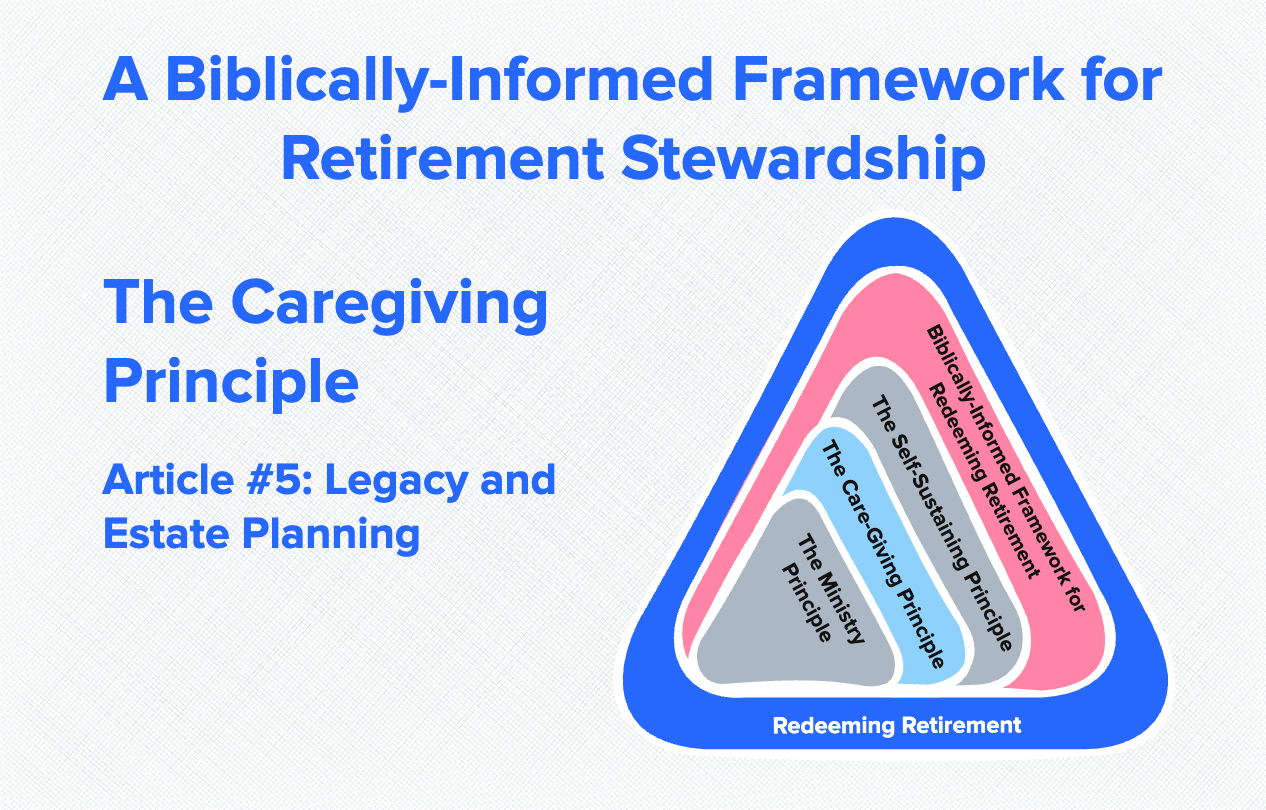
This article is part of the Biblically-Informed Framework for Retirement Stewardship (BIFRS) series.
In the first four articles of this Caregiving Principle series, we established the biblical foundation for preparing to give and receive care, explored healthcare planning and Medicare, and examined the realities of long-term care. Each of those articles addresses the care we receive in our final years.
This article, which is the last in the “Caregiving Principle” series, turns to the final act of stewardship: what happens after we are gone—well, sort of. How do we prepare the people we love for a transition they will inevitably face? How do we give generously and wisely during our lifetime, not just at the end of it (the “well, sort of” part)? How do we pass on the assets God entrusted to us in ways that honor him, serve our families, and extend our legacy beyond our years?
These questions feel distant when we are healthy and active. They feel urgent when we are not. The time to answer them is now, while we are clear-minded and unhurried. That is the calling of what I call “legacy stewardship.”
Note: If you’re interested in diving deeper into this topic, I’ve written an entire book about it (which I will confess is partially a compilation of most of the older articles referenced here that have been revised for inclusion in the book, along with a lot of newer material): Legacy Stewardship: A Biblical and Practical Guide to the Last Chapter of Life.
Stewardship until the end
The Bible treats our earthly possessions not as our own, but as God’s property entrusted to our management. “The earth is the Lord’s, and everything in it” (Ps. 24:1). This principle does not expire at retirement or at the threshold of death. We remain stewards of what God has given us until the moment it passes from our hands—and a faithful steward gives thought to how that transfer will unfold.
Proverbs 13:22 says that “a good person leaves an inheritance to their children’s children.” This verse is sometimes quoted as a biblical mandate to accumulate and preserve wealth, but its meaning is much broader and richer than that. Leaving an inheritance—of character, of faith, of wisdom, of financial resources where possible—is a form of generational love and care, and can be one of your final acts of wise stewardship. It reflects a life lived with others in mind, not only oneself.
But Scripture equally celebrates generosity that happens now, while you are alive to see it. The widow who gave two small coins gave everything she had (Mark 12:41–44). Paul’s appeal to the Corinthians in 2 Corinthians 9:6–8 isn’t about estate planning; it’s about cheerful, deliberate generosity in the present moment to meet a current need. Both the living gift and the posthumous inheritance can be acts of worship and stewardship.
Isaiah 38:1 records God’s instruction to Hezekiah: “Set your house in order, for you shall die.” Not as a death sentence (God actually prolonged his life), but as a call to stewardship. It’s an invitation to prepare—to do the work love requires so those who remain are not left with chaos and confusion at the moment of their deepest grief. Setting your house in order is an act of love for the people you will leave behind.
Note: I’ll allude to this elsewhere, but I have a document I call “A Letter From Your Husband Who is Now in Heaven” that I update periodically and keep with my will and other final documents. It tells my wife how to access our accounts, what our recurring bills are, where important documents are located, and what I think she should consider about our IRA accounts. It isn’t a legal document; it’s a love letter about money—a way of caring for her from beyond the grave, as best I can. I have also discussed these things with her directly. She knows roughly what we have, where it is, and what I recommend she do. That conversation is more valuable than any document. The document is a backup for what she may not remember or may be too overwhelmed to think clearly about in the hours and days after my death. If you have not done something like this for your spouse, I encourage you to start today. It doesn’t need to be perfect, but it does need to exist.
What is a legacy, really?
We tend to think of legacy in financial terms—what we leave behind in dollars, accounts, and property. But the most enduring legacies are not primarily financial. They are reputational: the character you modeled, the faith you expressed through good times and bad, the generosity you showed, the way you treated people when it cost you something. A theologian I admire once wrote, “A righteous man is one who lives for the next generation.” That definition has almost nothing to do with money.
The financial legacy is real and worth planning. It can fund a grandchild’s education, support a ministry that outlasts you, relieve your children of financial burden, and express love in concrete, lasting ways. But it’s downstream of the lived legacy. A person who leaves significant financial assets to heirs who have never witnessed generosity, never seen faith in action, and never been taught to handle money faithfully has left a gift that may do more harm than good. The financial inheritance is best understood as an extension of a life already well lived.
Retirement Stewardship and Your Legacy (Updated 2026) explores what a legacy actually is — arguing that the most enduring legacy is the sum of how we lived and loved, not primarily what we leave financially. Covers the biblical basis for estate planning, the distinction between “living” and “leaving” a legacy, and practical first steps for getting started, including listing priorities and beginning to think about how your assets reflect your values.
Giving during your lifetime
One defining question of retirement stewardship is whether to prioritize spending, giving, or leaving an inheritance. Scripture, read honestly, seems to encourage all three, so the question is really about proportion, priority, and prayerful discernment in each family situation.
Giving during your lifetime has a quality that posthumous giving does not: you can see its impact. You can watch a ministry flourish, accompany a grandchild through the education your gift helped fund, and witness your church reach people because you helped build its capacity. Generosity has a relational dimension that estate gifts cannot replicate.
For IRA owners age 70½ or older, Qualified Charitable Distributions (QCDs) are the most tax-efficient giving tool available in 2026. The annual limit is $111,000 per individual, and QCDs are excluded entirely from taxable income—bypassing the new restrictions the One Big Beautiful Bill Act placed on itemized charitable deductions. For charitably inclined retirees, the QCD is absolutely worth understanding in detail.
Giving in Retirement (Updated 2026) addresses whether and how Christians should continue giving after they stop working, covering the biblical basis for ongoing generosity, the question of tithing from retirement income, and the practical mechanics of giving from Social Security, pensions, and IRA distributions. Updated for 2026 with coverage of the OBBBA’s new charitable deduction restrictions and why Qualified Charitable Distributions (QCDs, up to $111,000 per person) are now the most tax-efficient giving tool available to retirees.
Setting your house in order
An estate plan is not a document you create for yourself. It is a gift you prepare for the people who must manage your affairs when you can no longer do so. Without one, state law determines who receives what, courts may appoint administrators, and your family navigates grief and legal complexity at the same time. With a good one, the path forward is clear.
The core of any estate plan is the will—the written expression of your wishes. But a will alone is insufficient, because most financial assets can and should be structured to pass outside of probate entirely: through beneficiary designations on IRAs and retirement accounts, payable-on-death designations on bank and brokerage accounts, and joint ownership with right of survivorship on property. These simple mechanisms transfer assets directly to named beneficiaries without court involvement, delay, or expense.
Beyond the will, four other documents are non-negotiable: a Durable Power of Attorney for finances (giving a trusted person authority to manage your affairs if you are incapacitated), a Healthcare Power of Attorney (designating who makes medical decisions on your behalf), a Living Will or Advance Directive (specifying your wishes for end-of-life treatment), and HIPAA Authorization (allowing named individuals to access your medical information). Without a durable power of attorney in particular, a family needing to manage an incapacitated person’s finances must go to court for guardianship—a slow, expensive process at the worst possible time.
Do you need a trust?
Trusts are useful in specific situations: when real estate or vehicles cannot pass via transfer-on-death designation in your state, when you want to control distribution over time (milestone ages, conditions), when you have a beneficiary with special needs, or when your estate is complex. For many retirees with grown children, beneficiary designations and a well-drafted will are sufficient. Whether a trust makes sense depends on your state’s probate laws, your asset mix, and your goals for how assets are distributed.
Estate Planning and Your Will (Updated 2026) is a practical guide to the documents every estate plan needs — will, durable power of attorney, healthcare power of attorney, and living will — along with guidance on beneficiary designations, joint ownership, and whether a trust makes sense for your situation. Updated from the original 2016 article to reflect the elimination of the Stretch IRA, the 10-year rule for inherited IRAs, and the 2026 estate tax exemption of $15 million per person under the OBBBA.
Avoiding Probate: Issues and Options (Updated 2026) walks through seven strategies for keeping assets out of probate — joint ownership, payable-on-death designations, transfer-on-death arrangements, revocable living trusts, and lifetime gifts — with state-specific notes (including North Carolina) on which tools are available. Updated for 2026 with the new annual gift tax exclusion ($19,000 per recipient) and the permanent $15 million federal estate tax exemption under the OBBBA.
Your financial legacy
A financial legacy is not simply what remains after you have spent everything else. For many people, it is a deliberate choice—a decision to hold resources in trust for others, to give in a way that extends your stewardship beyond your lifetime. The mechanics of that choice involve real legal and tax decisions, and making them wisely requires some understanding of how assets are treated at death.
Among the most important decisions is what to do with IRA assets. Traditional IRAs left to individual heirs carry embedded income taxes that those heirs must eventually pay. Under current rules (effective since 2020, with final IRS regulations in effect since 2025), most non-spouse beneficiaries must fully distribute an inherited IRA within 10 years—and if the original owner had already begun Required Minimum Distributions, heirs must also take annual distributions during years one through nine. This “10-year rule” can push heirs into higher tax brackets and substantially reduce the inheritance’s after-tax value.
One strategic implication: Roth conversions during your own lifetime allow you to pay the tax now, potentially at lower marginal rates, leaving heirs a tax-free inheritance that still must be distributed within 10 years but carries no income tax burden. Another option: naming a church or ministry as the beneficiary of your IRA is among the most tax-efficient legacy strategies available—qualified charities pay no income tax on IRA distributions, so the full value serves the mission rather than going partly to taxes.
Giving by Leaving a Financial Legacy (Updated 2026) covers the legal and tax mechanics of conveying assets to family and organizations at death, with particular focus on the 10-year rule that now governs most inherited IRAs, requiring non-spouse beneficiaries to fully distribute the account within a decade, with annual RMDs required if the original owner had already begun taking them. Discusses Roth conversion as a legacy strategy, the tax advantage of naming charities as IRA beneficiaries, and how to think about trusts as a distribution-control tool.
Passing assets wisely
Estate planning is not only about what you do with your assets. It is also about preparing your heirs for what they will receive—and for what they will be required to do with it. Two articles address this from different angles.
For surviving spouses
Surviving spouses receive the most favorable treatment of any IRA beneficiary under current law. They can roll an inherited IRA into their own account, or, under SECURE Act 2.0 rules now in effect, keep it as an inherited IRA and use the more favorable Uniform Lifetime Table for calculating Required Minimum Distributions. The difference between the old Single Life Table and the new Uniform Lifetime Table can mean thousands of dollars per year in lower required distributions—and correspondingly lower annual tax bills.
This is not a trivial planning matter. The choice a surviving spouse makes about how to handle an inherited IRA is often irreversible. Understanding the options before they become necessary—or at minimum, knowing that professional guidance is essential then—is part of loving your spouse well.
Surviving Spouses’ Options for Inherited IRAs (Updated 2026) explains the distribution options available to a surviving spouse who inherits a traditional IRA, including the spousal rollover, continuing as an inherited IRA beneficiary, and disclaiming. Highlights the significant SECURE Act 2.0 change now in effect: surviving spouses may use the more favorable Uniform Lifetime Table for RMD calculations rather than the Single Life Table, which can reduce annual required distributions by thousands of dollars and meaningfully lower the annual tax bill. Also covers the 2026 QCD limit of $111,000 and the 10-year rule for non-spouse beneficiaries.
For heirs receiving an inheritance
Receiving an inheritance is a moment that calls for wisdom. One in three households that receive an inheritance dissipates it quickly. As Christians, the question is not simply “What do I want to do with this?” but “How does God want me to steward what he has provided through this gift?” The answers may include building up depleted emergency reserves, paying down debt, strengthening retirement savings, funding long-term care coverage, or giving generously—ideally, some combination, carefully thought through and perhaps with professional counsel.
Received an Inheritance, Now What? (Updated 2026) is a guide for people who have received or expect to receive an inheritance, covering estate and inheritance taxes, the stepped-up cost basis on inherited property, the income tax rules for inherited retirement accounts, and the practical question of what to do with the money — from building an emergency fund and paying down debt to strengthening retirement savings, funding long-term care coverage, and giving generously. Emphasizes the stewardship perspective that inherited assets are God’s money, not a windfall to be consumed.
What to do now
The material in this article and the seven supporting resources can feel overwhelming if you approach it as a single project. It is not a single project. It is a set of overlapping decisions and conversations you can address in stages. Here is a practical sequence.
First: get the legal foundation right
If you don’t have a current will, durable power of attorney, healthcare power of attorney, and living will, start here. These documents protect your family not just at your death but throughout any period of incapacity that may precede it. An estate attorney can produce a complete package for a few hundred to a few thousand dollars, depending on complexity. This is not optional stewardship.
Second: review every beneficiary designation
Outdated beneficiary designations are among the most common and costly estate planning errors. IRAs, 401ks, life insurance policies, annuities, bank accounts, and brokerage accounts all have beneficiary designations that operate independently of your will. An ex-spouse, a deceased sibling, or a minor child listed as beneficiary on an account can create legal complications that a perfectly written will cannot fix. Review them now.
Third: have the conversations
The most important estate planning work is not legal or financial—it is relational. Conversations with your spouse about financial accounts, passwords, and what to do in various scenarios. Conversations with your adult children about your wishes and what to expect. If you have aging parents whose affairs are not in order, have conversations with them while they still have the full capacity to participate. These conversations are uncomfortable and essential. Families who have them navigate loss with clarity and grace; families who avoid them often face conflict and confusion at the worst possible moment.
Fourth: plan your giving deliberately
Generosity is not primarily a tax strategy, but wise giving incorporates one. If you are over 70½ with a traditional IRA, review your QCD options. If you want to make meaningful gifts to children or grandchildren, understand the annual gift tax exclusion. If you intend to leave a significant portion of your estate to your church or a ministry, consider the advantages of naming them as IRA beneficiaries rather than leaving them bequests of after-tax assets. A fee-only financial planner can help you structure your giving for maximum impact.
Fifth: write the letter
Beyond all the legal documents and financial accounts, consider writing a personal letter to your spouse and/or your children. Tell them where things are. Tell them what you want them to do. Tell them what you hope for them. This does not have to be polished or comprehensive—it just needs to be there for them. A document that is imperfect and present is infinitely more valuable than one that is perfect (in your mind) but never written.
Finishing well
The Caregiving Principle is ultimately about the full arc of life—preparing to care for others, accepting care graciously when we need it, and ordering the final season of our stewardship so that our departure is a gift rather than a burden. Long-term care planning, covered in the previous article in this series, addresses the physical and financial realities of that final season. The legacy and estate planning work in this article addresses what happens after.
Finishing well means more than dying with a good estate plan. It means living in such a way that the people around you have been loved, served, and equipped—so that when you are gone, what remains is not primarily confusion about assets but the clear memory of a life faithfully and generously lived. The financial legacy matters. The lived legacy matters more.
Set your house in order. Have the conversations. Write the letter. Give generously now and plan to give through your estate if you want to. Hold it all loosely, and trust the God who owns it to accomplish his purposes through every dollar of it—including the last one.
If you want to go deeper into this subject, consider getting my latest book: Legacy Stewardship: A Biblical and Practical Guide to the Last Chapter of Life.