
This article is part of the Biblically-Informed Framework for Retirement Stewardship (BIFRS) series.
Even if you retire before age 65, Medicare becomes the foundation of healthcare coverage once you reach that age. It isn’t a perfect system—it has gaps and limitations—but it’s what we have, and it’s worth understanding well.
I view Medicare as part of God’s common grace provision for our society. It ensures that seniors have access to basic healthcare regardless of their financial situation. Is it perfect? No, absolutely not, as I’ve said; reforms are needed. But it’s available to virtually everyone who reaches age 65, and it has worked reasonably well for many decades.
Let’s walk through how it fits together and how you can decide on which plans are right for you.
Medicare Part A: Hospital Insurance
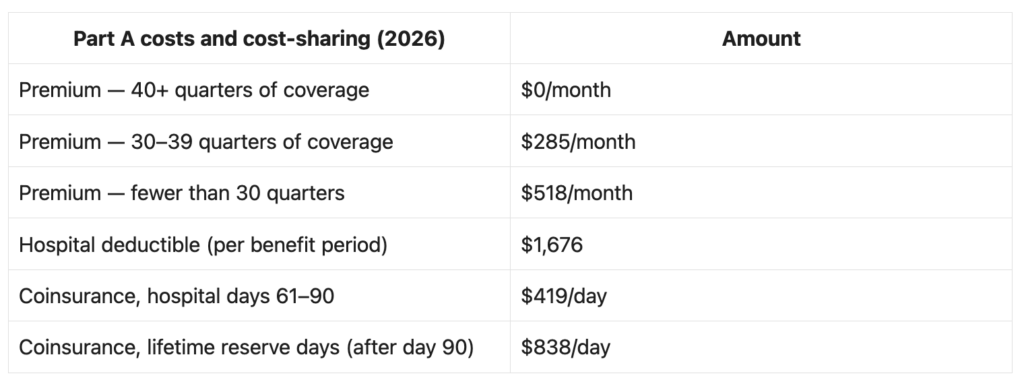
Part A covers inpatient hospital stays, limited skilled nursing facility care (only after a qualifying three-day hospital stay, and only for up to 100 days), hospice care, and some home health care. What it does not cover is just as important to understand: long-term custodial care in a nursing home is excluded entirely, and even the skilled nursing benefit it does offer is quite narrow.
Most people qualify for premium-free Part A because they or their spouse paid Medicare taxes for at least ten years. If your work history is shorter, you’ll pay a monthly premium instead. Because premium-free Part A carries no downside, most people should enroll at 65 even if they’re still working and covered by an employer plan.
Medicare Part B: Medical Insurance
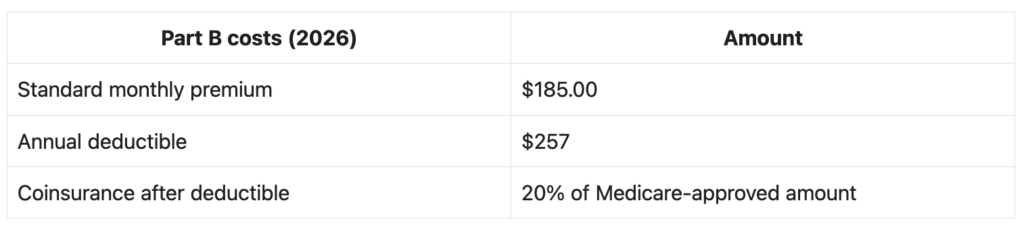
Part B is the companion to Part A, covering doctor visits, outpatient care, preventive services, durable medical equipment, and many diagnostic tests. Unlike Part A, it requires active enrollment, and there’s a real cost to waiting and missing your enrollment window.
Your Initial Enrollment Period runs seven months—three months before your 65th birthday month, your birthday month, and three months after. If you don’t enroll during that window and don’t have creditable employer coverage, you’ll face a permanent late-enrollment penalty of 10% for every twelve-month period you were eligible but didn’t sign up. The one exception is if you or your spouse are still working with employer coverage from a company of 20 or more employees; in that case, you can delay Part B without penalty and enroll later through a Special Enrollment Period.
That’s exactly what my wife and I did. When she turned 65, I was still working with employer coverage, so we enrolled her in Part A, at no cost and no downside, but delayed her Part B enrollment because my employer plan was primary. Two years later, when I retired, we both enrolled in Part B through the Special Enrollment Period with no penalty.
IRMAA: why your tax return matters
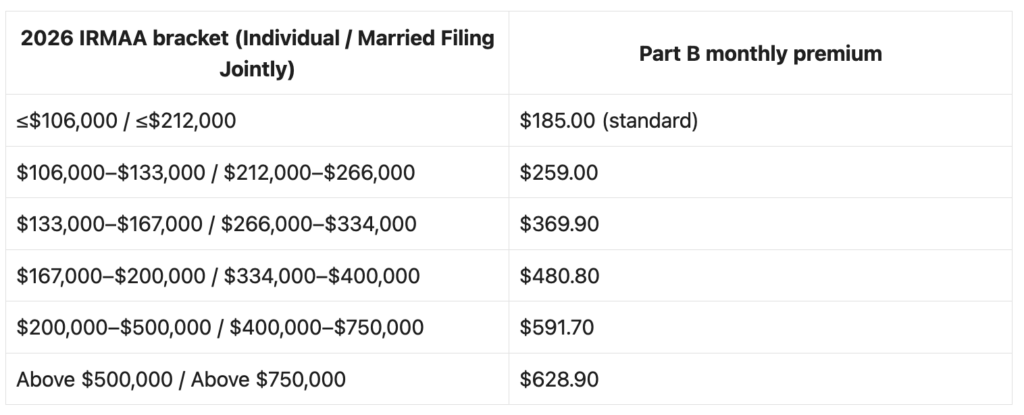
If your income exceeds certain thresholds, you’ll pay more than the standard Part B premium through a surcharge called IRMAA, which is the Income-Related Monthly Adjustment Amount. This is one of the most misunderstood pieces of Medicare, so it’s worth digging into further.
IRMAA isn’t based on your current income. It’s based on your Modified Adjusted Gross Income from two years prior. If you enroll in Medicare in 2026, the Social Security Administration looks back at your 2024 tax return. That two-year lag is exactly what creates tax-planning opportunities: Roth conversions, the timing of income, and the strategic use of Donor-Advised Funds (DAFs) for charitable giving can all be used to manage the income that will eventually determine your Medicare premiums two years down the road.
Medicare Part D: Prescription Drug Coverage
Part D is provided by private insurance companies approved by Medicare. It’s technically optional, but I recommend enrolling as soon as you’re first eligible, even if you’re only taking a few prescriptions today. The penalty for waiting is 1% of the national base beneficiary premium ($34.70 in 2026) for every month you go without coverage, and that penalty is permanent and compounds for the rest of your life, while your healthcare needs and your drug costs will only grow with age.
Premiums for 2026 average $40–60 a month, though they vary by plan and location, and the annual deductible runs up to $590 (many plans set it lower, or waive it). Once you and your plan together spend $5,030 on covered drugs, you enter the “donut hole,” where you pay 25% of drug costs until your out-of-pocket spending reaches $8,000. After that, catastrophic coverage takes over, and your costs drop sharply. IRMAA surcharges apply here too, using the same income brackets as Part B, adding another $13.70 to $86.90 a month depending on your income.
I’ll be honest—Part D can be pretty confusing. Every plan has its own formulary (the list of covered drugs), tiered pricing, and pharmacy network. I suggest you set aside an hour each fall during open enrollment, October 15 through December 7, to run your medications through Medicare.gov’s plan finder tool and confirm your current plans are still the best fit. (Most people don’t do this, but it’s an especially good idea if you have new prescriptions.)
Original Medicare vs. Medicare Advantage
Once you have a handle on Parts A, B, and D, you face the real decision point: do you stay with Original Medicare and layer on supplemental coverage, or do you move to Medicare Advantage? This isn’t primarily a question about which one is “cheaper” on paper. It’s a tradeoff between flexibility, predictability, and cost; the right answer depends heavily on your health, your travel habits, and your tolerance for administrative complexity.
Path #1: Original Medicare + Medigap + Part D
This is the traditional approach, and it’s what my wife and I chose. You keep Medicare Parts A and B, then purchase a Medigap (Medicare Supplement) policy from a private insurer to cover the gaps Original Medicare leaves behind, along with a standalone Part D plan for prescriptions.
Medigap comes in ten standardized plan letters — A, B, C, D, F, G, K, L, M, and N — and here’s the key thing to understand: the benefits for a given letter are identical no matter which company sells it. Plan G from Blue Cross covers exactly the same things as Plan G from Humana. The only differences between insurers are price and customer service.
Plan F used to be the most popular option, but it’s no longer available to anyone who became newly eligible for Medicare after January 1, 2020. That makes Plan G the current gold standard. It covers Part B excess charges, Part A coinsurance and hospital costs, the first three pints of blood, Part A hospice coinsurance, skilled nursing facility coinsurance, the Part A deductible, and even foreign travel emergencies. The one thing it leaves you exposed to is the Part B deductible itself, which is $257 in 2026.
Plan G premiums increase with age and vary significantly by state, ZIP code, gender, tobacco use, and whether the insurer uses attained age, issue age, or community rating. But as a rough guide, expect somewhere between $125–180 a month at 65, $155–220 at 75, and $190–270 at 85.
One timing note that matters more than almost anything else in this decision: your Medigap Open Enrollment Period is a six-month window that begins the moment you turn 65 and enroll in Part B. If you enroll during that window, insurers must accept you regardless of health conditions. Miss it, and you can be medically underwritten (meaning examined)—denied coverage outright, or charged significantly more—based on your health history.
Putting the pieces together for a couple, both age 70, a realistic total looks like this:
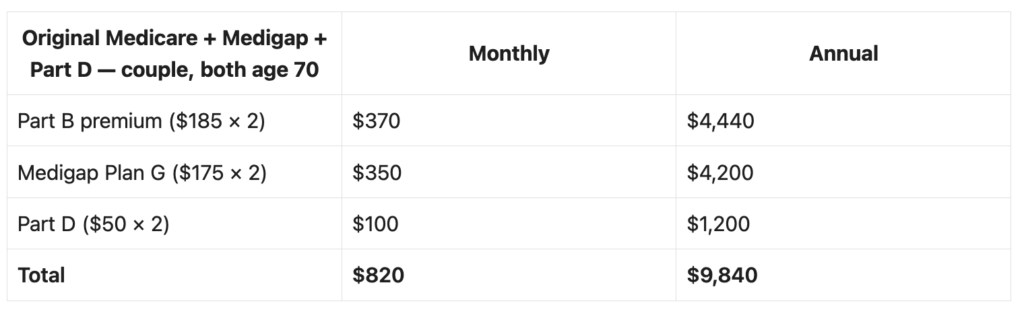
That total doesn’t include deductibles, prescription co-pays, or dental and vision care, which aren’t part of this path at all and would need to be purchased separately if desired.
What you’re buying with this path is freedom and predictability. You can see any doctor or specialist who accepts Medicare (roughly 93% of doctors nationwide) with no referrals, no in-network versus out-of-network calculations, and coverage that works the same way no matter where in the U.S. you happen to be. Medigap benefits also rarely change from year to year, so once you’re set up, you’re set up. What you give up is simplicity of billing (you’re coordinating three separate plans instead of one), and the extras such as dental, vision, hearing, and gym memberships aren’t included and would need to be purchased separately.
Path #2: Medicare Advantage (Part C)
Medicare Advantage takes a different approach entirely. Instead of Medicare paying providers directly, it pays a private insurance company a set amount to manage your care. That company is required to match Original Medicare’s coverage for Parts A and B, but it can add extra benefits on top of that, and it sets its own rules for networks, referrals, and cost-sharing.
Plans come in several structures. HMOs require you to use network doctors and get referrals to see specialists. PPOs let you go out-of-network at a higher cost, usually without needing a referral first. PFFS plans let you see any provider who accepts the plan’s terms, and Special Needs Plans (SNPs) are designed for specific diagnoses or circumstances.
Most Medicare Advantage plans bundle Parts A, B, and D, and many include dental, vision, and hearing coverage, with some offering extras like gym memberships, over-the-counter allowances, or meal delivery. Every plan is required to cap your annual out-of-pocket spending; the federal maximum is $8,850 in 2026 for in-network care, though individual plans can and often do set their limit lower.
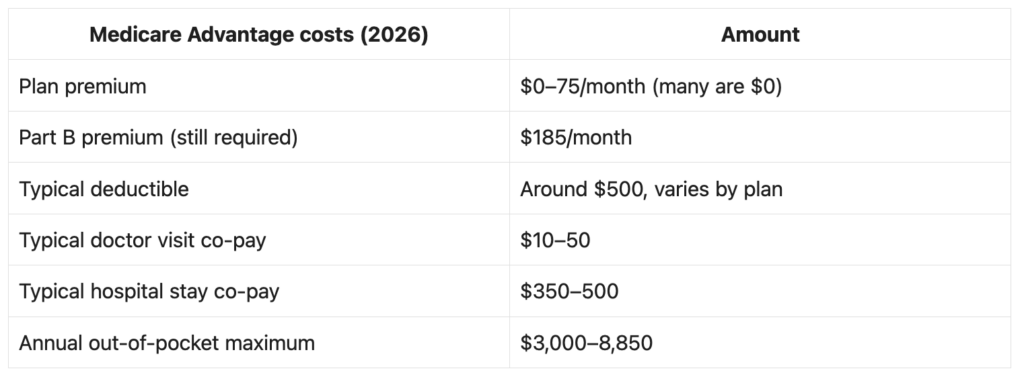
For the same couple, both age 70, a Medicare Advantage total might look like this:
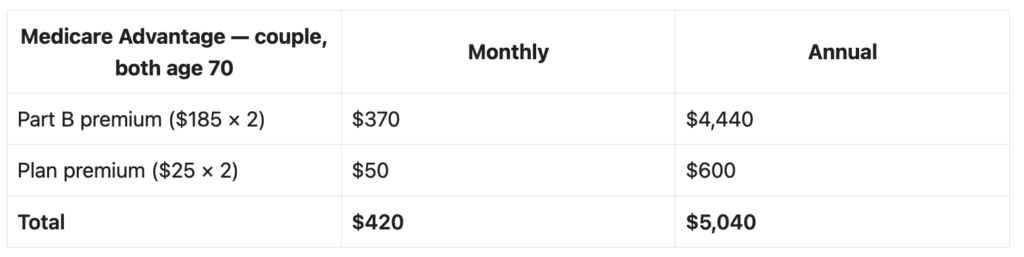
That’s before any co-pays, coinsurance, or out-of-pocket costs incurred during the year, which could push the total up toward the plan’s annual maximum in a heavy healthcare year.
The appeal here is obvious: lower monthly premiums, everything bundled into a single plan, and extra benefits that would otherwise cost extra. The out-of-pocket maximum also protects you against catastrophic costs in a way Original Medicare alone doesn’t. But the tradeoffs are real. You’re generally confined to a network, may need referrals and pre-authorization for certain care, and your plan can change its networks, costs, and benefits every single year. Coverage can also be limited if you travel or split time between states. And perhaps most importantly, if you try Medicare Advantage and later want to switch back to Original Medicare with a Medigap policy, you may find yourself facing medical underwriting again — meaning health conditions could get you denied or charged more the second time around.
Medicare Health Insurance Options (Updated 2026) is a more comprehensive guide to Medicare, updated from its original 2016 publication. It draws on nearly ten years of my actual Medicare experience to explain the four parts of Medicare (Part A hospital coverage, Part B medical insurance at $202.90/month standard premium in 2026, Part C Medicare Advantage plans, and Part D prescription drug coverage), the critical decision between Original Medicare plus Medigap versus Medicare Advantage, and the income-related surcharges (IRMAA) that can add $81.20 to $487/month per person to Part B premiums for those with incomes exceeding $109,000 individual/$218,000 joint based on tax returns from two years prior. The article provides detailed 2026 cost data (Part A deductible $1,736, Part B deductible $283, typical Medigap Plan G premiums $125-$260/month depending on age), explains enrollment periods (Initial Enrollment Period starting 3 months before your 65th birthday, Special Enrollment Period for those with employer coverage from companies with 20+ employees, and Annual Enrollment Period October 15-December 7), and emphasizes critical timing decisions to avoid permanent late-enrollment penalties (10% per year for Part B, compounding annually for Part D). I discuss our personal experience choosing Original Medicare with Plan F Medigap coverage and successfully navigating the Special Enrollment Period when transitioning from employer coverage. I conclude that while Medicare is complex, the system is navigable with proper planning and annual review, making healthcare cost management an essential component of faithful retirement stewardship.
Choosing wisely
There’s no universally right answer here—only the right answer for your health situation, your travel plans, your budget, and your tolerance for either higher fixed premiums or greater plan-year uncertainty. What matters most is choosing deliberately, during your enrollment windows, rather than defaulting into whatever option requires the least paperwork.
These bodies are “temples of the Holy Spirit” (1 Corinthians 6:19)—gifts from God to steward well, in sickness as in health. Getting this decision right is part of that stewardship.
If you are in your early 60s and coming up on your Medicare decisions, you’ll be inundated with marketing plays, mostly intended to get you interested in Medicare Advantage (Plan C) plans. Here are some articles that I have recently updated to help you understand what to expect and how to deal with it.
Medicare Commercials – Be Wise as Serpents and Innocent as Doves (Updated 2025) deconstructs the misleading Medicare Advantage television commercials that flood the airwaves every October-December Annual Enrollment Period by examining their specific claims and revealing what they conveniently omit—including that the “give-back benefit” of up to $202.90/month (2026 Part B premium) isn’t free money but rather a partial rebate of premiums you’re already paying the government, that “$0 premium” Advantage plans still carry out-of-pocket maximums up to $9,250 per person annually ($18,500 for a couple), that “free” dental/vision/hearing/transportation benefits come with network restrictions and prior authorization requirements that Original Medicare + Medigap don’t impose, and that the urgent “today is one of the only days” language creates artificial scarcity when the enrollment period actually runs 61 consecutive days from October 15-December 7. The article emphasizes the critical trap the commercials never mention: while Medicare Advantage plans are excellent for healthy people with minimal medical needs who don’t travel and are comfortable with networks, switching from Advantage to Medigap after developing serious health conditions (cancer, heart disease, COPD, diabetes) becomes extremely difficult or impossible because insurance companies can deny coverage or charge prohibitively high premiums based on pre-existing conditions except during the one-time six-month Medigap Open Enrollment Period when first enrolling in Part B. Drawing on Matthew 10:16’s call to be “wise as serpents and innocent as doves,” after nearly nine years on Medicare with a Medigap plan—I urge readers to use official government resources (Medicare.gov Plan Compare, state SHIP programs offering free unbiased counseling) rather than calling the 1-800 numbers in commercials that connect to commissioned insurance brokers, to understand that Medicare Advantage plans are for-profit insurance products (not government programs) designed to make money when you use less care, and to make Medicare decisions based on realistic assessment of long-term health trajectory and trade-offs (provider freedom and predictable costs versus lower premiums and bundled benefits) rather than FOMO manufactured by marketing departments targeting cognitively vulnerable seniors.
Medicare Commercials: The Hilarious But Confusing Comeback Tour You Didn’t Ask For (Updated 2026) is a lighthearted yet substantive consumer-protection article, updated for 2026 from its original 2023 publication, uses the characters from actual Medicare Advantage television commercials—particularly the perpetually skeptical “Martha” who adamantly refuses to call the 1-800 number and “Karen” who just wants the commercials to stop—to illustrate the manipulative FOMO (fear of missing out) tactics employed by Medicare Advantage marketing campaigns that promise “free” benefits, “zero-dollar premiums,” and “extra coverage” while conveniently omitting critical information like the $9,250 per person annual out-of-pocket maximum in 2026, network restrictions that limit which doctors you can see, prior authorization requirements that delay care, and most importantly the trap that makes switching from Medicare Advantage to Medigap extremely difficult or impossible if you develop serious health conditions (cancer, heart disease, COPD, diabetes) due to medical underwriting that allows insurance companies to deny coverage or charge prohibitively high premiums for pre-existing conditions. The article provides a detailed comparison showing that while Medicare Advantage plans with $0 premiums beyond the required Part B payment ($202.90/month in 2026) can save healthy people thousands annually, Original Medicare plus Medigap costs $905-1,265/month for a couple but provides complete provider freedom nationwide, predictable costs with minimal out-of-pocket expenses, and no network restrictions or prior authorization hassles—making it the better choice for those who travel, have chronic conditions, or value flexibility over lower monthly premiums.
How to choose
You can see by now that you have options, and I can’t tell you which path is right for you. Here’s an article that goes into detail on this all-important decision.
Choosing a Medicare Plan (Updated 2026), explains in detail the fundamental choice every Medicare beneficiary must make between Original Medicare plus Medigap supplemental insurance (which offers complete provider freedom nationwide, predictable costs, and comprehensive coverage but costs $905-1,265/month for a couple including Part B premiums, Medigap Plan G at $350-520/month for two, Part D prescriptions, and vision/dental) versus Medicare Advantage plans (which bundle Parts A, B, and usually D with often-included dental, vision, and fitness benefits, charge $0-80/month premiums beyond the required Part B premium of $405.80/month for a couple, but impose network restrictions, require prior authorization for some procedures, and carry out-of-pocket maximums up to $9,250 per person annually in 2026). The article emphasizes the critical but often-overlooked trap: while you can switch from Medigap to Medicare Advantage relatively easily, switching back from Advantage to Medigap after developing serious health conditions (cancer, COPD, diabetes, heart disease, stroke) is extremely difficult or impossible due to medical underwriting—insurance companies can deny coverage or charge prohibitively high premiums for pre-existing conditions except during the six-month Medigap Open Enrollment Period that begins when you first enroll in Part B, making that initial decision crucial and potentially irreversible. I stress that while neither choice is inherently wrong—healthy people who don’t travel can save thousands with $0-premium Advantage plans—the decision must be made intentionally based on individual circumstances, risk tolerance, provider flexibility preferences, and realistic assessment of future health trajectory, applying the “regret minimization” framework of imagining yourself 10-20 years out with serious health conditions and asking whether you’d regret having chosen network restrictions and potential difficulty switching to comprehensive coverage when you most need it.
Which path fits you?
There’s no universally correct answer here—only the answer that fits your health, your finances, your travel plans, and your peace of mind. A few questions can help clarify which direction makes more sense for your situation.
Choose Original Medicare + Medigap if:
- You want complete freedom to see any doctor without referrals or network restrictions
- You value predictable costs over lower monthly premiums
- You travel frequently or spend time in multiple states
- You have ongoing health issues requiring access to specialists
- You prefer a “set it and forget it” approach, with fewer annual changes
- You can afford the higher monthly premiums
Choose Medicare Advantage if:
- You want the lowest possible monthly premiums
- You’re comfortable with network restrictions and referrals
- You stay primarily in one geographic area
- You want extra benefits — dental, vision, gym — without buying separate policies
- You want an annual out-of-pocket maximum for budget protection
- You’re willing to reevaluate your plan annually during open enrollment
- You’re healthy and don’t anticipate frequent specialist visits
The “right” answer depends on your health, finances, preferences, and peace of mind. There’s no one-size-fits-all solution.